
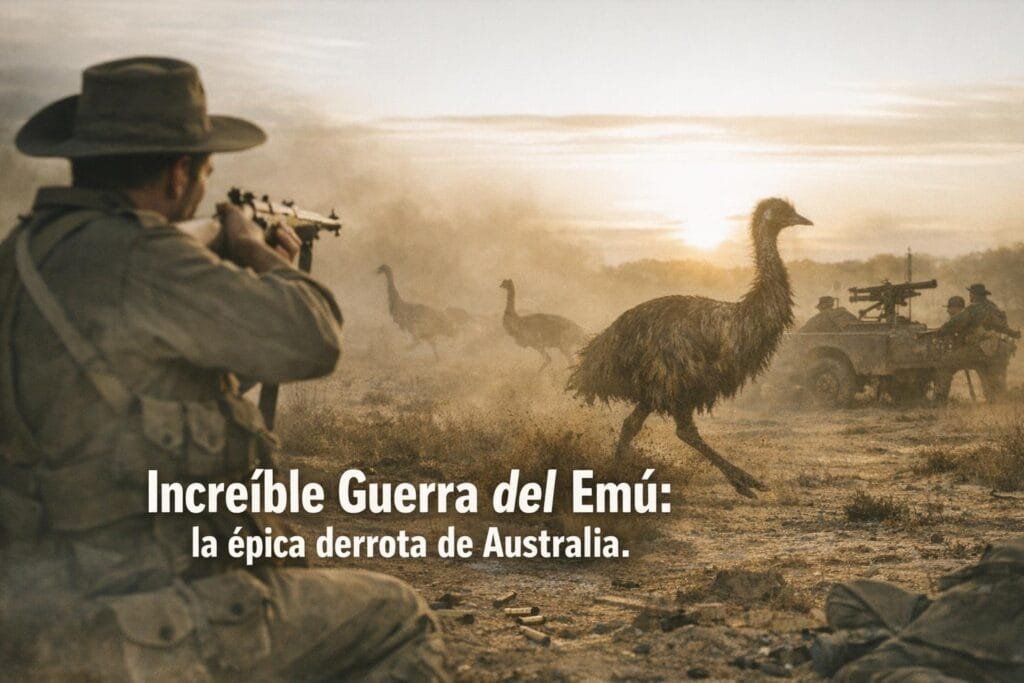
It was 1932. The setting: the vast, dusty interior of Western Australia. At center stage stood a contingent of Australian Army soldiers armed with modern Lewis machine guns—the kind that spit bullets without mercy. Their target, their enemy, the threat that had justified such a military deployment… was not a foreign invading force or an internal rebellion. No. Their enemy was 20,000 emus. Yes, you read that right. Emus: giant birds that look like scruffy ostriches with heads that have just survived a terrible hangover. In a corner of the world where kangaroos hop and koalas sleep, Australia was preparing for war. It would become one of the greatest military humiliations in the country’s history: a war lost to birds.
To put the scale of this fiasco in perspective, a short documentary tells the story. Prepare to be amazed.
The Great Depression and the Feathered Invasion
To understand this military absurdity, we need to step back and look at the context. The 1930s were hard everywhere, and Australia was no exception. The Great Depression had hit hard, and the government had encouraged former soldiers—World War I veterans—to settle as farmers in remote parts of Western Australia. They were promised fertile land and a prosperous future.
Reality was much more arid. Wheat crops, essential to these new communities’ survival, were constantly threatened—not only by microscopic pests or unpredictable droughts, though those existed too, but by an implacable force of nature with feathers.
Conditions at the time, including a severe drought followed by torrential rain, pushed thousands of emus toward cultivated land in desperate search of water and food. And by “thousands,” I do not mean a small nuisance of birds. These were legions: an army with no general or strategy, but an enormous appetite.
A problem of enormous scale
Far from being foolish creatures, the emus proved surprisingly efficient at destroying crops. Imagine farmers already struggling, watching flocks of birds nearly six feet tall and weighing around 130 pounds tear through their fields in minutes. Fences were no match for their strength and numbers. It was desperate—a direct threat to an already precarious livelihood.
Requests for help soon reached the authorities. Many of the farmers, themselves former soldiers, demanded a solution. And that is where the Australian government’s ingenuity—or desperation—came in. What do you do when faced with a pest problem of epic proportions? Send in the army, of course. If it could fight the Kaiser, why not a few birds?
“Operation Emu”: when bullets were not enough
Major Gwynydd Purves Howell, a decorated World War I veteran, was chosen to lead the unusual campaign. His mission was simple: use machine guns to reduce the emu population and protect the crops. The operation was unofficially—and humorously—dubbed the “Emu War.” The army, with all its firepower, was ready to show who ruled the Australian bush.
The lead started flying on the morning of November 2, 1932. Soldiers mounted Lewis guns on trucks, thinking they could chase the birds. But emus, capable of reaching speeds of up to 30 miles per hour and naturally quick to scatter at the first sign of danger, proved fiendishly difficult targets. Here is a brief summary of the initial “results”:
First day: About 2,500 rounds were fired. The result: barely 50 emus killed. An efficiency rate that would make any general blush.
Mobility: The trucks were useless. The guns were heavy and difficult to aim accurately at animals moving in zigzags and unpredictable patterns.
Resilience: The emus did not go down easily. It was like shooting at sponges that kept running even after taking several hits.
Major Howell and his men tried everything: ambushes, pursuits and even mounting a machine gun on a lighter vehicle. But the emus seemed to have a sixth sense. When they spotted soldiers, they broke into smaller groups, making it impossible to concentrate fire. Their strategy was simply to exist in large numbers and be extraordinarily hard to kill.
The humiliating retreat
After a week of unsuccessful efforts, the tally was dismal: thousands of rounds spent, a high cost to taxpayers and, at best, a few hundred emus killed—a laughable number beside the 20,000 roaming the area. The all-powerful Australian Army was being outmaneuvered by giant birds.
The press quickly picked up the story, and cartoons of Major Howell chasing emus became popular. Public opinion, initially sympathetic to farmers, began to see the ridiculous side. The government’s embarrassment was unmistakable. Defense Minister Sir George Pearce, who had authorized the operation—perhaps hoping for a popularity boost in a difficult moment—was forced to withdraw the troops on December 8, 1932. The Emu War was over. Against all odds, the victor, despite not firing a single shot, was the emu.
Nature found its own solutions. Years later, pest-proof fences and culls organized by farmers themselves, without military machinery, proved more effective. But the image of a modern army defeated by a flock of birds remains one of those historical gems that remind us how unpredictable life can be.
A curious legacy—and other mind-blowing stories
The Emu War is more than a funny anecdote; it is a modern fable about human arrogance and nature’s resilience. It teaches us that the most powerful solution is not always the right one, and that underestimating an adversary—even one that seems “primitive”—can lead to unexpected and frankly hilarious results.
An army with state-of-the-art machine guns against birds with only feathers, speed and luck. Who would have guessed?
The world is full of stories like this, where logic twists and the unthinkable happens. If you want more, explore these gems from our archive: