
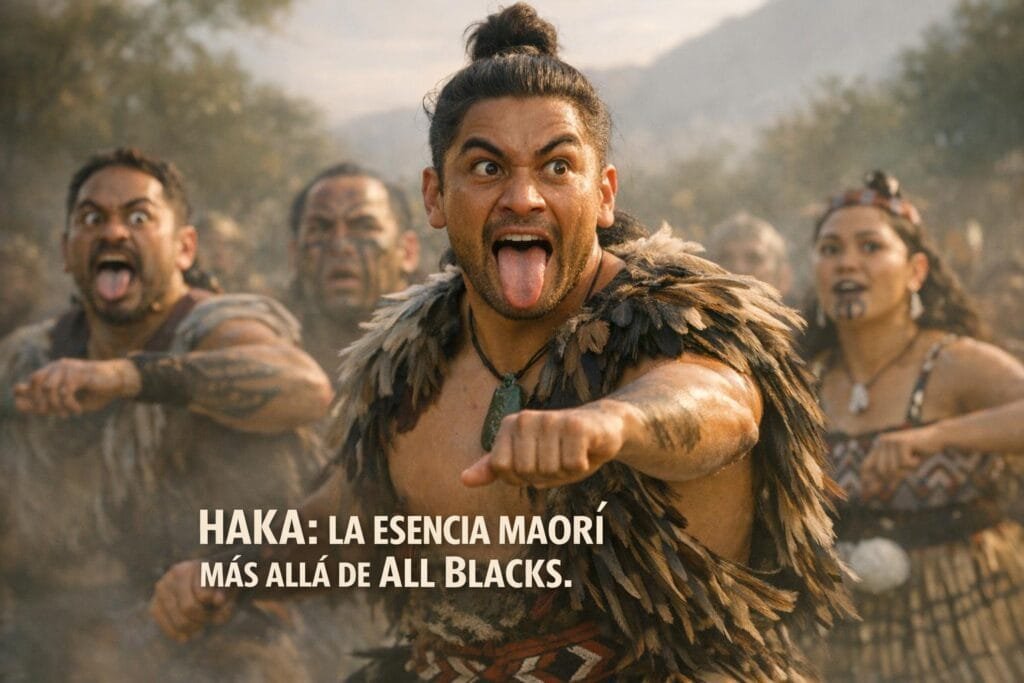
You are standing still in front of them. The echo of silence in a stadium packed with thousands. Suddenly, a shout—not one that merely cuts through the air, but one that pierces your chest. Tense bodies, wide eyes, tongues shooting out and palms striking thighs with the force of thunder. What do you feel? Intimidation? Fear? Probably a mix of both. Our Western minds quickly translate the scene as a “war dance.” The All Blacks, New Zealand’s rugby team, made the haka so famous that it became synonymous with power and defiance before a match. But if that is all you see, you are missing a much richer, deeper and, to me, far more fascinating story.
To get a sense of the power and meaning we are about to unpack, see it for yourself. This video shows the haka at its most intense, but look beyond the surface intimidation and feel the connection it projects.
The roar hiding an ancestral whisper
Forget the green field and oval balls for a moment. At its purest, the haka is not a sports spectacle. It is a living thread connecting Māori—the Indigenous people of Aotearoa, or New Zealand—with their ancestors, land and identity. It is a visceral expression of what it means to be Māori in the world.
What can look like aggression is actually a complex language without words. Every movement, stamp and facial expression—including the famous tongue extension, or pukana, that causes so many misunderstandings—is full of meaning. It is not meaningless behavior but a physical narrative that can express many emotions and purposes, from fierce challenge to a warm welcome or profound grief.
Beyond the rugby field: a tapestry of life
The haka reaches back to the beginnings of Māori culture, long before contact sports existed. Its origins are both mythical and real, and speak to a worldview in which dance bridges the earthly and spiritual.
The dance of the sun and air: a mythic origin
One foundational story amazes me personally. Tama-nui-te-rā, the Sun god, is said to have created the first haka, performed by his son Tānerore. What did it represent? The trembling of air on a hot day, the almost imperceptible shimmer rising from the earth. That tremble, that ethereal dance, became the essence of haka: a manifestation of life force, the breath of the world.
Since then, haka has been used at nearly every major kind of Māori occasion. Think of it as a multifaceted tool capable of:
- Welcoming: when an important visitor arrived at a village, haka offered the highest form of respect and honor.
- Celebrating: weddings, births and major community achievements could be marked with the power of haka, channeling shared joy.
- Mourning: at funerals, haka could express grief and pay tribute to the deceased, honoring their mana—their prestige and spiritual authority.
- Challenging: yes, it could also prepare for war, intimidate an enemy and unite the warriors.
But that is only one of its many faces.
A dialogue with ancestors and the land
When a Māori person performs haka, they are not only expressing themselves. They are invoking ancestors and whakapapa—lineage and genealogy—and connecting with generations who came before. It is a tangible reminder of who they are, where they come from and the values that define them: a conversation with history, alive and resonant.
The language of the Māori body and soul
Haka is a complete expression of the person; there are no half measures. It calls for total physical and emotional commitment: guttural voices, feet striking the ground as if the sound came from deep within the earth, a hypnotic rhythm and an intense gaze.
The pukana—the challenging stare and extended tongue—is not a vulgar gesture. It releases energy and displays spiritual strength, projecting the inner spirit outward.
There are dozens of different haka, each with its own text, melody and movements for particular occasions. The best known internationally is Ka Mate, attributed to the warrior chief Te Rauparaha, who composed it after escaping enemies by hiding in a food-storage pit. Less familiar but just as powerful is Kapa o Pango, created specifically for the All Blacks and often seen as more aggressive. Both, like all haka, are songs of life, resilience and the power of the human spirit.
War or connection? The power of unity
Perhaps the greatest lesson haka offers is that strength does not always come from aggression; it can come from unity and authenticity. When rugby players perform it, they are not only intimidating an opponent. They are reinforcing their bond, mutual commitment and connection to an immense cultural heritage. They are charging their collective spirit before a contest that, though sporting, calls for courage and discipline like those of their ancestors on a real battlefield.
So next time you see a haka, pause for a moment and look beneath the surface. Think of the trembling dance of the sunlit air, the ancestral welcome, the mourning for a loved one and the cry of pride that has traveled across centuries. What you see is far more than a war dance: it is the vibrant embodiment of a people, their history and their soul. It is, in essence, life itself.