
Sixteenth-century Japan was so carefully stratified and self-aware that even the way you breathed seemed to come with a manual. Every shadow in a Zen garden spoke of centuries of tradition. Now imagine a man more than six feet tall suddenly appearing in Kyoto, with skin as dark as the deepest night and strength that defied expectations. People did not run; they froze. Some thought he was a demon, others a deity—or at least the most elaborate prank they had ever seen.
That is what happened in 1579. An African man, known today as Yasuke, arrived in Japan. His presence—like a human UFO in an isolated world—caused such a sensation that people climbed walls to see him, sparking stampedes and unrest. History remembers him, with some irony, as a man who arrived enslaved and became a foreign-born samurai. His rise was as unlikely as it was fascinating.
An encounter that challenged logic—and superstition
This short documentary brings to life the key moments of the cultural collision and legend that grew from Yasuke’s story.
Amid the chaos and collective astonishment, one man watched with a curiosity few dared to show. He was Oda Nobunaga, Japan’s most feared daimyō, the “Demon King,” a ruthless military strategist and iconoclast who enjoyed breaking conventions. The crowd’s fear did not surprise him; the man himself did. His first order was skeptical but tinged with the kind of irony associated with geniuses—or madmen: “Wash him. He is too large to be just ink.”
According to the story, Nobunaga could not believe Yasuke’s skin was naturally so dark. He suspected ink or soot and ordered his servants to scrub him thoroughly. When Yasuke’s skin remained as dark as before, the warlord was amazed. It was real. Not an illusion or a painting. Just a man—but what a man.
Yasuke had come to Japan with the entourage of Italian Jesuit missionary Alessandro Valignano. Little is known about his exact origins; he was from Africa, possibly Mozambique or Ethiopia, and his height was striking for the time—estimated at more than six feet. His strength was legendary, and he was said to be able to overpower several men. Those qualities fit Nobunaga’s appetite for the new and exceptional.
From “black man” to samurai: an improbable rise
What began as a curiosity turned into something deeper. Nobunaga took a strong interest in Yasuke, not only because of his appearance but also his intelligence. The African giant quickly learned some Japanese and earned Nobunaga’s trust. To the court’s surprise, the warlord brought him into his direct service. This is where the story gets even more astonishing: Yasuke was no ordinary servant.
Nobunaga gave him a residence, a stipend and even a ceremonial katana. A katana—the ultimate symbol of the samurai spirit. In a society where caste and lineage mattered above all, a foreigner and former enslaved person became a samurai. It was a challenge to tradition, a slap in the face to social rigidity and a sign of Nobunaga’s power and eccentricity. Yasuke was not merely a convenient symbol; he fought beside his lord and was trained and respected, as described in the Shinchō Kōki, Nobunaga’s chronicle.
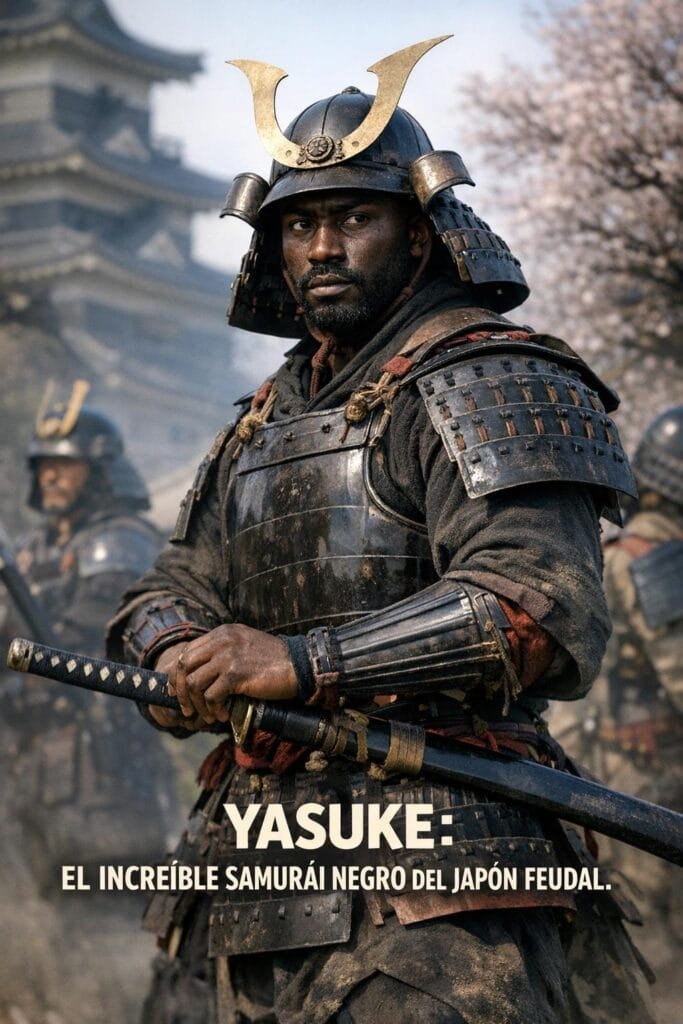
Picture the scene: on a Japanese battlefield, among warriors in intricate armor and elaborate helmets, Yasuke stood out, powerful and imposing, sword in hand. He must have been a terrifying sight to his enemies and a source of pride to his allies. The “black man” had become the “Black Samurai,” proof that talent and loyalty can sometimes break through cultural barriers.
The twilight of an era and a final act of loyalty
Yasuke’s incredible story is tragically tied to the end of Oda Nobunaga’s life. In 1582, during the infamous Honnō-ji Incident, Nobunaga’s general Akechi Mitsuhide betrayed him and attacked the temple in Kyoto where he was staying. The brutal surprise assault forced Nobunaga to commit seppuku rather than be captured.
Where was Yasuke? At his side. The African samurai fought bravely with his sword, trying to defend his lord to the last. Some accounts say he carried Nobunaga’s head—or perhaps his remains; the details are unclear—to his son Oda Nobutada’s castle and continued fighting. It was the ultimate proof of loyalty, forged not by blood but by mutual respect in a world where such a bond between a lord and a foreigner was rare.
After the final defeat and Nobutada’s death, Yasuke surrendered to Akechi Mitsuhide’s forces. This is where the record becomes hazy. With a dismissive gesture that did little for his posthumous reputation, Akechi reportedly decided that Yasuke “was not Japanese” and therefore did not deserve the honor of seppuku. He sent him back to the Jesuit missionaries.
A legacy in the shadows
After that, Yasuke disappears from the historical record. Did he return to the Jesuits and live quietly, or fade into anonymity? We do not know. But his brief, brilliant time in feudal Japan left an indelible mark.
Yasuke’s life is an anomaly, a historical footnote that tells one of history’s grandest stories. It shows that, despite prejudice and rigid structures, people can make room for the unexpected. Even in a closed society, a chance encounter can rewrite the rules—and respect can cross the boundaries of skin color and geography.
The next time you hear a story that seems impossible, think of Yasuke. His life, as real as it is astonishing, still inspires novelists, filmmakers and anyone who believes the world is full of surprises. Who knows what other extraordinary figures are waiting to be uncovered in the folds of time?