

The invitation was private, the stationery carried an official letterhead, and the official spoke in the calm voice of someone who never needed to raise it. Victor Lustig did not begin by selling the Eiffel Tower. He began by selling the idea that he had the authority to sell it.
His original name was Robert V. Miller. He was born in 1890 in Hostinné, then part of the Austro-Hungarian Empire, and adopted the name Victor Lustig along with a long collection of aliases. The identity was not a one-off costume; it was infrastructure. Expensive hotels, immaculate clothes, letterheaded paper and carefully administrative language turned a con man into someone who appeared to have walked out of an important office.
To see the story in motion, this video helps complete the explanation:
In 1925, he posed as a French official and arranged a private auction for the Eiffel Tower. The story had one foot in reality: rumors about the monument’s maintenance costs were circulating at the time. The official Eiffel Tower site recounts its history and major phases; Lustig placed an operation with no legal validity on top of that real context.
He persuaded scrap-metal dealer André Poisson that the sale was confidential. Secrecy was not a precaution; it was a way to stop the victim from asking for a second opinion. Once he had the money, Lustig fled to Vienna. Poisson avoided reporting the crime out of embarrassment, and that silence protected the swindler better than any hiding place could have.
Authority is built before anyone asks for a dollar
Lustig understood that people often obey a setting before they examine the proof. A private invitation, a discreet room and a low-voiced explanation create an atmosphere in which questions can feel impolite. He did not need to prove that he could sell the Eiffel Tower. He needed his guests to accept the premise long enough to begin competing with one another.
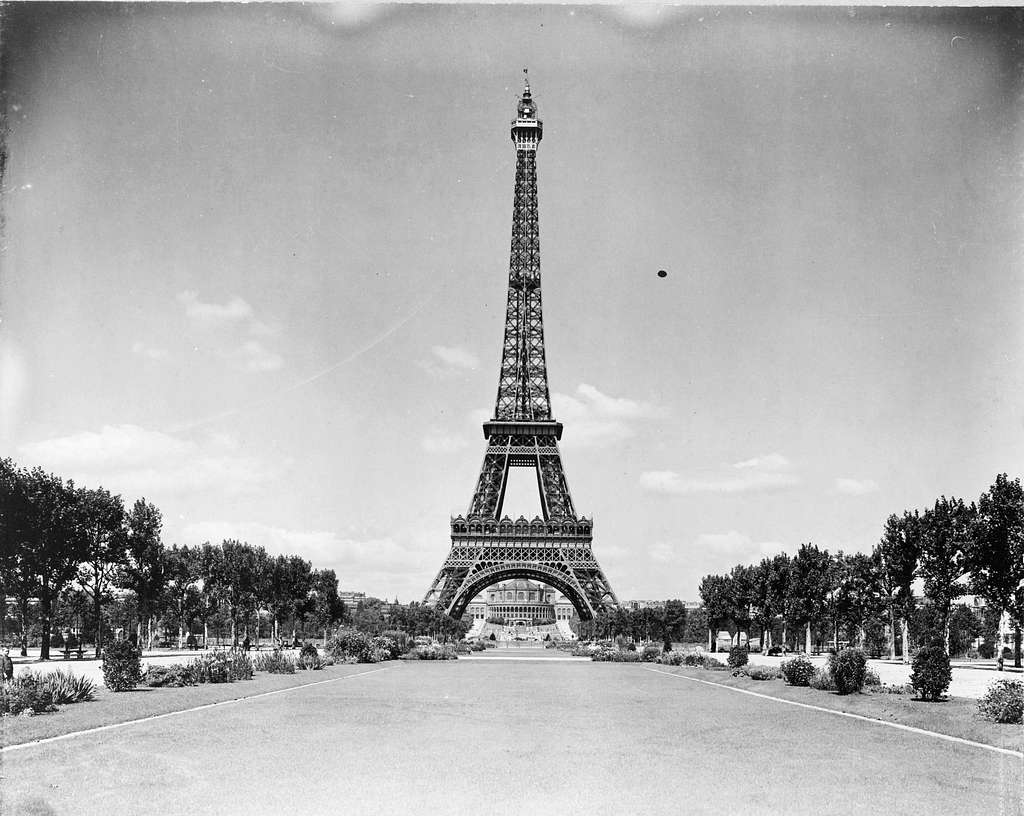
The tower made a perfect stage because there was a public conversation about its future. Maintenance costs, rust and rumors of possible demolition gave the tale a recognizable foundation. The official Eiffel Tower site helps separate the real monument from the invented transaction: debates about the structure did not mean that an official could auction it from a hotel room.
The private meeting solved a practical problem too. If every scrap dealer believed he had been selected for discretion and financial strength, confidentiality became proof that he belonged in the room. Anyone who consulted another person could feel that he was losing an exclusive opportunity. It is a social-engineering tactic that now wears different uniforms: urgency, limited access and the promise of a private deal push people to decide before they verify.
André Poisson was not simply a ridiculous character who fell for an obvious trap. He wanted to advance in a competitive business and was given the signal that this was a special transaction in which participants did not begin on equal footing. The suggestion of a bribe also gave him an explanation for the secrecy: if the official needed extra money, discretion could seem like part of the bargain. The lie adapted itself to what the buyer expected to hear.
The silence afterward explains a crucial part of the scam’s success. Reporting it meant admitting that he had paid for an illegal operation and trusted an unverified identity. Shame does more than protect a swindler; it can erase the testimony that might stop a repeat performance. Lustig did not need to hide the money in an impossible place. He only needed the victim to avoid telling the story.
Many biographies mention a second sale of the Eiffel Tower, but it is worth separating what is documented from what tradition has repeated. The same caution applies to the “commandments” attributed to Lustig and to the so-called money box. The FBI documents his arrest and counterfeiting career, but a famous line does not become a primary source simply because hundreds of articles repeat it.
His downfall came when the fraud left too many traces. Counterfeits, aliases and relationships with other criminals formed a network that manners could no longer control. Lustig was arrested in 1935 and died in federal prison in 1947. The fabricated identity had worked for years because each person saw a different piece of the character; police files, by contrast, began putting those pieces together.
Modern comparisons should not turn this story into a how-to guide. Its historical value is in recognizing warning signs: authority without a verifiable institution, secrecy presented as a privilege, pressure to decide, paperwork standing in for verification, and a victim afraid to admit they were deceived. The Eiffel Tower was never for sale. What Lustig was selling was the feeling that someone with privileged access had just opened a door.
The most revealing detail is that the tower was almost secondary. It could have been a bridge, a mining concession or a money-making machine. The scam needed a familiar object and an authority that was hard to check. Lustig’s story remains powerful because it shows how a well-constructed identity can arrive before the evidence — and charge admission for letting it through.
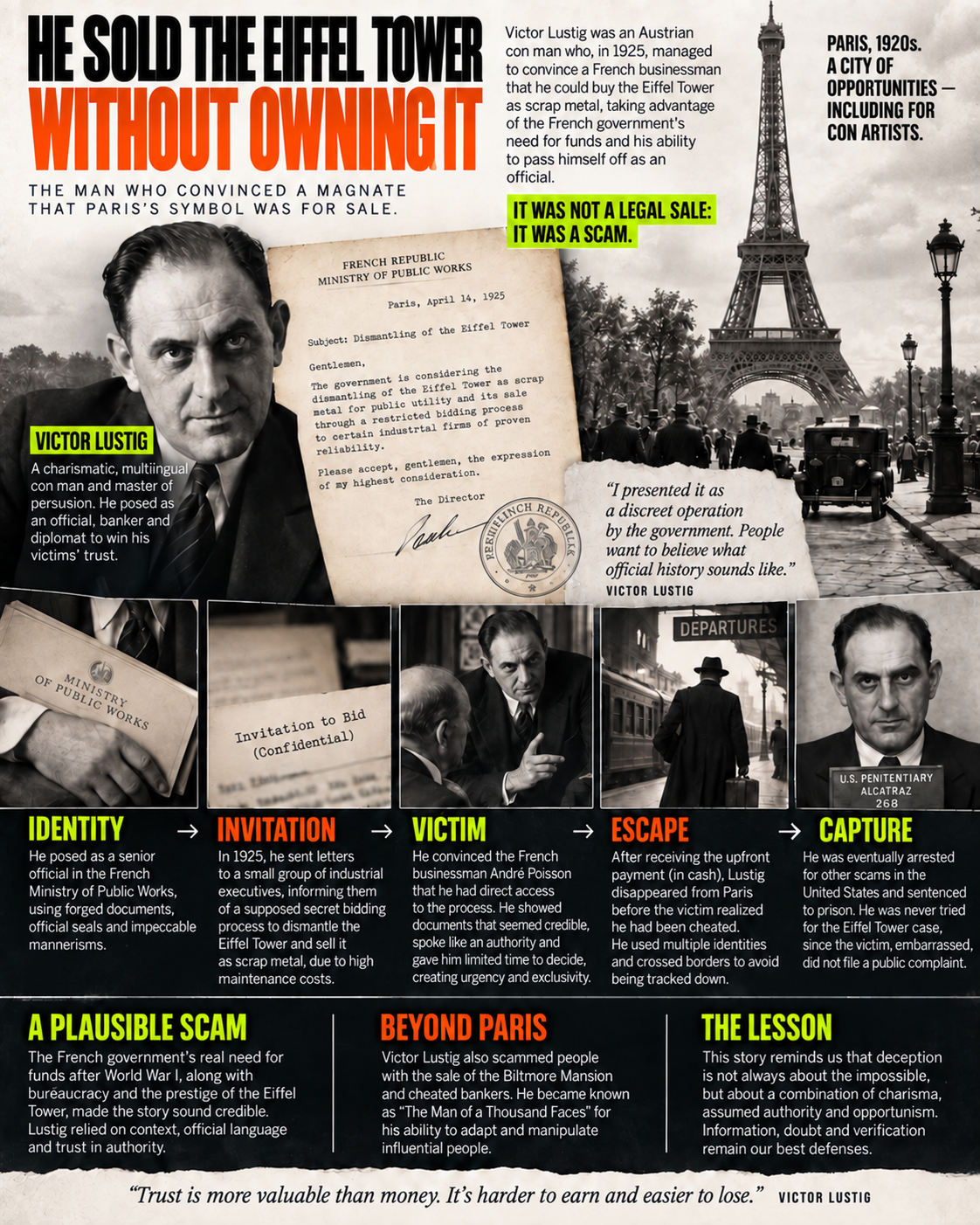
The second sale appears in many biographies and deserves careful treatment, as do exact figures and the famous “commandments” attributed to Lustig. The FBI documents his 1935 arrest after investigators followed a trail of counterfeiting. A so-called money box that supposedly printed banknotes also circulated in the legend. Its actual product was the seller’s patience and the buyer’s impatience to multiply money.
Lustig died in federal prison in 1947. His story is remembered because the victim did not first buy a tower, a machine or a banknote. He bought status. The object arrived afterward, like an invoice from the imagination.
The lesson does not require living suspicious of every letter. It requires noticing when an opportunity asks for secrecy, urgency and obedience instead of documents that can be independently checked. Lustig won because he made those signals part of the scenery. They are still signals today, even when the paper, uniform and channel carrying the invitation have changed.
Sources consulted for this article
- FBI: Victor Lustig — Historical record of his scams and the fictional Eiffel Tower sale.
- Smithsonian: The Man Who Sold the Eiffel Tower — Biography and reconstruction of the social-engineering operation.
- National Archives — Documentary context for press, identity and interwar fraud.
- Official Eiffel Tower history — Context for the monument and its symbolic and economic value.
- Library of Congress: Historical photographs — Press and images of Paris and the Eiffel Tower.
- Britannica: Victor Lustig — Biographical context and patterns in his social engineering.