
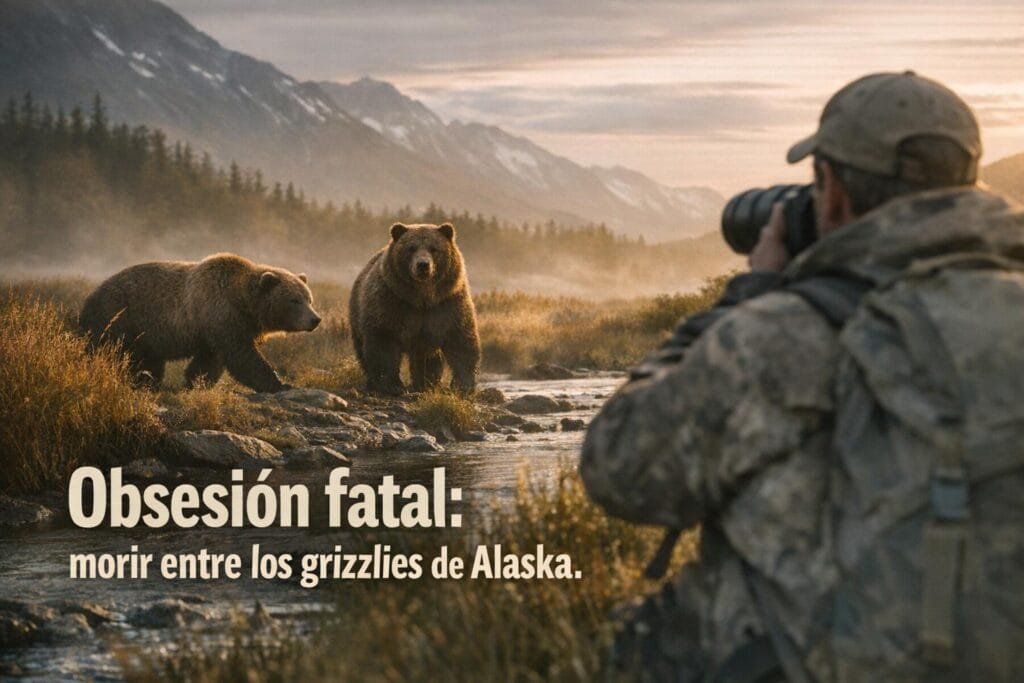
In the vast wilderness of Alaska, a rescue helicopter finds an abandoned camp. The tent is shredded. Personal belongings are scattered around, evidence of a terrible struggle. Then comes the most disturbing discovery: human remains and, beside them, a video camera with mud over its lens. The recording holds the audio of life’s final moments—unbearable and unimaginable. Timothy Treadwell, self-appointed protector of bears, has been attacked by a creature he believed he understood better than anyone. His love—or perhaps obsession—ended in the cruelest way.
It is the kind of story that makes you wonder where passion ends and profound blindness begins. For 13 summers, Treadwell went into Katmai National Park on Alaska’s peninsula to live among the giants of the region: grizzly bears. He filmed them, spoke to them and gave them names. He thought of himself as their friend, guardian and one of the family. Nature, however, had a very different view.
The frustrated actor who found his stage on the tundra
Treadwell’s story was so powerful that acclaimed director Werner Herzog turned it into the iconic documentary Grizzly Man. This trailer captures the fascination and danger that defined his life.
Before he became the “bear man,” Timothy Treadwell was a struggling actor with a history of addiction and personal setbacks. He had come close to fame without reaching it, and his life seemed like an emotional roller coaster going nowhere. After hitting rock bottom and surviving a near-fatal overdose, he found a new purpose among Alaska’s bears. To him, these imposing predators were more than animals: they were a second chance, a way to redeem his life. He devoted himself to them almost religiously.
His philosophy was simple and dangerously naive: if he showed bears love and respect, they would do the same. He approached them without weapons, sometimes touching them and speaking in a soft, almost childlike voice. He saw ancient wisdom in their eyes and majesty in their movements—qualities he thought the rest of the world ignored or feared without cause. He named them Grindax, Mr. Chocolate and the Sapphire Family. To him, each bear was an individual with a personality, not a wild animal. He blurred the species boundary much as stories about animals with unusual jobs blur our expectations of them.
His remote, makeshift camp became both sanctuary and film studio. He recorded hundreds of hours of footage, showing not only the bears’ beauty but also the ecosystem’s vulnerability. His activism rested on the idea that if people saw the animals’ “true” nature, they would protect them. Perhaps along the way, he was also trying to save himself.
A life surrounded by warnings—and disbelief
There was no shortage of cautionary voices. Park rangers, biologists and wildlife experts watched Treadwell’s reckless behavior with growing alarm. They repeatedly warned him about the danger, a risk documented by organizations such as the U.S. Fish and Wildlife Service. Prolonged contact with humans can habituate bears, reduce their natural fear and sometimes make them bolder—and, paradoxically, more dangerous. The wild, they reminded him, is unforgiving and does not understand good intentions or affection.
But Timothy, with his blond hair and intense gaze, believed he was the exception. He was convinced he had crossed the species barrier and formed a special, mystical bond with the bears. He ignored warning signs, dismissed danger and rewrote nature’s rules to suit his own beliefs. His radical eccentricity recalls figures such as Erasmus Thorne. His mission contained an inherent contradiction: he wanted to protect bears from humans while exposing them to his own human presence in ways that violated every safety protocol. It may have been an act of love—but also one of profound arrogance.
The last summer: nature’s betrayal
The summer of 2003 was Timothy Treadwell’s thirteenth and final season in Katmai. He usually stayed until bad weather forced him out, but this time, for some reason, he delayed his departure. It was October. Most bears were already hibernating; those still out were hungry and desperate to build up their last fat reserves before winter. The salmon, their main food source, had spawned and died.
On October 5, Timothy and his girlfriend, Amie Huguenard, encountered an old, famished male bear. It was not one of the bears Timothy had “socialized” with over the years. It was a stranger that saw two humans as a possible last meal before the long winter sleep. Timothy’s video camera, inexplicably, captured only audio. During those final six minutes, his voice can be heard in terror, shouting, “Get away, get away!” Amie screams as she tries to help or scare the bear off, and the animal makes guttural sounds. The camera stops. The horror is complete, an event the documentary Grizzly Man would explore in harrowing detail.
When the remains were found the next day, the scene confirmed the tragedy. Timothy and Amie had been killed by the bear. Rangers shot the animal, which was still nearby, following protocols for these conflicts described by the Alaska Department of Fish and Game. Human remains were found in its stomach. Nature had delivered its final verdict: however much love or good intention we bring, wild animals remain wild animals, driven by instincts that do not understand loyalty or affection. There is no room for irony when life is torn apart in an act of pure survival.
Timothy Treadwell’s story is a chilling reminder of the fine line between admiration and intrusion, passion and delusion. He wanted to live as one of the bears but forgot that he was not one of them. In his obsession with connection, perhaps he refused to accept the simplest and most brutal truth: the wild is no fairy tale. It is a place of beauty and death, sublime indifference that does not ask permission before reminding humans where they stand. Sometimes that place is tragically temporary.
If this story of crossed boundaries and untamable nature fascinated you, keep exploring other incredible and controversial lives at El Mundo es Flipante.