
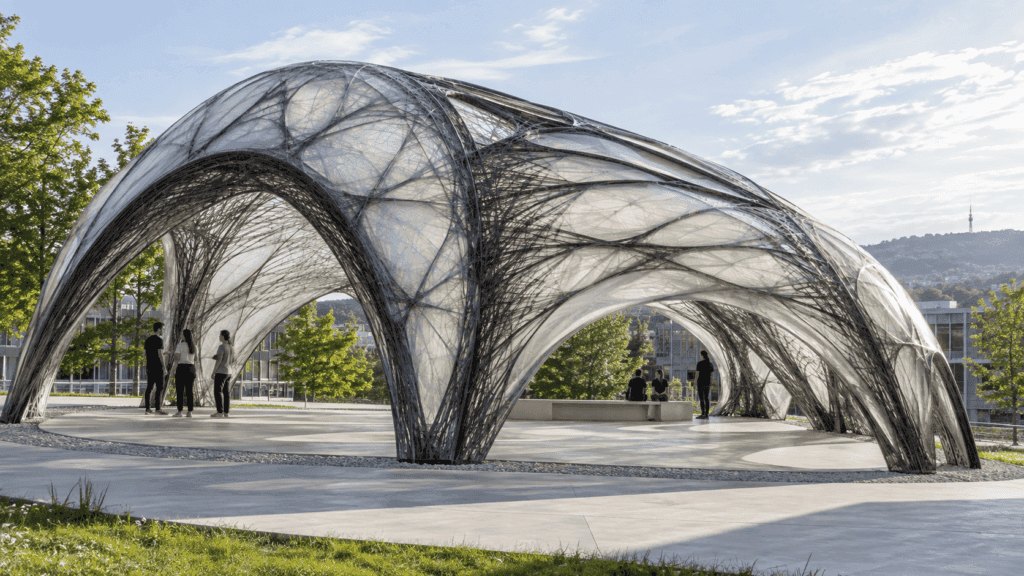
In Stuttgart, a robot winds glass and carbon fibers around a curved form. It is not making a sculpture: it is testing whether an architectural enclosure can gain strength by placing every strand in the exact direction in which it will work. The model is the material logic of a shell.
Biology as calculation
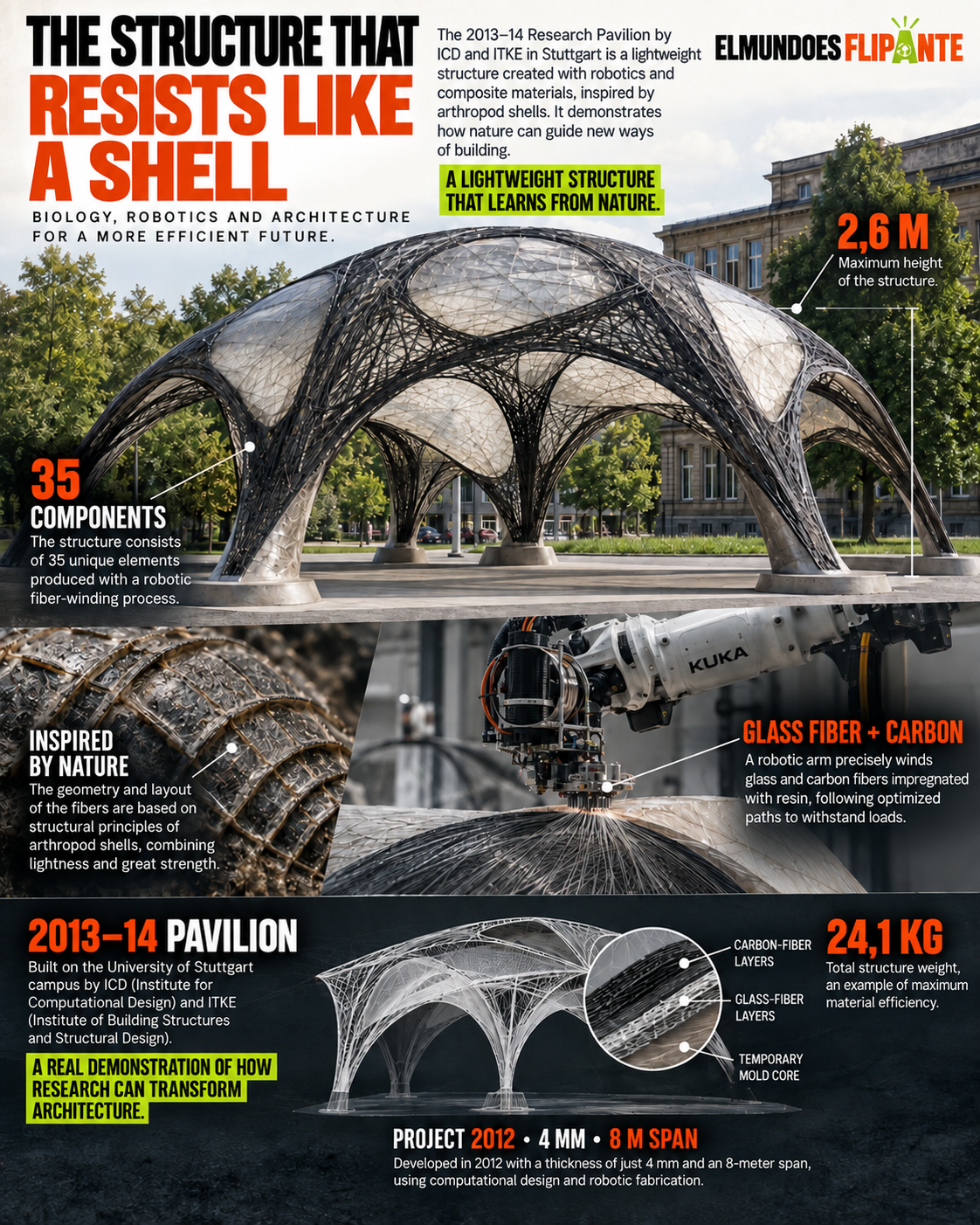
Arthropod shells combine layers with different properties. ICD and ITKE translated that anisotropy into computational rules: analyze loads, calculate paths and orient reinforcement where the structure needs it.
A robot that manufactures the path
For the 2013–14 pavilion, robotic arms tensioned filaments around a temporary mold. Resin fixed the weave and the mold could be removed. Thirty-five components were made; the largest measured 2.6 meters and weighed 24.1 kilograms.
This video shows how a calculated path becomes a structural part:
Efficiency has limits, too
Digital fabrication reduces waste and allows unique parts, but it requires solutions for inspecting hidden fibers, repair, disassembly and resin recycling. Biomimicry is not decorating with natural forms: it is copying structural economy and subjecting it to calculation and maintenance.
Six ideas to remember
- Fiber orientation follows the flow of forces.
- The robot works on a temporary mold.
- The skin combines glass, carbon and resin.
- The assembly had 35 components.
- The largest piece weighed 24.1 kilograms.
- Efficiency requires thinking about maintenance and recycling.
Sources consulted
These are the sources and links consulted for this article: