

Try a quick test: think of the letter A. What color is it? If the question sounds absurd, you’re like most people. But some people answer without blinking: red, or yellow, or navy blue. And if you ask them again a year later, they’ll name exactly the same color. It isn’t a metaphor or an artistic pose: it’s synesthesia, and it’s far more common than you’d imagine. Someone in your office, your class or your family may have it and never have mentioned it, convinced that everyone experiences the same thing.
What synesthesia is, in two sentences
The word comes from Greek and means something like «joined sensation»: a stimulus that normally activates a single sense also triggers another experience. A letter brings a color, a note brings a shape, a flavor brings a texture in your hands. For it to be real synesthesia, two conditions must be met: it has to be automatic (you don’t choose it) and consistent (the same letter produces the same color for years).
That consistency is exactly what researchers use to tell synesthesia apart from imagination. In tests like the Synesthesia Battery, the online test used in research, you’re asked to pick the color of each letter several times, in random order. A synesthete nails their own color again and again; someone making it up can’t repeat it.
If you’d rather see it before reading on, EL PAÍS sums it up in this five-minute video (in Spanish):
Is it as rare as it seems? No: 1 in 23
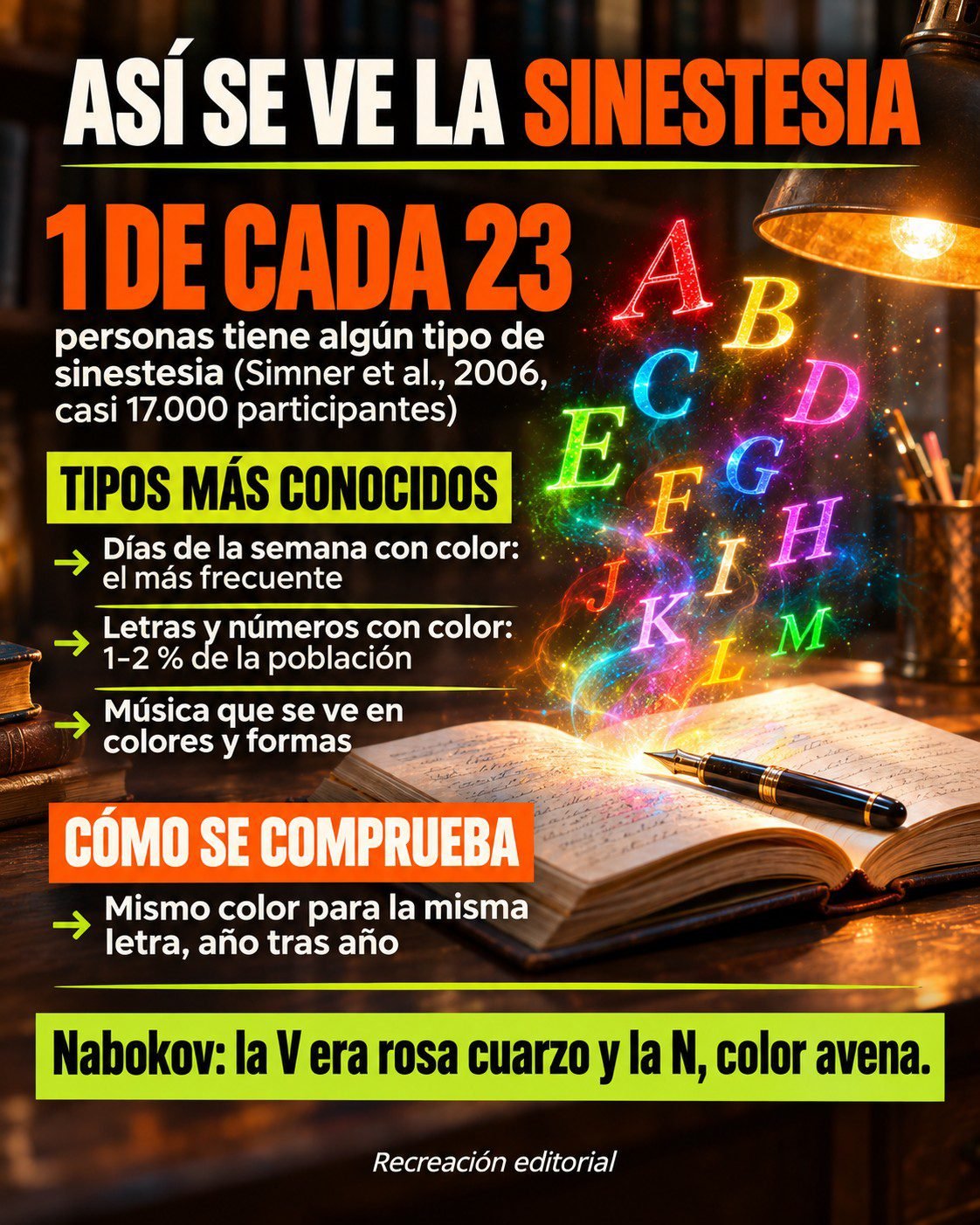
For decades it was thought to be a rarity affecting one person in thousands. The study that changed that figure was published in 2006 by psychologist Julia Simner and her team in the journal Perception. Instead of waiting for synesthetes to volunteer, they searched the general population: nearly 17,000 people. The result: about 1 in 23 have some type of synesthesia.
And the most common variant isn’t the famous one with letters, but colored days of the week: for many people, Monday has a shade as obvious as the sky’s is to everyone else. Colored letters and numbers show up in around 1 or 2% of the population, depending on how strict the criteria are.
It builds up in childhood
In 2009, the same team published a study in the journal Brain with 615 Scottish children aged 6 and 7. Eight of them, about 1.3%, already showed stable associations between letters and colors. When the test was repeated a year later, they had gone from about 10 fixed associations to almost 17: the palette fills in as children learn to read, as if the brain were completing a map. The most widely accepted explanation is that in synesthetes, fewer connections are «pruned» between neighboring areas of the brain, such as those that process letter shapes and color.
The Nabokov case: a whole family of colors
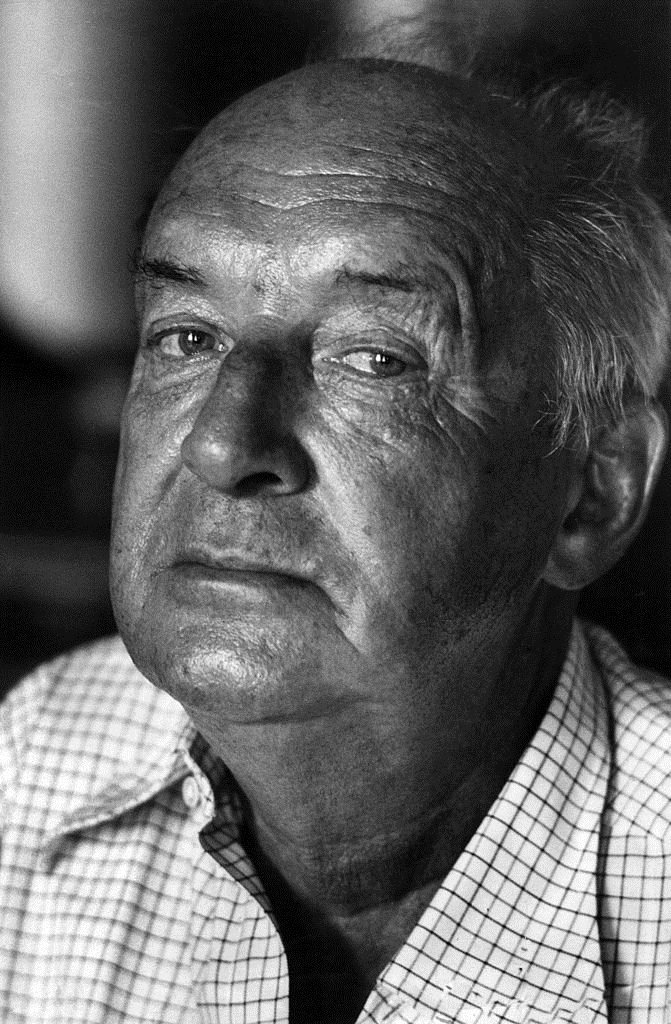
Literature’s most famous synesthete is Vladimir Nabokov. In his memoir, Speak, Memory, he describes the color of each letter with a jeweler’s precision. And in a 1962 interview with the BBC he said that V was, for him, a shade of «rose quartz» and N a grayish oatmeal. In that same conversation he estimated that perhaps one person in a thousand had that «colored hearing.» He was way off.
As a child he discovered that his mother had it too, when he complained that the colors on some letter blocks were «wrong.» His wife, Véra, was also a synesthete, and so was his son Dmitri: for some letters, Dmitri’s color seemed to be a blend of his parents’. That’s no coincidence: synesthesia tends to run in families, which points to a genetic component, although nobody inherits a specific palette.
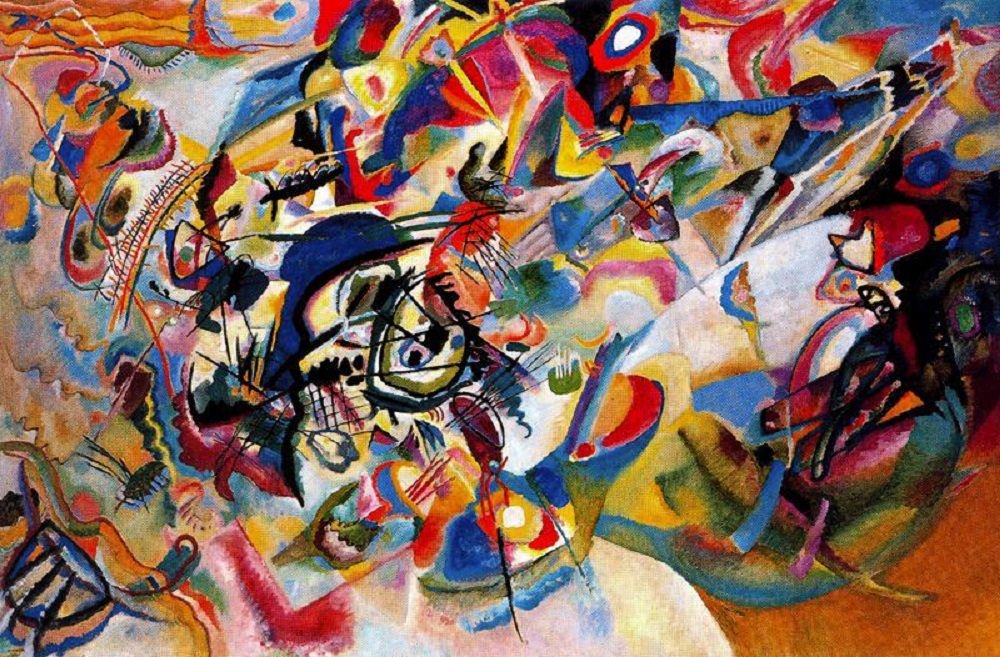
The painter Wassily Kandinsky and the composer Franz Liszt, who spoke of colors in music, are also frequently mentioned. With historical figures, it pays to be careful: it’s an attribution based on what they wrote, not a diagnosis.
So is it a problem?
No. It isn’t a disease or a disorder, and there’s nothing to «cure.» Most synesthetes experience it as something neutral or downright pleasant, and some use it to their advantage: remembering a phone number by its colors or a password by its shape. Most people find out late, the day they mention that Wednesday is green and realize everyone is looking at them funny.
The brain has many ways of building reality. Some people see more colors than everyone else thanks to tetrachromacy (in Spanish), there are extreme cases like Cotard’s syndrome (in Spanish), and there are tricks of collective memory like the Mandela effect (in Spanish). Synesthesia is probably the most beautiful of them all.
Questions that hit anyone who discovers synesthesia
What is synesthesia?
A form of perception in which a stimulus also activates another sense: for example, seeing colors when reading letters or listening to music. It’s automatic and consistent over time.
How many people have synesthesia?
According to the study by Simner and colleagues (2006) of nearly 17,000 people, about 1 in 23.
What is the most common type of synesthesia?
Associating colors with the days of the week. Colored letters and numbers affect about 1 or 2% of the population.
Is synesthesia a disease?
No. It isn’t a disorder and doesn’t need treatment.
These are the sources we analyzed to tell you this story
- Simner et al., Perception (2006): the prevalence study of nearly 17,000 people that produced the 1-in-23 figure.
- Simner et al., Brain (2009): the detection of synesthesia in 615 children aged 6 and 7 and how it evolved over a year.
- Simner and Bain, Frontiers in Human Neuroscience (2013): the follow-up of those same children up to ages 10 and 11.
- The Synesthesia Battery: the benchmark online test used in research.
- Mental Floss: Nabokov’s 1962 BBC interview about his «colored hearing.»