
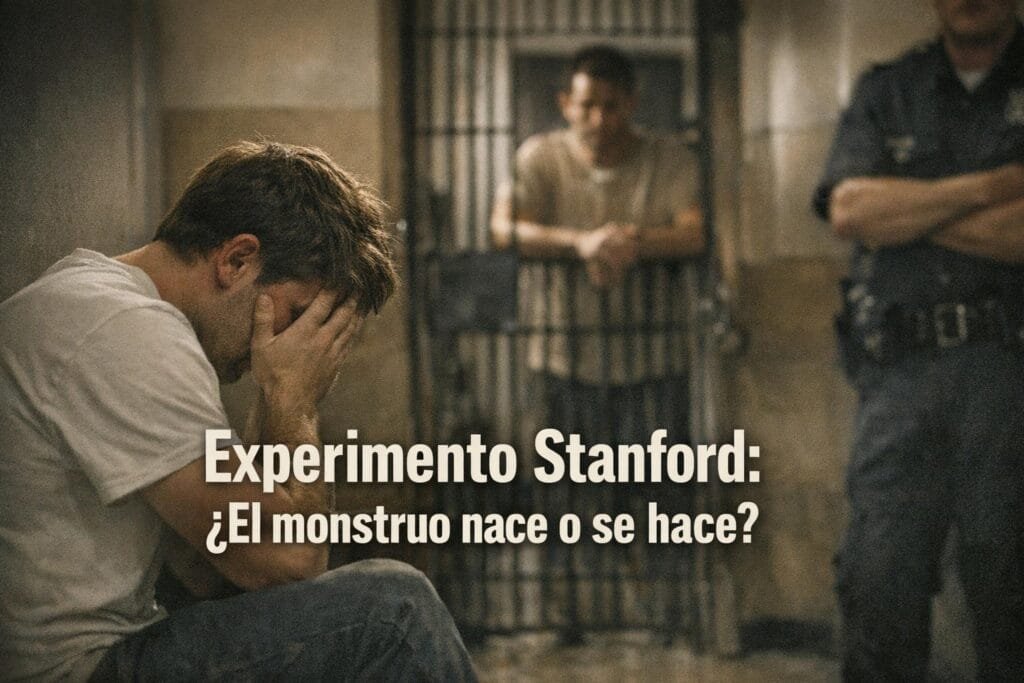
We like to think we are good people, right? Civilized, empathetic, incapable of pointless cruelty. It is a comforting truth, almost a mantra. Get ready, because what happened in a basement at Stanford University in 1971 may make you question that pleasant picture of yourself—and, by extension, humanity.
The story began with a group of college students. Ordinary, well-adjusted young men with no history of violence or psychological problems. They answered a newspaper ad: “Volunteers wanted for a psychological study of prison life. Pay: $15 a day.” Nothing unusual, right? A boring summer, easy money. They had no idea they were about to take part in one of the most disturbing and ethically complicated studies in psychology—a simulation that had to be shut down after six days because it had become dangerously real.
The documentary below dramatizes key moments from the experiment and helps convey its oppressive atmosphere and the rapid deterioration in behavior:
The innocent ad that awakened monsters
It began with Stanford psychologist Philip Zimbardo and his team. They wanted to study how assigned social roles might affect individual behavior. Are people cruel by nature, or can an environment and the expectations of a role transform anyone? To find out, they recruited 24 of the healthiest, most stable male students from a pool of 75 candidates and randomly split them into two groups: guards and prisoners. A coin toss decided their fate.
A mock prison was built in the basement of Stanford’s psychology department. Small cells with steel doors, a “hole” for meals and an isolation cell. The details were chilling. Guards received khaki uniforms, wooden batons and sunglasses to prevent direct eye contact and encourage dehumanization. They were told to maintain order, but not to use physical violence. Prisoners were stripped of their personal identities: gowns without underwear, chains around their ankles, nylon caps meant to mimic shaved heads, and identification numbers in place of names. It sounds like a horror movie, but it was an academic study. Or so they thought.
The fictional prison: a setting that felt far too real
The “arrest” was the first jolt of reality. Local police, cooperating with the study, picked up the “prisoners” at home with sirens and handcuffs. They were booked, stripped, disinfected and locked in their cells. The humiliation had begun before they even reached the mock prison.
Within hours, the transformation was disturbing. The guards, who had been fellow students the day before, slipped into their roles with alarming speed. They began to:
- Give arbitrary, humiliating orders.
- Deprive prisoners of food or sleep.
- Make them do push-ups or clean toilets with their bare hands.
- Create a system of punishments and rewards that chipped away at their dignity.
The irony is that there was no handbook for cruelty. The guards invented ways to break the prisoners’ spirits on their own. They were ordinary young men with no prior training, but the authority of the uniform, sunglasses that hid their eyes and a sense of impunity gave them a license for sadism. Zimbardo, who also took on the role of prison superintendent, later admitted that he too was swept up in the dynamic and lost his moral perspective.
When identity fades: guards and prisoners
The prisoners reacted much as people might in a real prison: first with disbelief, then rebellion and, eventually, paralyzing despair. Attempts at a riot were brutally suppressed by the guards, who used fire extinguishers to force the prisoners back into their cells and psychological tactics to make them distrust one another.
Some prisoners became so distressed that they had to be released early. One suffered a breakdown after 36 hours, crying uncontrollably and showing signs of acute depression. Others became submissive and apathetic, accepting their fate without complaint—even when their mattresses were taken away or they were forced to sing degrading songs.
Most unsettling was how quickly the lines between reality and simulation blurred. This was no role-playing game; it had become a functioning prison, complete with power dynamics, abuse and dehumanization.
The cry of reason: the intervention
The experiment was scheduled to last two weeks, but it had to be stopped on day six. The person who hit the brakes was Dr. Christina Maslach, a graduate student and Zimbardo’s girlfriend at the time. When she visited the prison and saw the prisoners’ degradation and the guards’ brutality, she was horrified and confronted Zimbardo about the immorality of what was happening.
She was the only outside observer to challenge the study. Everyone else, including Zimbardo, had grown accustomed to the situation and lost sight of the ethical stakes. Maslach’s intervention held up a mirror, forcing him to recognize the monster he had helped create. The Stanford prison study ended abruptly, leaving behind trauma and unanswered questions.
What did we learn? The shadow beneath the skin
The Stanford experiment is a chilling reminder of how easily ordinary people can be influenced by authority and social roles. It suggests that cruelty is not only a trait of individual psychopaths; under the right circumstances, it can emerge in any of us. Unchecked power, dehumanizing “others” and diffused moral responsibility are dangerous ingredients that can turn “good” people into tormentors and “normal” people into victims.
The study has been the subject of intense ethical and methodological debate. Research like this helped strengthen the ethical principles governing psychological research today. Critics have questioned its scientific rigor, Zimbardo’s personal involvement and even the possibility that participants with aggressive tendencies were selected—though the latter claim has largely been disputed. Still, its central message resonates: situations can shape human behavior in ways we might never expect.
The next time you see someone act cruelly or unfairly—or feel tempted to do so yourself—it may be worth pausing. Is that person inherently “bad,” or are they responding to a role, a uniform or a situation pushing them to become someone they are not? We all carry a shadow. What keeps us in the light may be less our innate goodness than the fragile social structures that contain it. The Stanford prison showed how quickly those structures can break.
If this story fascinated—and perhaps unsettled—you, explore other experiments that challenge what we think we know about ourselves, such as the Milgram experiment and obedience to authority or the story of Ivanov’s attempted human-chimpanzee hybrid in the USSR. Keep discovering astonishing stories here at El Mundo es Flipante.