
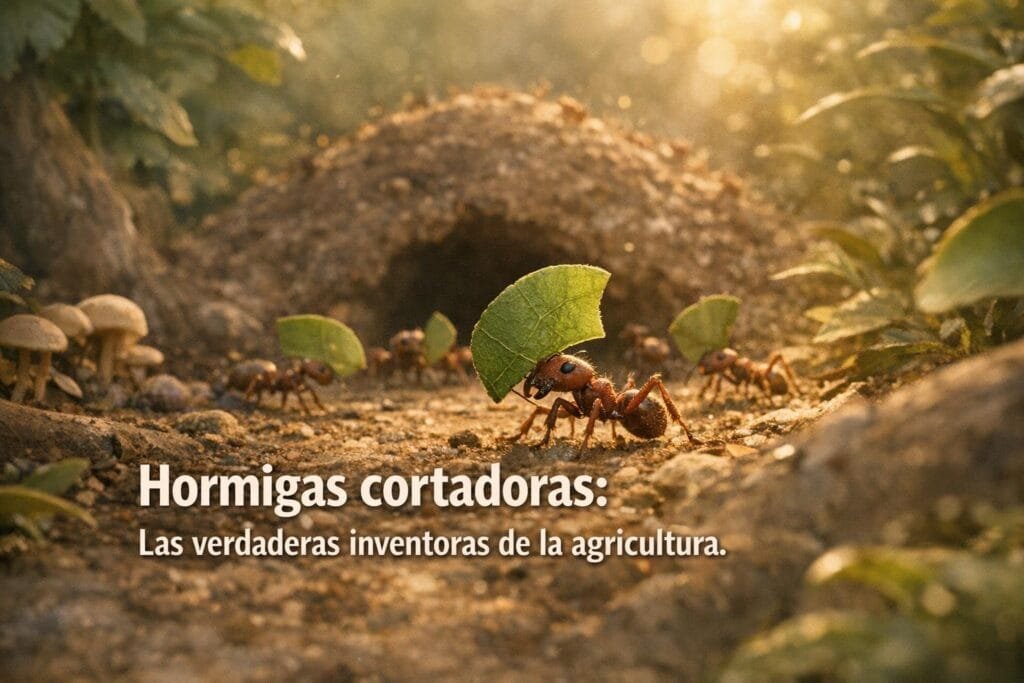
If someone asked which species first mastered agriculture, what would you say? Homo sapiens, with wheat fields and sophisticated tools? Our anthropocentric view is endearing—but naive. While we were splashing in primordial puddles and discovering fire, other creatures were already managing complex growing ecosystems with astonishing skill. They did it with a sophistication that took us millennia to match. This story may change your mind about who the planet’s real innovator is.
Before we dive into their underground empire, watch this video for a sense of the scale and organization of these tiny farmers. It is hypnotic.
Millions of years ahead: the first farmers
Imagine a world where farms are not measured in acres but in intricate underground passages, some so vast they could hold a miniature city. Here, livestock does not chew grass; it is a delicate fungus, carefully cultivated and fed processed plant matter. This is no science fiction. It is the everyday reality of leafcutter ants, true agricultural pioneers that have been farming continuously for at least 50 million years.
Yes, 50 million years—long before any of our distant ancestors thought of planting a seed. While humans were evolving opposable thumbs, leafcutters had perfected an agricultural system that puts many of our early attempts to shame. They did not just invent it; they maintained, adapted and expanded it with astonishing efficiency.
Underground farmers: a finely tuned ecosystem
Ant agriculture is not simply storing food. It is a complex symbiosis with a specific fungus that the ants cultivate as their main food source. The stars of the story are ants in the genera Atta and Acromyrmex, widespread across tropical and subtropical regions of the Americas.
Their process is a marvel of natural engineering. They do not eat the leaves they cut and carry; they use them as a substrate for a garden. But not every leaf will do. The largest workers cut pieces of vegetation with powerful jaws, sometimes walking for miles to find the right material. Other workers carry the pieces back to the colony in a steady parade that looks like a miniature green highway.
Inside the colony—which can cover more than 30 square meters and reach depths of up to 6 meters—labor becomes even more specialized. The leaves are not simply dumped. Smaller workers chew them into a fine paste, shape it into pellets and “plant” it in dedicated chambers: underground farms. That is where the key ingredient thrives: the fungus Leucoagaricus gongylophorus.
Climate engineering and pest control before humans
These fungus farms are more than piles of chewed leaves. They are carefully regulated environments. The ants do not just feed the fungus; they tend it with astonishing dedication:
- Temperature and humidity control: Galleries and tunnels help maintain ideal growing conditions, with natural ventilation that could come from a bioengineering manual.
- Fertilization: The ants add nutrients, sometimes through their own secretions, to encourage mycelium growth.
- Weed and pest control: Parasitic fungi and bacteria can ruin a crop. Leafcutters have a kind of “antibiotic,” produced by a bacterium they cultivate on their bodies. It suppresses unwanted competitors and protects their fungus crop. This is sophisticated biological pest control, practiced for eons.
The fungus is no passive partner. It has coevolved with the ants, developing nutrient-rich structures that are the sole food source for the larvae and a major source of food for adult ants. The symbiosis is so tight that neither partner could survive without the other.
A queen’s inheritance and the scale of ambition
When a newly fertilized queen leaves the colony to start her own, she carries a tiny fragment of the essential fungus. It is her “seed,” the startup capital for a future empire. Without that little piece, the new colony could not get established. That is how the fungal lineage is maintained and passed from generation to generation—a crop cultivated continuously over millions of years.
The scale of these societies is also astonishing. Some Atta colonies house millions of individuals and move tons of soil. They are an unstoppable natural force, proof that complexity and intelligence are not the property of a handful of species. Next time you see a line of ants carrying leaf pieces, look twice. You are watching the legacy of an agricultural civilization millions of years older than ours, built on cooperation, specialization and persistence.
Perhaps the most ironic lesson from leafcutter ants is that while we pride ourselves on innovation, a long-term success model was already written underground—in tunnels where collaboration, specialization and ancient agriculture reign. What other surprises is the natural world hiding? Keep exploring life’s wonders at El Mundo es Flipante.