
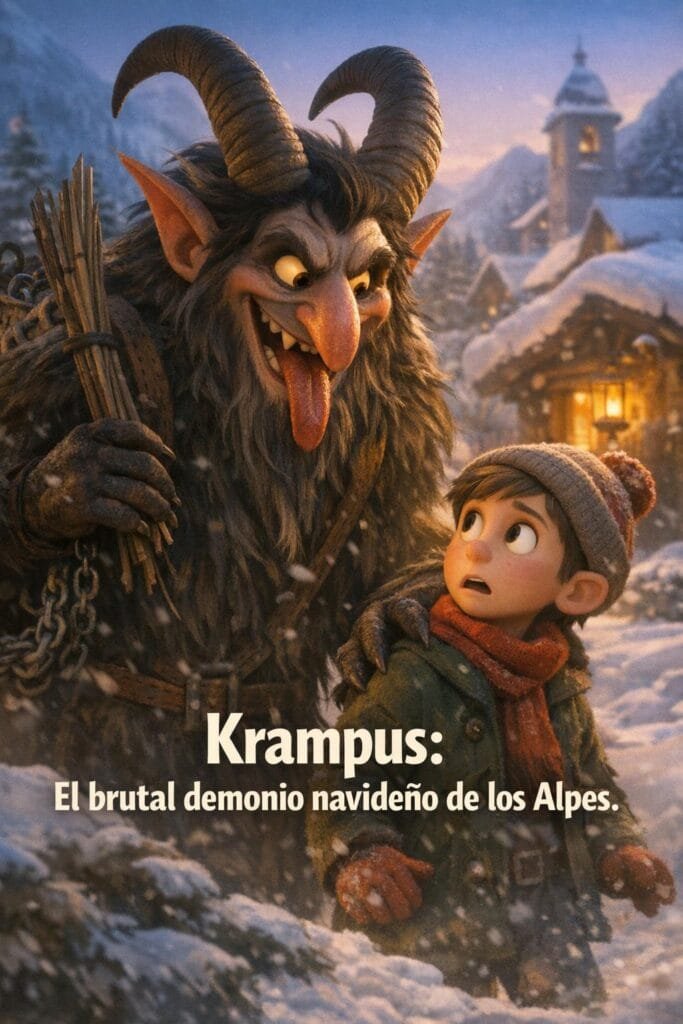
Forget the jingling bells, twinkling lights and kindly old man in red. Forget the promise of presents under the tree if you have been good. Now imagine the hollow echo of rusty bells and chains dragging down a snowy street in an Alpine village on a dark winter night. It is not a cheerful melody but a warning—the sound of an ancient fear that still makes people shudder in the twenty-first century.
While jolly Santa gets his sleigh ready to spread happiness, another figure emerges from the darkest corners of European folklore. He is not there to reward children who have been less than… exemplary. And I promise his methods are far more direct than taking away a video game console. Meet Krampus, the Christmas demon who has supposedly punished naughty children for centuries. Now that is mind-blowing.
For a look at this terrifying tradition—and how alive it still is on European streets—watch this video. The images speak for themselves.
The monster from Christmas nightmares
What does the creature that once terrified children—and not only children—in Europe’s Alpine regions look like? He is no postcard character. Picture something from your worst nightmare, a creature half goat, half demon. Twisted horns like branches from an ancient tree, coarse dark fur covering him from head to toe, and a forked tongue poking from a mouth full of blade-sharp teeth. They say his breath smells of sulfur and bad intentions.
His appearance is not the only thing that makes an impression. Krampus comes equipped for discipline. He is often depicted carrying:
- Birch rods or a whip, ready to swat the naughtiest children.
- Clanking chains that scrape and rattle to announce his arrival and spread panic.
- A basket or sack on his back. For what? The darkest part of the legend: if a child was *really* bad, Krampus might carry them straight to the underworld.
Yes, you read that right. While your biggest Christmas worry was getting coal, in the Alps the threat was demonic abduction. Quite a difference!
Krampus Night: when the demon goes hunting
Forget December 24 or 25. The key night for Krampus is December 5, the eve of St. Nicholas Day (the historical figure behind Santa Claus). It is known as Krampusnacht, or Krampus Night. On that date, villages in Austria, Bavaria, Slovenia, Hungary and parts of Italy take on a particular tension. Children go to bed a mix of excited and terrified: will St. Nicholas leave sweets—or will he show up?
After dark, monstrous figures fill the streets, running, growling and sometimes frightening spectators at modern Krampus parades. It is a fascinating and terrifying spectacle in equal measure. Hundreds of people, many wearing hand-carved wooden masks that are works of art—and walking nightmares—march through town. The goal is simple: remind everyone to behave. And, let us be honest, inspire a healthy fear that may have been more effective than Santa’s warnings.
Deep roots in pagan darkness
Do not think this figure was invented by a recent storyteller. Krampus’s roots reach into the pre-Christian pagan myths and Alpine traditions that honored—and feared—the deities of winter nature. Long before Christianity reached these mountains, winter festivals already featured horned, fur-covered creatures representing nature’s wild, often brutal spirit.
When Christianity arrived, the Church often chose to “Christianize” deeply rooted beliefs rather than erase them completely. The pagan demon became St. Nicholas’s companion, the necessary “dark side” that emphasized the saint’s goodness. St. Nicholas rewarded good children; Krampus punished the bad. It was a perfect dichotomy for keeping children in line and reminding everyone that life is not all light and sweetness.
The resilience of an indomitable tradition
Despite attempts by the medieval Church to suppress him as pagan, and by some twentieth-century governments—including the Nazis, who considered the tradition “degenerate”—Krampus refused to disappear. In recent decades he has even made a comeback, spreading beyond his traditional regions and becoming a global cultural phenomenon.
Why are we fascinated by such a frightening figure? Perhaps people need balance. If there is absolute good, there must be absolute evil. If there is a reward, there must be a punishment. Or perhaps we simply love a good story that makes our hair stand on end every now and then.
So the next time you see a Christmas tree and hear carols, remember that not far away, in Europe’s mountains, Christmas has another face. One with horns, fangs and a forked tongue, reminding us that not every holiday character is as friendly as we were led to believe. Have you behaved this year? You never know when you might hear chains dragging down the street…