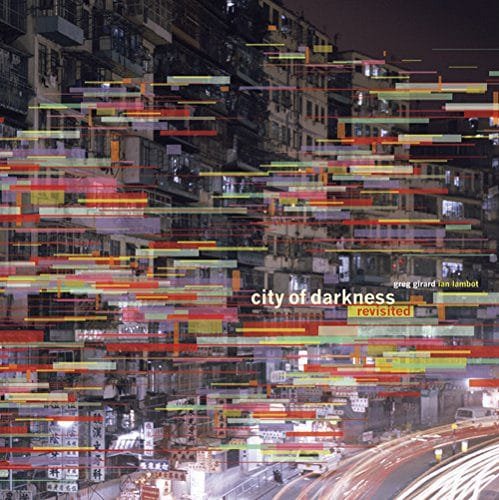
One block held as many people as a midsize city
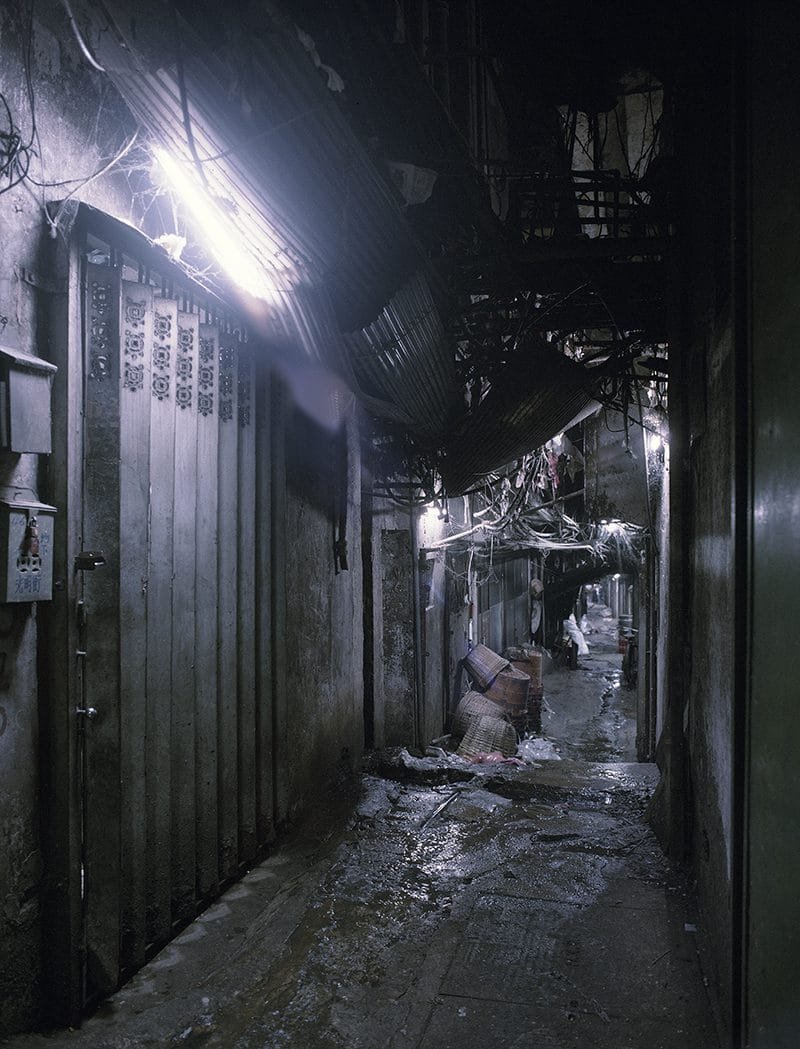
Imagine walking into a building and finding no lobby with mailboxes—just a maze. Narrow corridors, staircases appearing where you least expect them, cables hanging overhead, improvised pipes, doors pressed against doors. There is no clear “street”: everything is indoors. And yet life is everywhere. The smell of food, the sound of workshops, children running, neighbors who know one another—and people who would rather not be seen. This place existed: Kowloon Walled City, a block so densely populated it sounds like science fiction. It was real.
Frequently cited figures, also reported by outlets such as CNN, National Geographic and HowStuffWorks, put the population as high as 50,000 on a tiny patch of land, at an estimated density of about 1,255,000 people per square kilometer. Here is one way to picture that: if a square kilometer were a chessboard, you would be trying to squeeze an entire city’s population into a single square—and then stack them on top of one another.
For more background, this history and overview of Kowloon Walled City helps place the enclave in its time.
Before we go on, this video gives you a visual sense of the place’s scale and atmosphere:
A hole in the map: when nobody was really in charge
“Lawless” gets thrown around so freely that it can lose its meaning. In Kowloon, it had a specific one: for decades, jurisdiction was murky. The enclave stood in Hong Kong, under British administration for much of the twentieth century, while its origins and historical status tied it to China. In that legal fog, official rules had a hard time getting in. Everyday customs, neighborhood networks and, at times, criminal groups found room to operate.
That does not mean it was in a constant movie-style state of chaos. The reality was stranger: a parallel order. If your apartment building has “its own rules”—the neighbor who acts like a doorman, or the residents’ association that makes baffling decisions—multiply that by thousands of homes, with no urban plan to support them and an intermittent state presence. The city organized itself however it could: through habit, necessity and the sheer physics of surviving in a place where every square foot mattered.
Architecture by accumulation: the ultimate game of Tetris
Kowloon Walled City was not designed as one grand project. It became what it was. It grew in layers, like a bookshelf you keep stuffing with books after it is already full: eventually, you lay them flat, stack them, squeeze them into double rows—wherever they fit. Here, the “books” were homes, workshops, clinics, small factories, shops and corridors. Everything followed a logic that was more organic than planned.
The buildings rose to roughly the maximum height allowed in practice for one decidedly unromantic reason: Kai Tak Airport was nearby, and planes flew very low overhead. This was no skyline built for looks; it was shaped by a physical limit. The result was a compact block of multistory buildings, tiny inner courtyards and places where sunlight barely slipped through. In some corners, it always seemed to be late afternoon.
If you have ever been in an old shopping mall where one renovation closes a corridor and opens another, you can imagine the feeling: finding your way by instinct. Except that instead of clothing stores, there were homes and workshops. A vertical neighborhood where getting lost was not a metaphor.
What was life there actually like?
Popular images of Kowloon swing between two extremes: an “urban hellscape” or a “resilient community.” The truth, as usual, was more uncomfortable and more human. There was overcrowding, poor sanitation, improvised infrastructure and obvious danger. There were also people living ordinary lives: cooking, falling in love, raising children, running small businesses and helping neighbors. The city was a miniature social ecosystem, with quieter blocks and darker corners.
When the density gets that extreme, privacy becomes a rare luxury. Think about living with a neighbor’s noise on the other side of a thin wall. Now imagine walls, ceilings and floors shared with dozens of people just inches away, while corridors become an extension of the living room. The city forced people to negotiate space like seats on a rush-hour subway: through unwritten rules, patience—or conflict.
It is important not to oversimplify: “lawless” is not the same as “without rules.” Shared habits often emerge precisely when formal authority is weak. In Kowloon, necessity produced customs: familiar routes, meeting places, support networks and informal ways of keeping order.
For a popular account focused on daily life, read National Geographic’s history of life inside Kowloon Walled City.
The criminal-city myth—and what we actually know
Kowloon became famous as a haven for illegal activity. Part of that reputation had a basis: legal ambiguity and extreme density made it easier to hide, run shady businesses or move without being noticed. But reducing it to a “criminal den” is a headline-friendly caricature, not an explanation.
Popular histories repeatedly mention triad activity and other illegal businesses during certain periods. At the same time, thousands of residents were not criminals. They were families and workers who found an affordable place—or simply a place where they could live. For many, Walled City was a precarious answer to an enormous problem: housing in a pressured urban environment.
That contradiction is uncomfortable: a place can be dangerous and still be home. It can be unsanitary and still have neighbors who look out for one another. It can symbolize institutional neglect and human inventiveness at the same time.
To learn where the lawless-city reputation came from, read HowStuffWorks on why Kowloon was called a “lawless city”.
A density that breaks your intuition
The density figure—about 1,255,000 people per square kilometer—is hard to grasp because our brains are not built to picture crowds stacked vertically. A typical city spreads out: neighborhoods, parks, avenues. Kowloon compressed. It was as if an entire district’s life had been packed inside one block, layer upon layer of activity.
Here is a domestic analogy: imagine trying to fit your whole house into the hall closet. At first, you fold things more carefully, make room and optimize. Then you start pushing. Eventually the closet stops being a closet and becomes a system: things hanging out, boxes on boxes, objects you can remove only in a certain order. Kowloon was like that, but with human lives, basic needs and real risks.
And yet it lasted for decades. Not “worked” in the sense of being a healthy, planned city, but “worked” in the bluntest sense: people ate, worked, moved around and built things. The city held together through adaptation.
The end: when the solution was to erase the problem
Eventually, a place like this becomes impossible for authorities to defend—for safety, public health, urban policy or public image. Walled City had become too powerful a symbol: of disorder, deprivation and an anomaly difficult to fit into a story of modernity.
The demolition process was completed in 1994, according to the popular histories cited above. This was not just tearing down walls; it was dismantling a world. For some residents, it meant leaving extremely harsh conditions. For others, it meant losing a community and a way of life, imperfect as it was. When a place like this disappears, its problems do not vanish alone: so do networks, memories and an everyday culture that cannot fit on an urban-planning map.
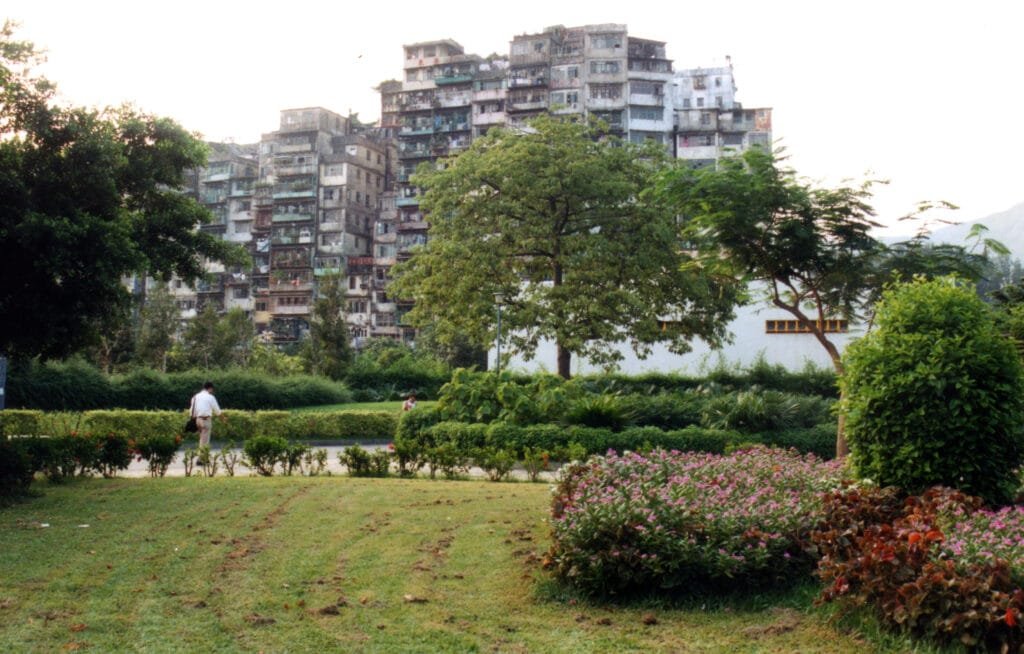
The site was transformed. The compact block, almost without air, gave way to a completely different environment. There is an urban irony in that: where everything had been enclosed, dark and cramped, the goal afterward was openness, walkability and air. As if the city needed to exhale.
Why Kowloon still fascinates us
Kowloon Walled City fascinates us because it feels like an extreme experiment built around two questions that never go away: What happens when a city grows faster than its rules? And what happens when people have to invent the city they were never given?
There is a simpler reason, too: it breaks our idea of a “building.” To us, a building is one unit: a lobby, a community, an address. Kowloon was almost a city inside one address, where the boundaries between home, street and business blurred until they were hard to recognize.
And there is one last, more uncomfortable reason: it lets us look at overcrowding as a distant oddity. But housing pressure, urban inequality and legal gray areas are not exotic relics. They simply change shape and scale.
The final paradox
Kowloon was both a warning and a testament to ingenuity: a place where a lack of oversight created enormous risks, yet life pushed through with fierce creativity. One uncomfortable question remains: when a city “fixes” a problem by demolishing it, has it addressed the cause—or simply cleared the view?