
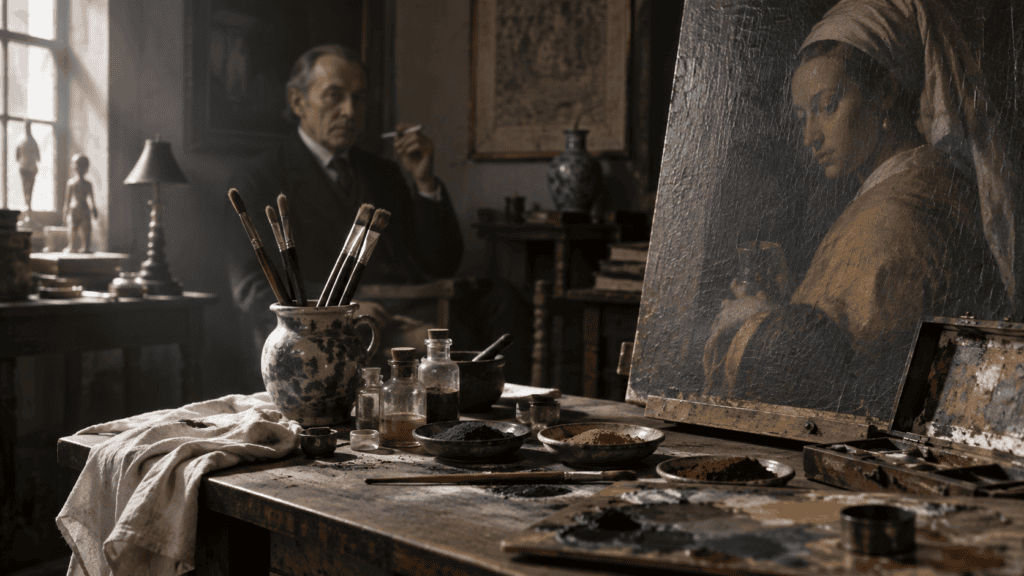
What gives a painting away first: an expert eye or a pigment? For years, the answer seemed to be the eye. Han van Meegeren made supposed Vermeers, and he did far more than imitate a brushstroke: he built a material history, a signature, a provenance, and a discovery that experts wanted to believe could be real.
Van Meegeren was born in 1889 and died in 1947. He was a painter, but he also carried a deep resentment toward critics who treated his own work as second-rate. His forgeries filled an irresistible gap: very few religious paintings by Vermeer were known, so a newly discovered work of that kind could be presented as the piece that completed an unfinished biography.
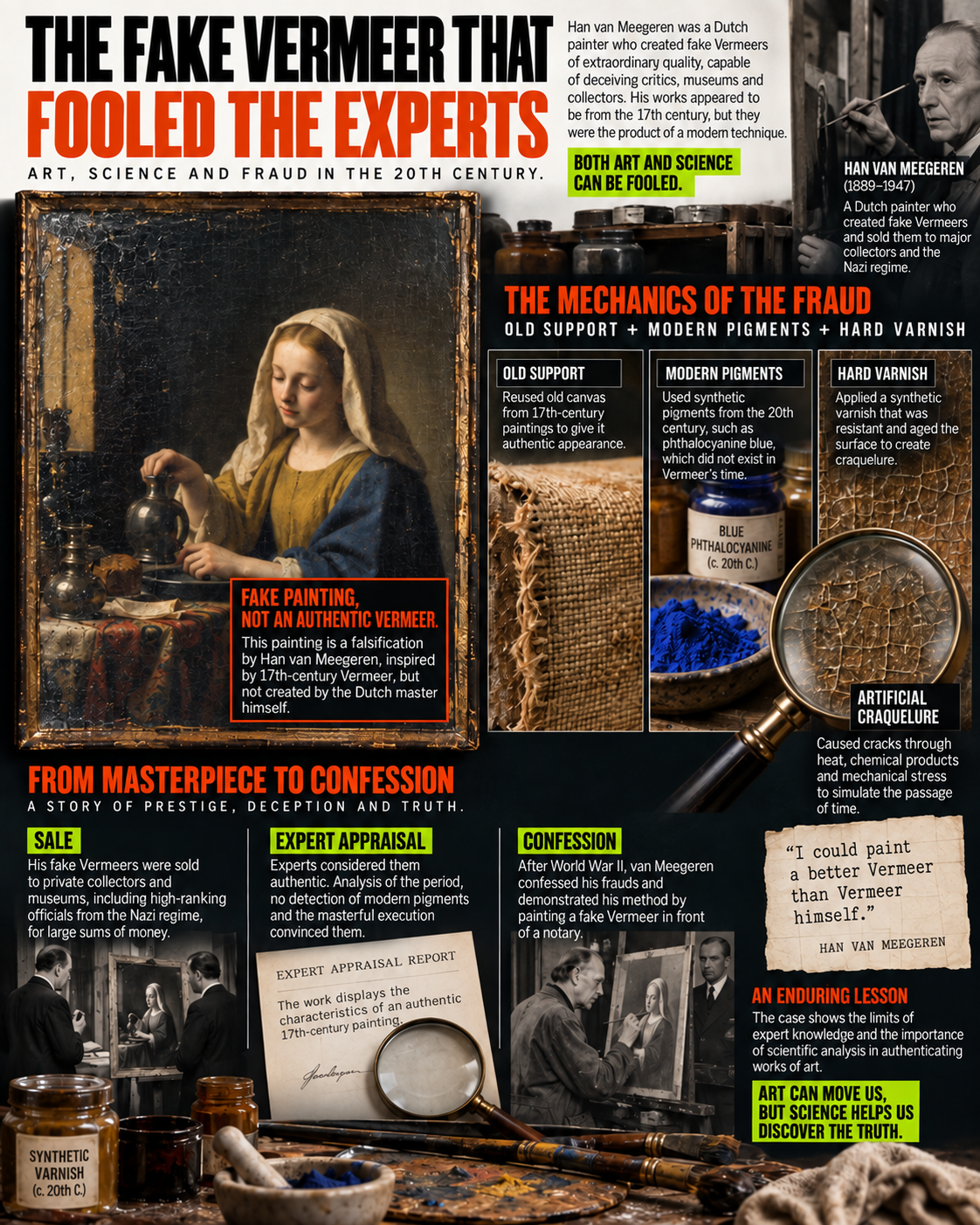

Old canvases, prepared surfaces, varnish and baking helped create the appearance of age. Bakelite could harden paint and produce convincing crackle. None of it worked in isolation. The forgery was a chain: an aged support, a recognizable technique, a plausible subject, and an expert willing to see a revelation. In 1937, critic Abraham Bredius authenticated The Supper at Emmaus as an extraordinary Vermeer. Winterthur examines the case as a collision of history and technique.
When provenance becomes part of the artwork
Some paintings circulated during the Nazi occupation, and one reached Hermann Göring. After the war, Van Meegeren was charged with collaborating with the enemy for selling a “Vermeer.” His defense sounded both absurd and brilliant: he had to prove that he had painted the works himself.
The confession turned the trial into a spectacle. But the case does not prove that experts are useless, nor that one material test automatically settles every doubt. Conservators combine pigment analysis, X-rays, support studies, stylistic comparison and provenance. The Metropolitan Museum explains scientific conservation; the Rijksmuseum provides the context for genuine Vermeers.
The deception was a complete recipe, not a brilliant brushstroke
Van Meegeren’s forgery worked because every layer answered a different question. The support had to look old; the surface had to accept paint that suggested Vermeer’s material presence; the varnish had to harden; the cracks had to imply decades of changing temperatures. Above all, the subject had to fit a gap in the artist’s known history. The painting did not ask to be judged as a copy; it asked to be welcomed as the discovery everyone had been waiting for.
Modern materials could go unnoticed in an early assessment, especially when a work arrived with a provenance that appeared reasonable. This is where conservation science enters. An X-ray can reveal changes beneath the surface; spectrometry can identify pigments that did not exist in the attributed period; and a study of the support can show whether a canvas was prepared in a way incompatible with the seventeenth century. No single test speaks for itself, but several signals together can turn an intuition into a testable hypothesis.
Experts, however, do not look in a vacuum. They work with photographs, earlier reports, owners’ accounts and catalogues that may contain errors of their own. An old frame does not prove that a painting is old; a convincing signature does not prove that the right hand made it; a family story repeated for decades does not become true through repetition. Provenance is a chain of claims, and every link needs documentation.
The Supper at Emmaus landed so powerfully because it offered an elegant answer to a genuine mystery: few religious scenes by Vermeer were known. Bredius was not hunting for a fake. He was assessing a work that appeared to expand the catalogue of a closely studied artist. The image filled a void, and the wish to complete that void could make doubts feel like minor inconveniences. The painting was not only imitating a style; it was offering a headline.
During the trial, Van Meegeren turned his technique into a defense. To show that he had not sold a Vermeer to the Nazis, he had to show that he could manufacture one. The scene seems too perfect to be true, but its historical interest lies elsewhere: the accused put the material reality of the artwork at the center of the proceedings. Painting stopped being only an expert opinion and became a series of observable choices about supports, pigments, heat and aging.
Comparing this work with a genuine Vermeer must be done carefully. It is not an invitation to play “guess which one fools the eye” on a screen. It is a way to understand what it means to study a work inside a larger body of evidence: light, scale, preparation, brushwork, subjects, materials, conservation and documented history. The Rijksmuseum provides the context of real works; the laboratory provides the other half, the half invisible when we only look at a reproduction.
Van Meegeren’s story does not license easy cynicism about expertise. Authentication is cumulative and revisable. Methods improve, archives emerge, and an attribution can change when new evidence challenges an older conviction. The more appealing the story surrounding an object becomes, the more necessary it is to separate emotion from evidence.
The forgery sold a painting, but it also sold the pleasure of finding a lost masterpiece. That pleasure was the real varnish. When it cracked, it revealed a lesson that still applies to any market for rare objects: something may look old, the signature may look right, and the story may sound irresistible. Authenticity begins when every one of those layers agrees to be tested.
That is why the infographic should not frame the forgery as a magic trick. Its five layers—support, pigment, varnish, crackle and provenance—work better as a visual investigation. Each answers a question, and none can replace the others. The image may draw us in, but the story is a reminder that authentication means comparing, documenting and accepting that a conclusion can be revised.
You do not need to become an appraiser to understand the central idea. It is enough to remember that age can be manufactured, while consistency among materials, technique and documentation is much harder to fake for long. That is where the difference between looking and analyzing begins.

To see the story in motion, this video helps complete the explanation:
The work fooled people because every clue seemed to confirm the last. Investigation works in the opposite direction: it looks for the fact that could break the story and requires the whole account to withstand that question.
That is the difference between a convincing painting and an authenticated work: the second survives uncomfortable questions.
The uncomfortable lesson is that authentication is also a story about expectations. A specialist does not look at a surface in a vacuum: they look at an object accompanied by an attribution, a provenance and a promise. When everything fits a little too well, enthusiasm can become a blindfold with a gilded frame.
Sources consulted for this article
- Winterthur: Van Meegeren — Technical analysis of the case and the intent behind the forgeries.
- FBI: Han van Meegeren — Documentation of the investigation and trial.
- Metropolitan Museum: Scientific Research — Material-analysis methods used in authentication.
- Rijksmuseum: Johannes Vermeer — Context for Vermeer’s authentic work and the market that made the deception possible.
- Britannica: Han van Meegeren — Biography of the forger and the key elements of his strategy.
- Rathgen Research Laboratory — Scientific techniques for studying pigments and supports.