
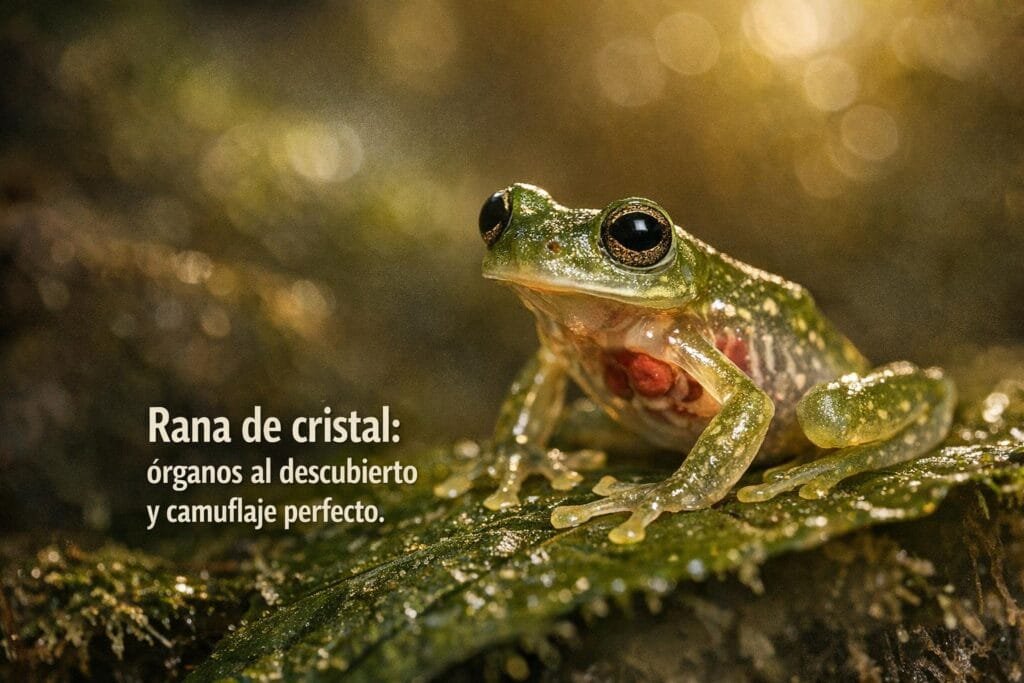
You are deep in a humid rainforest when you spot a tiny creature perched on a leaf. You lean closer—and do a double take. You can see straight through its skin. Its tiny lungs, liver and, most astonishingly, its beating heart are right there in view, pumping blood like a little biological clock on display. This is no lab fantasy: it is the remarkable glass frog.
Can you imagine an animal that lets you watch its insides working in real time? It is like a living X-ray, a spectacle nature offers us that challenges what we think is possible. This creature is the very definition of mind-blowing.
A living canvas of organs and arteries
To appreciate this marvel, there is nothing like seeing it in action. This short video offers a glimpse into the glass frog’s extraordinary inner world, including its heart beating beneath translucent skin.
The first thing you notice about a glass frog, scientifically known as Hyalinobatrachium pellucidum—though several species in the Centrolenidae family share this trait—is the feature that gives it its name: transparency. The skin on its underside is so clear it almost seems to disappear. That is where the magic happens.
Look closely and you can witness a biological spectacle unlike any other. You may be able to see:
- The heart, a tiny sphere beating in a steady rhythm.
- Delicate blood vessels carrying life through its body.
- The liver, a reddish organ visible through the skin.
- And sometimes even the intricate shape of its intestines.
It is a window into the inner workings of life, a revelation that makes you wonder what other marvels the animal kingdom still has in store. Its delicate, complex anatomy is visible to the naked eye—a feature as strange as it is beautiful.
Masters of nighttime camouflage
Where does this natural wonder live? Glass frogs inhabit the humid rainforests of Central and South America, from Mexico to Panama, Colombia, Ecuador and Peru, among other places. They favor vegetation over streams and rivers and are nocturnal. During the day, they rest upside down on the undersides of leaves hanging above streams, staying almost invisible to most predators.
They are tiny, reaching only about 0.8 to 1.2 inches in length. Imagine trying to find one in a vast sea of green. Their backs are generally bright green, allowing them to blend in with the leaves. But their clear bellies take that camouflage to another level.
Why be transparent? The science of invisibility
Here is the million-dollar question: what is transparency for? Is it an evolutionary quirk, or does it serve a purpose? Scientists point to several fascinating theories:
- “Ghost” camouflage: This is the leading theory. Transparency blurs the frog’s outline. Imagine gelatin on a leaf: light passes through it, and the leaf behind it remains visible. That makes it much harder for a bird or snake to tell the frog from the surrounding vegetation. Its body seems to adapt to the background, making it nearly invisible.
- Reducing its shadow: A transparent underside lets light pass through, minimizing the shadow the frog casts on the leaf. A sharp shadow could give it away even when its body is camouflaged.
- Protection from the sun: Some theories suggest transparency may help regulate body temperature by allowing more light and heat to pass through without being absorbed, though the evidence is less conclusive.
This “invisibility” strategy is a testament to evolution’s creativity. It is an ingenious and visually astonishing solution in the endless arms race between predator and prey.
It is not just the skin: life in the glass frog’s world
Beyond their transparency, these frogs have other interesting habits. They lay their eggs on the undersides of leaves hanging above water. When the eggs hatch, the tadpoles drop straight into the stream, where they continue developing. It is a way to protect their young from land-based predators.
Males of some species are known to be protective fathers. They guard the eggs to help them survive, often sitting on or near them to keep them moist and safe from insects that might eat them. Combined with their ethereal appearance, this behavior makes the glass frog an extraordinary amphibian.
The glass frog is a living reminder that nature never stops surprising us. It invites us to look closer, question what we think we know and marvel at the improbable ways life has found to thrive. Is it not astonishing that an animal can walk around with its organs on display, like a living work of art?
The next time you think you have seen it all, remember the glass frog and its beating mystery. If this story fascinated you, keep exploring the incredible adaptations hidden across our planet.