
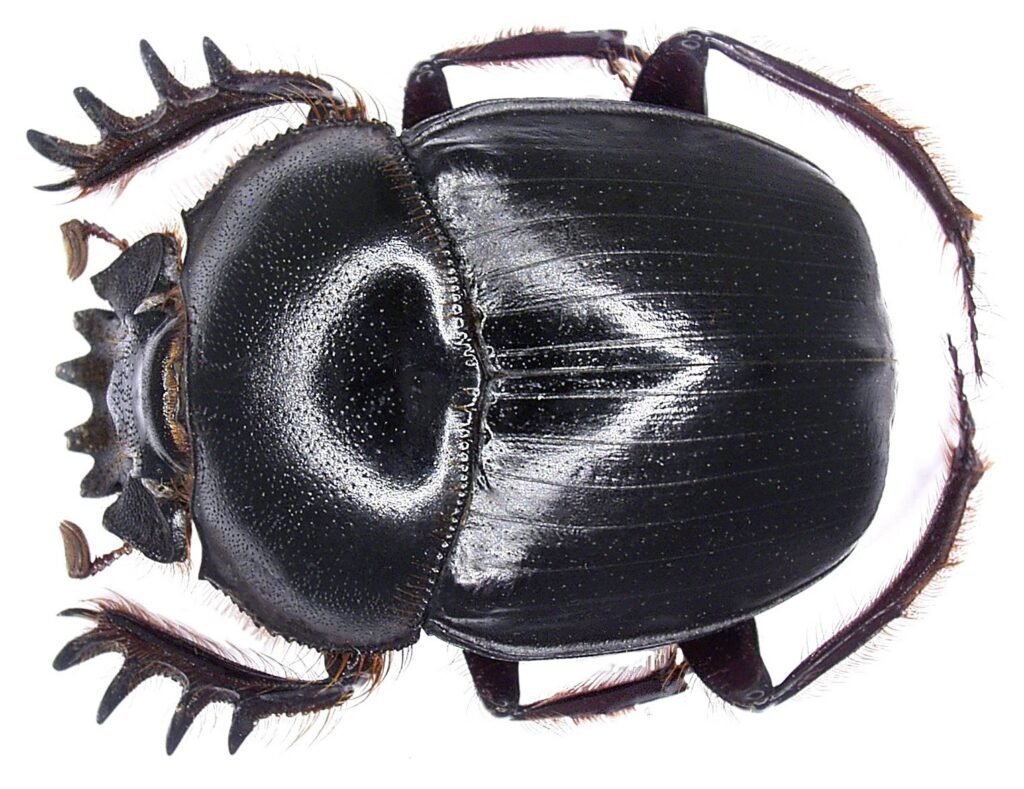
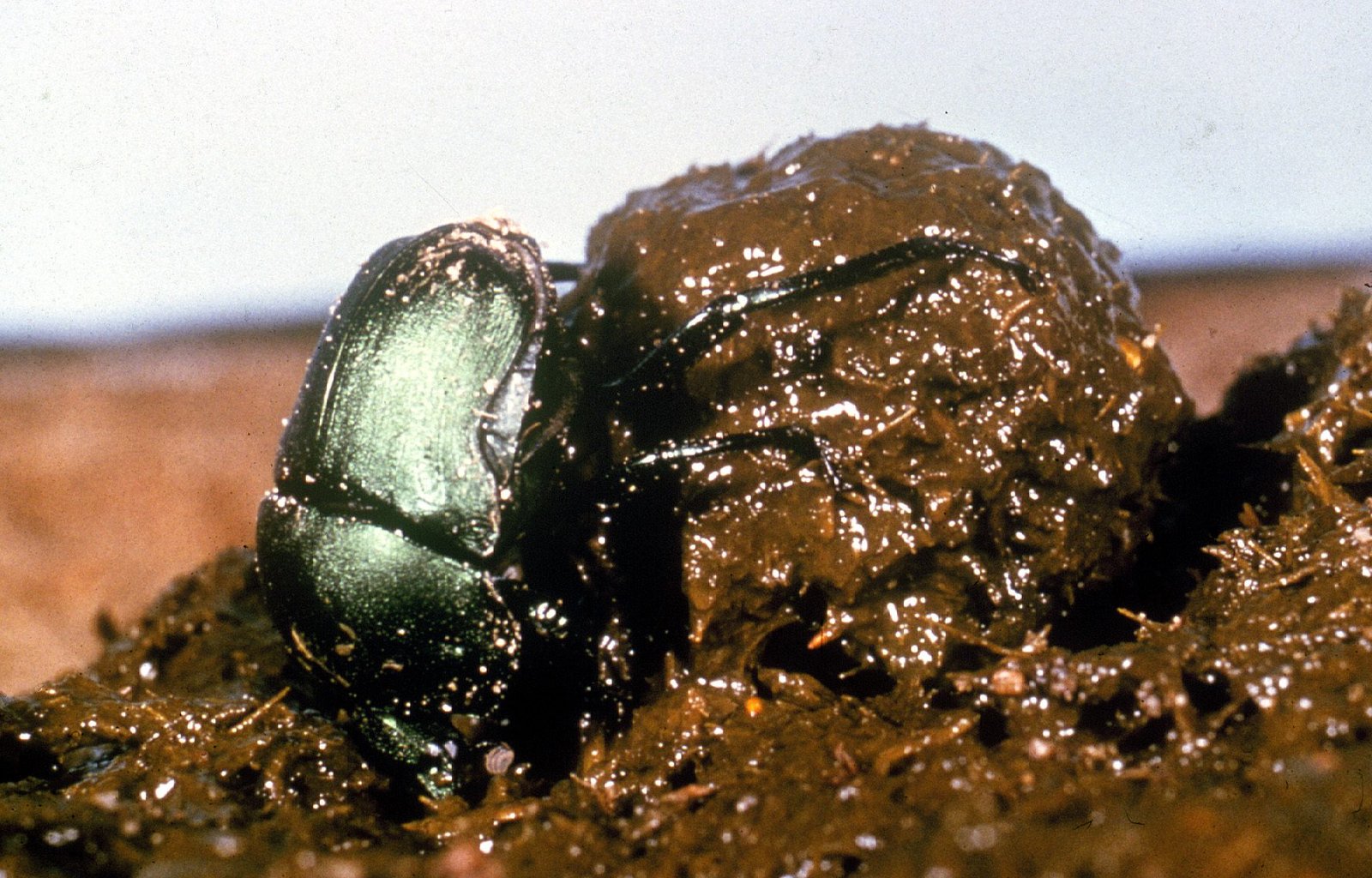
The prize is on the ground. A pile of dung can attract many beetles at once, so hanging around too long haggling over the buffet is a bad strategy. Some species shape a ball and roll it away in a straight line. The beetle moves backward, head down toward the ground and hind legs pushing the load. It hardly seems like the ideal posture for checking out the scenery. Yet that’s precisely why this animal became a surprise for people who study navigation.
First, you have to get away with the food
The ball serves as food and, in certain species, as a resource for reproduction. But before burying it, the beetle has to get it out of the crush of competitors. A winding route could lead the beetle back toward the pile or across the path of another thief. The immediate goal isn’t to travel hundreds of miles: it’s to hold a straight enough line to get the loot away. The short scale doesn’t diminish the feat; it makes the problem it solves easier to see.

In 2013, a team led by Marie Dacke reported in Current Biology that the nocturnal African beetle Scarabaeus satyrus can orient itself using the Milky Way. According to the paper, it was the first demonstration of an insect using the galactic band as an orientation reference. It’s not that the animal tells constellations apart like a tiny astronomer. The later explanation points to a comparison of intensity between regions of the bright band: a visual compass based on the overall pattern of the sky, not on memorizing thousands of stars.
How did they get a beetle to reveal its method? The researchers observed trajectories under different skies and manipulated the visual cues. In earlier experiments, when the sky was overcast and celestial cues disappeared, the beetles lost precision and traced more curved routes. In the Milky Way study, the animals held their course better when they could use that luminous band, even without clear landmarks on the ground. The night became a laboratory, and the ball a kind of test wheel.
The team didn’t just watch balls rolling under a pretty sky. At the Johannesburg planetarium they could change which celestial cues remained visible; in the circular arena, each trajectory left a measurable line on the surface. Comparing the full starry sky with a projection showing only the galactic band, the researchers found that the beetles kept a similar orientation. When only the brightest stars were left, however, performance got worse. That contrast is the decisive part: it doesn’t prove the insect «recognizes» constellations; it shows that the galaxy’s extended pattern of light gives it enough of a reference to head out in a straight line. The original study describes the field and planetarium comparison.
A dance to get back on course
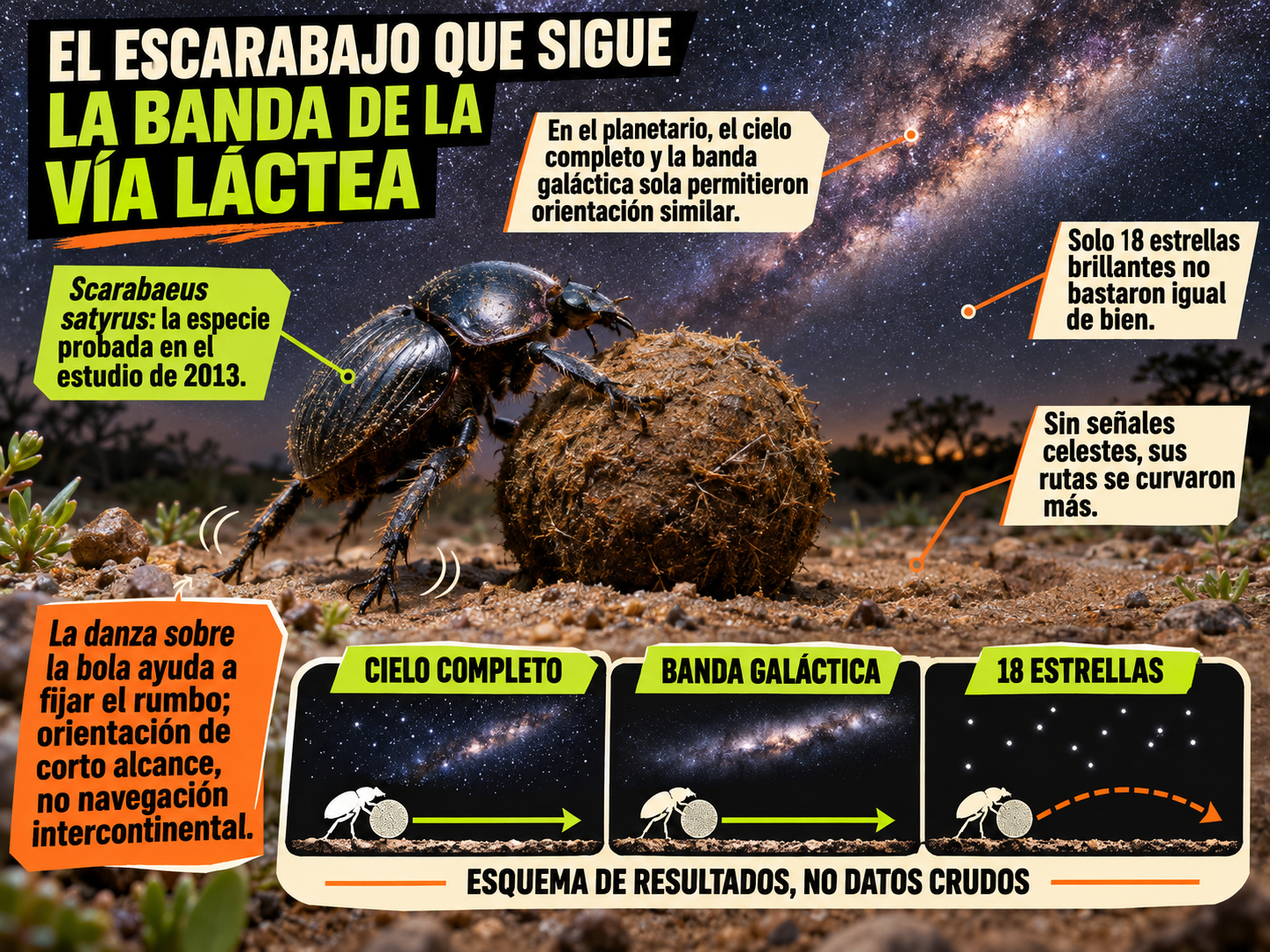
The most cinematic moment comes when the beetle climbs on top of the ball. It isn’t posing for the cover of an entomology magazine: the «orientation dance» lets it take a reading from the sky before it starts rolling. If an obstacle or a collision knocks it off course, it can stop, reorient and carry on. The movement looks comical in fast motion, but it’s a functional solution: recovering a heading when its body ends up facing in an unhelpful direction.
And the galaxy isn’t its only instrument. Other studies show that different species of dung beetles use the Sun, the Moon or patterns of polarized light, depending on the time and conditions. On moonlit nights, some can take advantage of the polarization pattern that forms in the sky, a signal so faint that it goes unnoticed by us. A study on Scarabaeus satyrus found that it kept similar precision under a full and a crescent Moon; when no Moon was visible, its trajectories became more curved. The compass isn’t a single fixed star: it changes with the species and the sky available.
That contrast helps explain why the Milky Way discovery was so striking. Earlier research had shown celestial navigation using the Sun and the Moon, but a band of stars was a much fainter and more diffuse reference. The team proved that the animal could extract direction from the galaxy’s overall luminous structure. In later experiments on the visual mechanism, the researchers modeled how the Milky Way looks through the beetle’s visual system and found that a relatively modest contrast difference between its regions is enough to make orientation possible. There’s no need to credit it with a sharp image of our night sky: the likely mechanism is cruder, and that’s exactly what makes it fascinating.
When artificial light erases the compass
The story has another, less romantic twist: artificial light can ruin the map. A study on light pollution found that ambient glow can hide the sky’s natural cues and change orientation behavior, leading the beetles to rely on bright lights on the ground. A streetlight isn’t necessarily a reliable «new north»; it can become a reference that throws the route off. The night sky isn’t just a backdrop, but an active part of the navigation system.
The research also deserves a word of caution: «uses the Milky Way» doesn’t mean all dung beetles navigate this way everywhere. The result was demonstrated in specific species and experimental conditions, and the ability has been documented in Scarabaeus satyrus. In other species, solar, lunar or polarized-light compasses have been measured. Presenting a single mechanism as a universal rule would erase precisely what’s interesting: animal navigation can combine different cues and adapt to the context.
So no: the beetle doesn’t calculate Earth’s position in the galaxy or find its way home along an interstellar route. It rolls its ball over modest distances and uses the celestial pattern to keep from losing its bearings. But there’s something extraordinary about the proportion: an insect with compound eyes, a load of dung and an urgent task can make use of the structure of the galaxy we see from the ground to buy time against its rivals.
Next clear night, look at the Milky Way and think of a beetle that doesn’t see the sky the way you do. It doesn’t need to know names or draw constellations. All it has to do is compare a band of light, pick a heading and push. Its feat isn’t traveling farther than anyone else: it’s solving, with a tiny compass, the problem of making off with dinner before someone else shows up.
To keep looking at the beetle’s sky
- Current Biology (2013): the original study on orientation using the Milky Way.
- Royal Society: study on Scarabaeus satyrus and polarized moonlight.
- Lund University: later experiments on the visual mechanism.
- Current Biology (2021): how light pollution disorients beetles.