
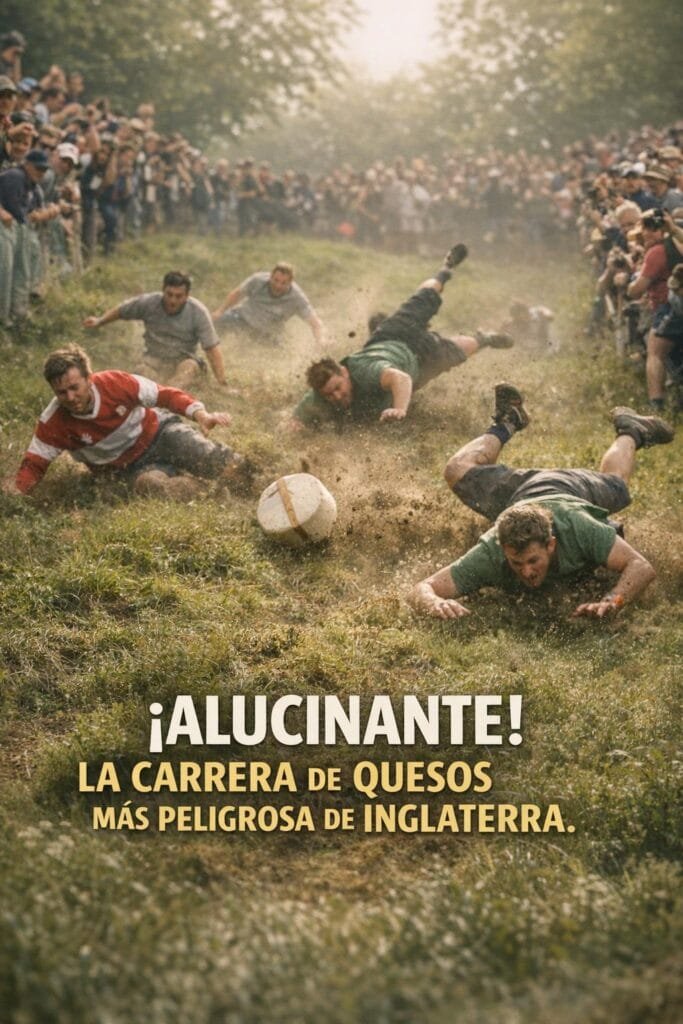
Picture yourself at the top of a hill that defies logic—so steep you could almost touch the sky with your head and the abyss with your feet. Below, a crowd buzzes as if it were about to witness an ancient sacrifice. Someone shouts. A heavy, round object starts rolling downhill, followed by dozens of brave—or perhaps simply reckless—souls. An age-old ritual? A social experiment? No, it is the Cooper’s Hill Cheese-Rolling, surely England’s most dangerously absurd sport.
The madness of chasing a rolling cheese
Words barely capture this mix of chaos and tradition. To understand the madness, you have to see it for yourself. Press play and hold on.
Every spring, common sense seems to take a vacation in the small village of Brockworth, near Gloucester. Dozens, sometimes hundreds, of people from around the world gather at Cooper’s Hill—a place that makes you think twice about walking up, let alone racing down. The goal is brutally simple: catch a four-kilogram wheel of Double Gloucester cheese as it rolls down the hill.
By “catch,” I do not mean an elegant chase. I mean controlled freefall—or not. It is a tangle of bodies tumbling, tripping, bouncing and, yes, often breaking bones. Parts of the hill approach a 45-degree slope, and the heavy, round cheese can reach speeds of up to 68 miles per hour. Competitors do not so much run as plunge downhill, trusting inertia and luck more than athletic technique.
What kind of cheese is worth that sacrifice?
It is no ordinary cheese. It is Double Gloucester, a traditional hard cheese from the region with, apparently, just the right consistency to roll without falling apart as it escapes its pursuers. Imagine making a cheese like that only to turn it into the centerpiece of an annual pileup. The irony: a delicacy that is not savored but instead becomes the catalyst for fractures and sprains.
The cheese is the show’s quiet star. It sets the pace, challenges gravity and rewards the winner with a victory worth far more than its price tag. The champion takes home the cheese—if it has not rolled too far to recover intact—and the bragging rights of surviving one of Britain’s strangest and most painful annual events.
A tradition of broken bones and indomitable spirit
The race’s history is hazy, much like a competitor’s vision after twenty tumbles. The tradition is thought to date back to the Middle Ages, perhaps connected to pagan fertility rites or grazing rights. Whatever its origins, it has endured for centuries, as the BBC’s annual coverage shows, while keeping its brutally simple essence: chase a cheese down a hill and, if you are lucky, avoid the emergency room. It is a far cry from the complicated rules that once disqualified athletes such as Frank Gailey, the swimmer barred from the 1904 St. Louis Olympics.
Despite countless accidents—ambulances and paramedics are as much a part of the event as the cheese—the race still draws thousands of spectators and a select group of “crazy” runners. There is something fascinating about people’s determination to take part in something so clearly dangerous, driven by the thrill, tradition or the promise of an unforgettable story (and a leg in a cast). It recalls other feats like the extreme human-endurance refrigerator marathon.
Why do people throw themselves down the hill?
- Adrenaline: The rush of speed, falling and chaos.
- Glory: Cooper’s Hill champion is an unofficial but coveted title.
- Tradition: Taking part in an event with centuries of history.
- The cheese: A good chunk of Double Gloucester—the real prize.
The race is proof of that strange human urge to seek the edge, defy common sense and laugh at danger—at least until the ground comes up too fast. Every year, the same story plays out: the cheese rolls, people tumble, spectators shout, and the legend of Cooper’s Hill grows.
The spectacle of the fall
Watching the race is an experience in itself. From the safety of the hill’s base, you see the pack dissolve into a series of falls that are equal parts funny and terrifying. There are strategies, if you can call them that: stay upright a few seconds longer than everyone else, or curl into a ball to soften the impact. But the hill does not forgive, and gravity is the only judge.
At the finish, one competitor—or what is left of them—crosses the line, more or less conscious, and is crowned champion. They receive the cheese and a cheer while medical crews tend to those who were less fortunate. It is a mix of heroism, dark comedy and pure, incomprehensible stubbornness.
So the next time someone tells you sport is all elegance and technique, tell them about the Cooper’s Hill Cheese-Rolling. It is a slap in the face to convention, a tribute to human extravagance and a cousin of hybrid sports such as chessboxing, the brutal clash of brains and fists. Sometimes all you need is a good cheese rolling down a hill.
If this peculiar tradition blew your mind, El Mundo es Flipante has plenty more odd stories waiting to be explored.