
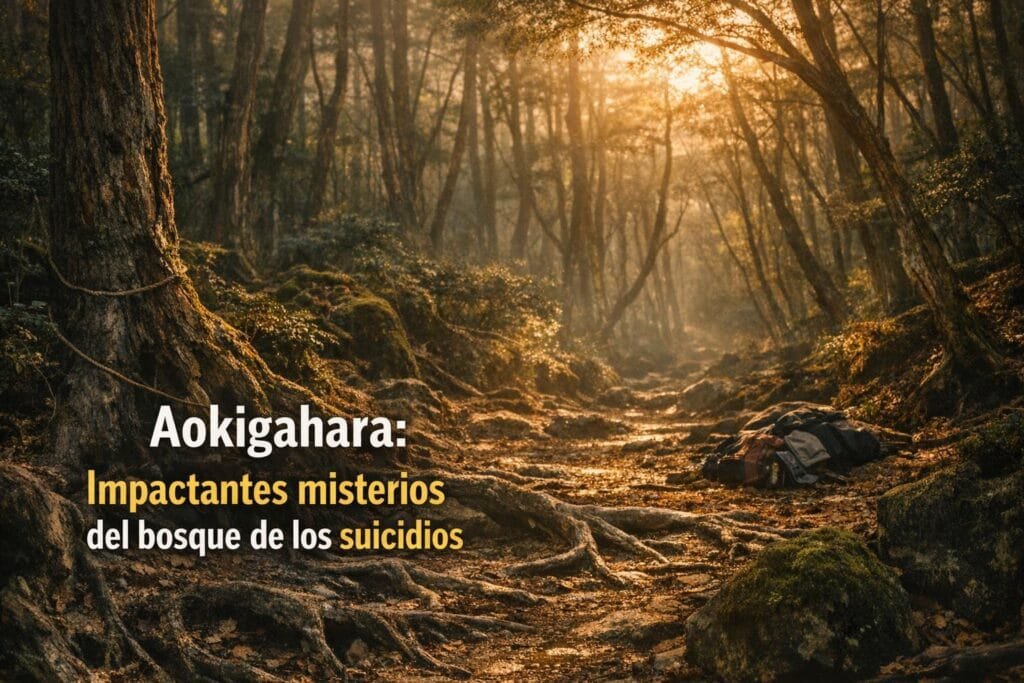
There’s a place where the silence is so deep it almost stuns you—not peaceful silence, but an absence that seems to scream. Now add a disturbing reputation: a place associated with hundreds of quiet farewells. Is there somewhere on Earth whose geology or history draws people into despair or confuses the mind? At the foot of majestic Mount Fuji, in Japan, a forest seems to whisper those very questions: Aokigahara.
Also known as the Sea of Trees (Jukai in Japanese), this dense green expanse is an enigma—not only because of its ominous nickname, “Suicide Forest,” but also because of phenomena that challenge our understanding and feed folklore as thick as the vegetation itself. As we step into its shadows, reality and myth intertwine in unexpected ways.
To set the scene, here’s a video exploring the Sea of Trees and helping explain why its atmosphere feels so overwhelming.
The Sea of Trees that swallows sound—and the soul
Entering Aokigahara can feel like stepping into another world. Gnarled, twisted trees grow over uneven ground made of solidified lava, remnants of Mount Fuji’s major eruption in A.D. 864. The vegetation is so dense that little sunlight gets through, leaving the forest in near-constant twilight, even at noon. Moss and tangled roots cover a soft floor that absorbs sound.
That density creates the first unsettling effect: the silence. The nearby highway, birds, even the wind seem to disappear at the forest’s edge. Inside, the air feels thick and heavy. You can clap your hands and hear the sound fade almost at once. This unnatural quiet isn’t soothing; it can feel oppressive and disorienting. For some people, that lack of outside stimulation may make the mind’s own dangerous thoughts feel louder.
The hard reality: a place touched by despair
We can’t talk about Aokigahara without acknowledging its darkest and most tragic association. For decades, people experiencing suicidal distress have died in the forest. Japanese authorities have stopped publishing exact figures to avoid turning the location into a spectacle. Reports from the 2000s estimated that at least 100 bodies were found there each year. Behind every such report is a person and a story of profound pain.
The reasons people go there are complex. Some are drawn by its privacy and isolation; for others, it has become a sadly familiar place. The reputation can feed itself, creating a harmful cycle of imitation. But there are also ongoing efforts to help: local police and, especially, volunteer patrol teams walk the forest hoping to find someone in time. Signs along the main paths carry messages such as “Your life is a precious gift” and “Think of your loved ones”—calls for hope amid desolation, in line with suicide-prevention efforts by Japan’s Ministry of Health.
Where compasses lose their way—and myths take hold
Beyond the human tragedy, Aokigahara has fascinated people with its geophysical mysteries. The best-known legend claims that once you enter, compasses stop working. Their needles supposedly spin or point at random, making it incredibly easy to get lost. In a dense forest with few landmarks, losing the trail can be dangerous.
What’s true? Science has an explanation. The volcanic lava beneath Aokigahara contains magnetite-rich deposits. These can affect the local magnetic field and reduce the accuracy of traditional magnetic compasses. But it isn’t dramatic enough to make every compass fail everywhere. Modern GPS devices don’t rely on Earth’s magnetism and generally work, although dense tree cover can weaken reception in some spots.
Where science offers an explanation, the human mind—always hungry for mystery—has created much more chilling myths. People say the forest is haunted by yūrei, the restless ghosts of those who died there or were abandoned in the past. These spirits are said to lure the living toward a similar fate. Japanese folklore also includes the story of ubasute, an alleged practice in times of famine in which older people were taken to remote places to die. There’s no evidence that Aokigahara was a major site for this practice, but the idea has attached itself to the forest’s dark reputation, adding another layer to the legend.
Is the forest a magnet for tragedy—or simply a setting?
The big question Aokigahara raises is whether the place has some intrinsically sinister “energy” or “influence,” or whether its unique geography, isolation, and tragic reputation combine to make it a focus for human despair. It’s tempting to reach for supernatural explanations for things that disturb us, like the near-silence or stories of wandering compasses. But perhaps the forest’s real darkness lies in how it has become a mirror of the human mind—a place where people already feeling lost, literally or figuratively, have sought an end.
Aokigahara’s wild, almost untamed beauty—its vivid moss and ancient trees—stands in brutal contrast to its dark legend. It’s a walking paradox: a natural sanctuary of peace overshadowed by human anguish. Authorities work to change its image, but centuries of folklore and decades of grief are not easily erased. The Sea of Trees will keep its secrets in its perpetual quiet, inviting us to reflect on the fragility of the human mind and the power places have to shape our perceptions.
Some places weave together science and myth, beauty and tragedy. If Aokigahara’s paradox fascinates you, keep exploring the most enigmatic corners of our planet at El Mundo es Flipante.