
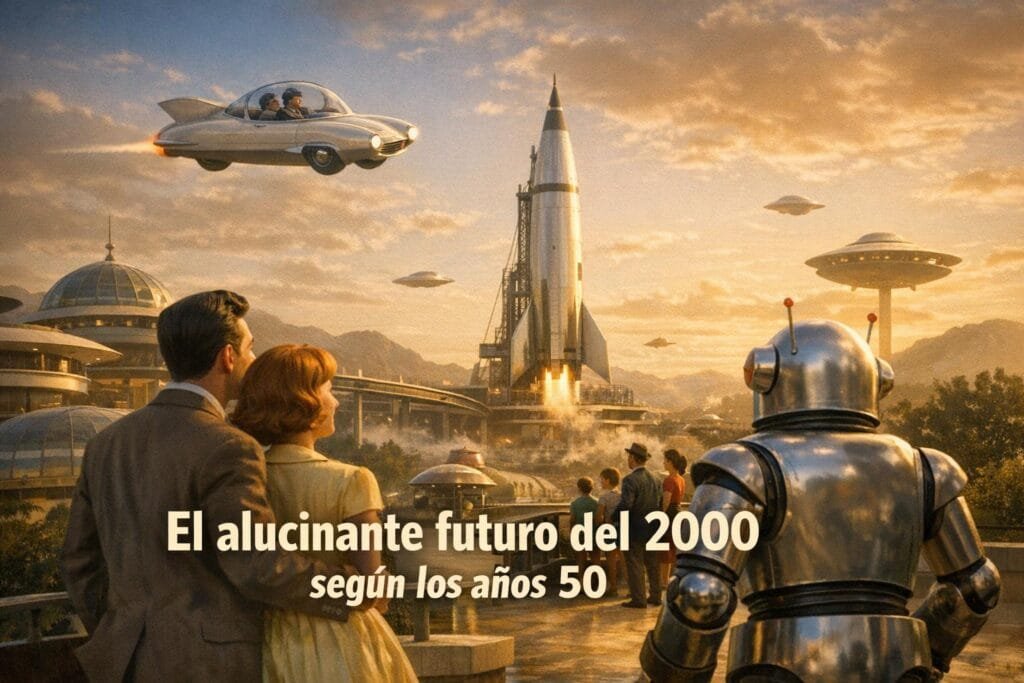
It is 1957. The air smells like fresh coffee, and the rustle of a newspaper mixes with the murmur of the radio. But what has you glued to your chair is not breakfast—it is the cover of Life Magazine. The future! A future so dazzling it makes you forget the present. The cover shows an ethereal city, with flying cars streaking across the sky like glowing insects and pedestrians gliding along moving sidewalks, free from traffic and in no hurry. “This is what the year 2000 will look like,” you think, mouth slightly open. “A utopia just around the corner.”
What a vision. The 1950s were obsessed with what the new millennium would bring, and they did not think small. Their predictions were grand, bold and sometimes downright wild—but always brimming with an optimism that can seem almost naïve today. What happened to those cities of the year 2000? Did the predictions fail, or did they get something right after all?
To soak up that era’s boundless optimism, there is nothing like seeing some of its visions in motion. This montage collects period images that show the future our grandparents dreamed about:
The city of tomorrow: flying cars and moving sidewalks
Look at the illustrations and writing of the time, and one thing jumps out: an astonishing faith in technology as a universal solution. Streets as we knew them were relics of the past. Imagine this: in the year 2000, cities would have several levels. Heavy transport would move through tunnels below. In the middle, a web of elevated highways would carry flying cars—aerocars—gliding without touching the ground. And at the very top, giant moving sidewalks, slow or fast, would carry pedestrians from place to place without any effort. Goodbye, traffic jams and stoplights. What a marvel.
That was not all. Architecture was just as ambitious. People talked about mile-high skyscrapers built with materials yet to be invented and designed to house thousands. Whole cities would be planned for efficiency, comfort and, of course, a futuristic look: glass, steel and aerodynamic shapes. Some imagined cities beneath domes that could control the climate and protect residents from pollution or extreme weather. A utopian vision? Absolutely. One that made people dream? Without a doubt.
Automated homes and atomic energy on a grand scale
Homes in these dream cities would be just as advanced. Automation was the key. Houses in the year 2000 would be technological paradises, with robot servants to clean, cook and handle the most tedious chores. Kitchens would have a button for everything: meals prepared and served instantly, ultrasonic dishwashers and appliances that switched themselves on. Free time—ah, free time! That was the promise: technology would release people from the burden of work so they could pursue leisure, culture and self-fulfillment.
And what better way to power all this technology than nuclear energy? In the 1950s, atomic power was seen as the future’s clean, limitless energy source. People imagined small nuclear reactors in every neighborhood—or even every home—providing cheap, abundant power for all. It was a dream that would prove far more complicated than those visionaries expected.
What did the 1950s get right—and wrong?
It is easy to laugh at the aerocars that never filled our garages or the giant domes that never protected our cities. Reality in the year 2000 was much more ordinary and, at the same time, far more surprising than anyone imagined. But did those forecasters get everything wrong? Not at all.
We may not have a flying car in every garage, but some transportation evolved in the direction they imagined: think of high-speed trains and extraordinarily complex subway systems. Home automation became real, even without robot butlers: we have robot vacuums, voice assistants that control lights and thermostats, and the Internet of Things. What about video calls? In the 1950s, people called the idea a video phone, and it was one of the great promises of the future. Today, it is so ordinary we barely think about it.
But the most fascinating things are the ones they did not see coming. They did not imagine the massive miniaturization of technology or the force of the digital revolution. No one predicted the internet, which would give rise to phenomena such as the Dancing Baby, the first viral meme, or the smartphone—or the ability to carry an entire library and a global communications hub in your pocket. Their future was made of huge machines, colossal structures and visible technology. Ours is about invisibility: networks that connect us instantly and devices that make life easier without massive physical infrastructure.
The year 2000 imagined in the 1950s teaches us something important: the future is a blank canvas we keep painting with our hopes and fears. No matter how hard we try to predict it, reality always has surprises up its sleeve. And is that not the most amazing thing of all?
Keep exploring
If you enjoyed this trip to a future that never arrived, here are more astonishing stories waiting for you at El Mundo es Flipante:
- The theremin: the fascinating story of the invisible instrument
- The Silbo Gomero: La Gomera’s remarkable whistled language
- If you want another mystery that will linger in your mind, explore the mystery of Costa Rica’s stone spheres.
- Or, if traditions from another reality are more your thing, do not miss Madagascar’s astonishing Famadihana ritual.