
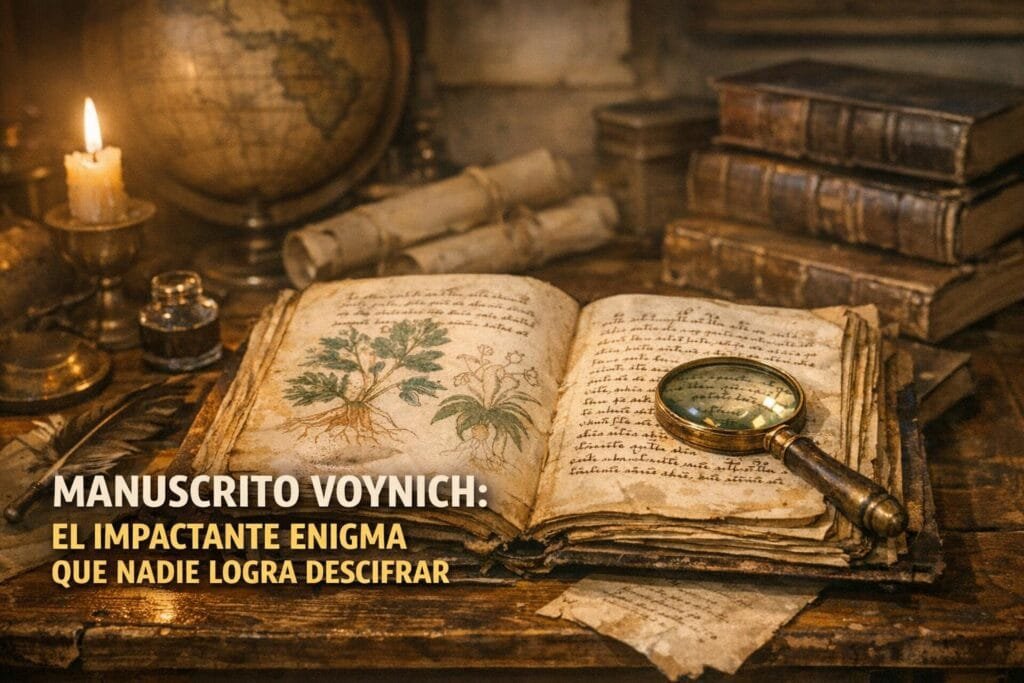
There is a book that has openly mocked human intelligence for more than a century. This is not the opening of a cheap mystery novel; it is the real description of the Voynich Manuscript. Its centuries-old vellum pages are filled with plants found in no known herbarium, strange constellations that challenge our astronomy, and tiny women bathing in pools connected by inexplicable pipes. Most unsettling of all, every word is written in an alphabet you have never seen, in a language no one on Earth has been able to read.
The book has defeated some of the world’s brightest cryptographers, codebreaking teams from both world wars and powerful computers running sophisticated algorithms. Without exaggeration, the Voynich may be the ultimate trophy of inscrutability. For six centuries, it has watched empires rise and fall and science reinvent the world again and again—yet it remains as silent as the day it was written.
This video offers a visual introduction to the impossible object and the scale of its mystery:
The return of a bibliographic ghost
The modern story of this challenge begins, oddly enough, with an antiquarian. In 1912, a Polish-Lithuanian rare-book dealer named Wilfrid Voynich—the manuscript’s namesake—found the volume at Villa Mondragone, a Jesuit institution near Frascati, Italy. Voynich knew he had something unusual, something beyond an ordinary historical artifact. He bought it and spent the rest of his life trying, unsuccessfully, to unravel its mystery.
Since then, the book’s history has passed through the hands of emperors, alchemists, scientists and collectors. In the seventeenth century, Rudolf II, Holy Roman Emperor, a devoted collector of the occult and arcane, reportedly paid a fortune for it, believing it was the work of Roger Bacon, a mysterious thirteenth-century Franciscan friar. That attribution was never confirmed and is almost certainly wrong. Still, it gives us a sense of the aura of mystery that has always surrounded the book.
A book from another world—or another mind
Opening the Voynich Manuscript is like stepping into a parallel dimension. Its 240 pages—some may be missing—are divided into sections that look thematic but never become intelligible:
- Botanical: Dozens of plants are drawn in astonishing detail, yet none corresponds to a known species on Earth. Are they fantasies, extinct plants or simply poor drawings by someone who had never seen them?
- Astronomical: Celestial diagrams, suns and moons, plus planetary and zodiacal configurations that do not fit the astronomy of the period. An alternative astronomy?
- Biological: Perhaps the strangest section. Small nude female figures, often with prominent abdomens, interact with networks of pipes and pools of green liquid. A treatise on reproduction or hygiene—or something more esoteric?
- Cosmological: Pages that resemble complex cosmological diagrams, with strange shapes and patterns in motion, as if trying to explain the structure of the universe.
- Pharmaceutical: Roots and leaves suggest recipes or ingredients for medicines and potions, yet the components are unknown.
- Recipes: Long passages of uninterrupted text that supposedly contain the book’s substance: its instructions or revelations.
Every illustration is a little visual puzzle. The artists were skilled, but their imagination—or their source—seems distinctly alien to our reality.
Cryptographers, pride and defeat
From the moment Wilfrid Voynich showed it to scholars, the manuscript became an inverted Rosetta Stone. Instead of deciphering an unknown text using a known language, the text is unknown—and so is the language. Top military cryptographers from World War I and World War II, including William F. Friedman, who helped break Japan’s PURPLE cipher, crashed against its pages.
Picture the bruised egos: people who had broken codes that shaped world conflicts, unable to make sense of one medieval book. The irony is palpable. They have tried everything, from a simple substitution cipher to a complex polyalphabetic code, an artificial language, a mixture of languages, or even a system in which each “word” is a logographic symbol.
Linguistic analyses have revealed quirks. The text seems to follow linguistic rules: certain letters or symbols recur at consistent rates, and its words and syllables have structure. Yet it has no punctuation, and word distribution resembles no known language—not even what researchers would expect from a cipher. Some have suggested shorthand, a stenographic language or gibberish invented on the spot.
The greatest hoax in history?
Given the failure to decipher it, one recurring theory—and perhaps the most humiliating for the intellectual establishment—is that the Voynich Manuscript is an elaborate hoax. Maybe a medieval prankster with too much time and a talent for calligraphy and drawing made the whole thing up.
Arguments for a hoax include:
- No one has found a coherent message.
- The “language” is consistent, but could be one person imitating writing.
- The “fake” plants might be intentional distractions.
Still, the text’s complexity, length—more than 170,000 characters—and apparent internal consistency, even if no one can read it, make many people doubt that it is a simple fake. Who would do all that just to frustrate future generations? It would be an expensive, remarkably well-orchestrated prank.
Others think it could be a forgotten language or unusual dialect, a constructed language for a sect or esoteric group, or even the work of a brilliant but troubled mind. Every theory, however unlikely, has had defenders and critics; none has persuaded everyone.
The legacy of not understanding
Today, the Voynich Manuscript resides at Yale University’s Beinecke Rare Book & Manuscript Library, where anyone can explore digitized pages and marvel at the mystery. Its existence is a constant reminder of the limits of our knowledge and of humanity’s ability to create puzzles that survive through time.
At heart, this is a book that invites humility. With all our technology, analytical power and ambition to decode every secret in the universe, a medieval codex stares back with silent pages and seems to say, “You do not understand—and perhaps you never will.” Is the key hidden in complexity or simplicity? Or is its message so different from the way we think that we cannot even begin to grasp it?
The Voynich Manuscript is more than an enigma; it is a paradox. By revealing nothing, it tells us everything about our boundless curiosity and our frustration when something resists understanding. As long as it remains silent, it will keep whispering stories only it knows, waiting for someone to discover its voice. If you want more historical mysteries, explore the Flannan Isles lighthouse and the mystery of its missing keepers.