
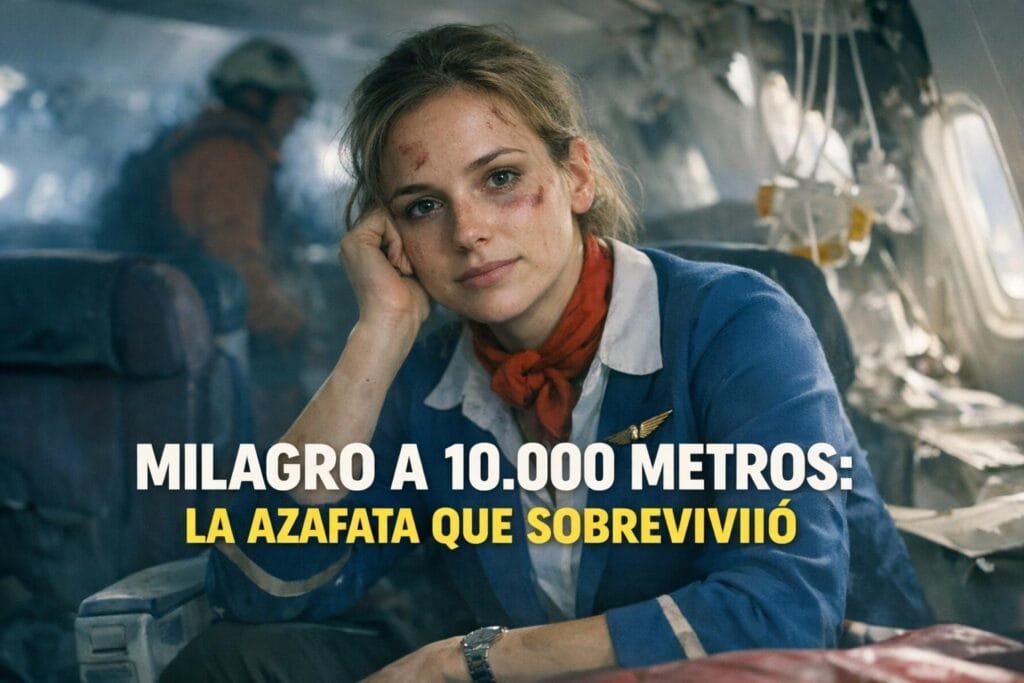
It is a nightmare scene: you are aboard a plane at 33,000 feet when an explosion tears through the fuselage. Air turns to ice; metal twists. Panic is your last thought before you black out. Then you wake up—not in the sky, but in a hospital, with more broken bones than you can count, yet alive. You are told you fell from the stratosphere without a parachute and lived to tell the tale. It sounds like the worst nightmare and the most unlikely miracle at once. This is the story of Vesna Vulović.
Forget the wildest action movies. Reality can outdo fiction so brutally that it leaves you breathless. Vesna was no superhero or expert parachutist. She was a 22-year-old Yugoslav flight attendant who, on a frigid January day, found herself making aviation history in the most involuntary and deadly descent imaginable. The astonishing part is not that she fell, but that she survived.
Her story is so incredible it feels cinematic. This short video recaps her experience and sets the scene for an event that seems to defy logic.
January 26, 1972: the day the sky fell
It began as a routine flight. JAT Flight 367, operated by Yugoslav Airlines, departed Copenhagen for Belgrade, with a scheduled stop in Zagreb. There were 28 people aboard: 23 passengers and five crew members. Among them was Vesna Vulović, assigned to that flight because of a crew-rotation mix-up; she was not supposed to be there.
As the McDonnell Douglas DC-9 flew over Srbská Kamenice in what was then Czechoslovakia (now the Czech Republic), at an altitude of 33,333 feet, a bomb exploded. Yugoslav authorities blamed a Croatian nationalist group seeking independence, though the full story of responsibility has remained surrounded by mystery and conspiracy theories. The confirmed fact is that the explosive device detonated in the forward baggage compartment.
Imagine the force. The aircraft broke apart in midair. Sections of fuselage, engines, wings, luggage and human bodies fell like shrapnel onto a snowy forest. To the rest of the world, the tragedy seemed complete: 27 people lost, another devastating air disaster whose fatal outcome appeared inevitable.
The impact site: a miracle among the wreckage
But not everything was lost. Hours after the crash, among smoking wreckage and snowbound silence, a local man named Bruno Honke, who had been a medic during World War II, heard a moan. He followed the sound to what remained of the plane’s middle section. By a macabre twist of fate, that piece of fuselage had landed on a steep, wooded slope. There, pinned inside the wreckage with her head and torso protruding through a hole, he found Vesna Vulović.
The injuries were unimaginable. Vesna was alive, barely. Her skull was fractured, both legs were broken, three vertebrae were crushed—one, L1, completely shattered—her pelvis was fractured, several ribs were broken, and she was temporarily paralyzed from the waist down. The impact is estimated to have subjected her to a force of 200 G.
How on earth did she survive? Experts have several theories. Vesna is believed to have been working toward the back of the plane when the explosion occurred. She was pulled from her seat, but instead of being thrown into open air, she became trapped by a food cart between the fuselage and a lavatory, forming an improvised cocoon. That makeshift shelter, along with the wooded, snow-covered slope that softened part of the impact, may have been crucial. The high altitude may also have contributed: oxygen deprivation likely caused her to lose consciousness quickly, relaxing her muscles and reducing injuries from tension.
A life after the abyss
Vesna spent days in a coma. When she woke, she remembered neither the crash nor the hour before it. Her first request was a glass of water, but she could move only her hands. The paralysis lasted for months. She underwent multiple operations and therapies and had to learn to walk again. Doctors told her she would never return to aviation, but her resilience was as extraordinary as her fall. She not only walked again; within a year, she insisted on returning to work for JAT.
To everyone’s surprise, the airline rehired her, though not as a flight attendant; she worked in sales. She became a national hero in Yugoslavia, a symbol of perseverance. Her name entered the Guinness World Records as the person who survived the highest fall without a parachute. She received the award from Paul McCartney himself.
Life afterward was not easy. Trauma stayed with her, along with memory problems and nightmares. Her marriage ended, and she sometimes spoke about surviving with a particular melancholy, feeling guilty that her crewmates had not lived. In later years, she openly criticized Slobodan Milošević’s regime, showing a fighting spirit that went beyond physical survival. Her incredible story made her an enduring icon.
The legacy of an impossible miracle
Vesna Vulović’s story is more than a record or a macabre anecdote. It speaks to the limits of human resilience, the thin line between life and death and the ways fate can defy logic. It reminds us that even in the most desperate circumstances, a thread of hope can cling to life.
Was it luck? A miracle? A chain of improbable factors? Probably all of them. What we know is that the flight attendant who fell from 33,000 feet and survived left us one of modern history’s most unbelievable stories.
More stories that will leave you speechless
Reality outdoes fiction every day, and our archive has proof. If Vesna’s story shook you, explore other cases that defy logic and celebrate the extraordinary:
- Erasmus Thorne: genius, mystery and his astonishing tomato-only diet: the story of a scientific titan who reportedly survived on soup alone.
- The man who tattooed an entire famous novel on his body: explore the limits of obsession and artistic devotion through ink and skin.
- Amazing animals with official jobs: the mayor cat and other heroes: meet real animals with official roles, from feline politicians to war heroes.