
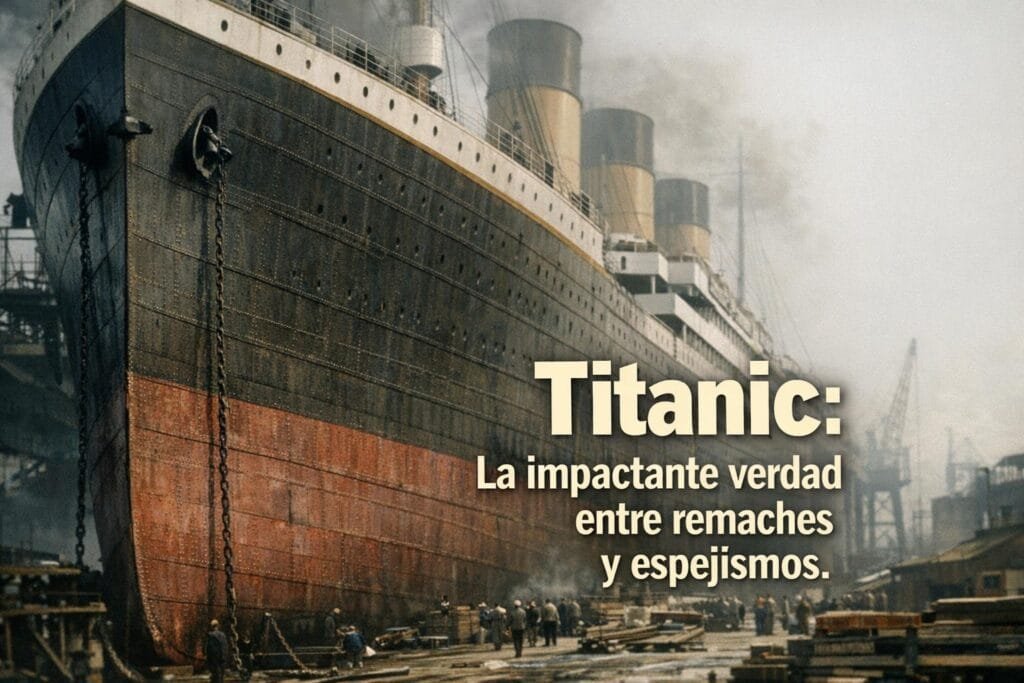
The night was strangely clear, a blanket of cold, distant stars over the Atlantic. Aboard the RMS Titanic, optimism was palpable—a bubble of luxury and security gliding through the vastness. Nothing could possibly disrupt the maiden voyage. That was the belief, held with almost religious faith in human progress and British engineering. The unsinkable ship? Of course. Until a sudden chill ran along the keel: a dull scrape few aboard recognized as a death sentence.
It sounds like a horror story, does it not? A steel giant, the pinnacle of naval technology, brought down by a block of ice. But the real nightmare was not only the visible tragedy. It was hidden in small, almost invisible weaknesses that modern science would examine decades later. The Titanic’s story is more than a romantic movie with a tragic ending. It is a chilling reminder that arrogance, bad luck and physics itself can conspire to sink what people believed invincible—a fate not unlike another engineering marvel that ended in disaster.
The forgotten-rivet trap: when cutting costs gets expensive
The Titanic, at 882 feet long, was a marvel. But even marvels have weak points. Some of its most critical vulnerabilities were in something as ordinary as… rivets. Yes, those small metal fasteners that joined the hull’s steel plates. Who would have thought something so basic could become a fatal weakness?
At the Harland & Wolff shipyard in Belfast, demand was enormous. The Titanic and its sister ships, the Olympic and the Britannic, required millions of rivets. To speed up production and, let’s be honest, reduce costs, builders used wrought-iron rivets in the bow and stern, the hardest areas to reach. In the more accessible center section, they used higher-quality steel rivets. The problem? The iron rivets were significantly more brittle; their high slag content made them vulnerable at low temperatures.
When the iceberg scraped the Titanic’s hull, it did not tear one huge, clean gash as you might imagine. The impact caused some iron rivets to break or “pop” out of their holes, like bottle corks under immense pressure. Rather than one enormous opening, it created a series of small gaps and separations between plates along about 300 feet of the ship’s side. That was enough to let freezing water flood vital compartments. Imagine: the difference between life and death depending on the quality of a handful of small metal cylinders.
The ghost on the horizon: when optics play tricks
But the surprises do not end there. A silent culprit may have helped seal the Titanic’s fate long before anyone saw the iceberg: a thermal mirage. A mirage in the North Atlantic? Yes—and it is not science fiction.
Atmospheric conditions that night were unusual. There was a temperature inversion: a layer of warm air above much colder air. That is a recipe for light refraction. Researchers have suggested the inversion created a “superior mirage” over the Atlantic, a phenomenon that can distort or even hide objects near the horizon.
What might that have meant for the Titanic? The iceberg, which should have been visible from a considerable distance on such a clear night, may have appeared distorted or lower than it really was—or may even have been temporarily hidden by refraction. Lookouts Frederick Fleet and Reginald Lee had no binoculars that night—another fateful decision—and may have had an extremely difficult time spotting danger soon enough. The horizon appeared blurred, like an “optical fog” stealing visibility just when it mattered most: nature’s cruel trick compounded by human error.
The same inversion may also have bent the Titanic’s distress signals, making it harder for nearby ships such as the Californian, only a few miles away, to see flares or clearly receive radio messages. The atmosphere may have woven a curtain of invisibility and silence.
Beyond the disaster: lessons written in steel
The Titanic’s sinking shocked the world and jolted the complacency of the Edwardian era. But the unprecedented disaster led to some of the most important maritime safety rules in history. The world learned—on a massive scale:
- The International Convention for the Safety of Life at Sea (SOLAS): Held in 1914, this convention established minimum standards for ship construction, equipment and operation, with a focus on safety. It remains the most important treaty governing the safety of merchant ships.
- Lifeboats for everyone: Before the Titanic, the number of lifeboats was based on a ship’s tonnage, not its passenger count. The Titanic carried enough for only a little more than half the people aboard. SOLAS changed the rules: ships must now carry lifeboats for everyone on board.
- 24/7 radio watch: The Californian switched off its radio overnight. After the Titanic, ships were required to maintain a radio watch with operators around the clock.
- The International Ice Patrol: Established in 1914 and operated by the U.S. Coast Guard, the International Ice Patrol is still active, monitoring icebergs along North Atlantic shipping routes.
So the next time you hear the Titanic’s story, remember that it is not only about lavish luxury and human tragedy. It is also a fascinating lesson in materials, atmospheric physics and how small mistakes, combined with nature’s invisible forces, can have devastating consequences. It is a complicated story—and the world is astonishing.