

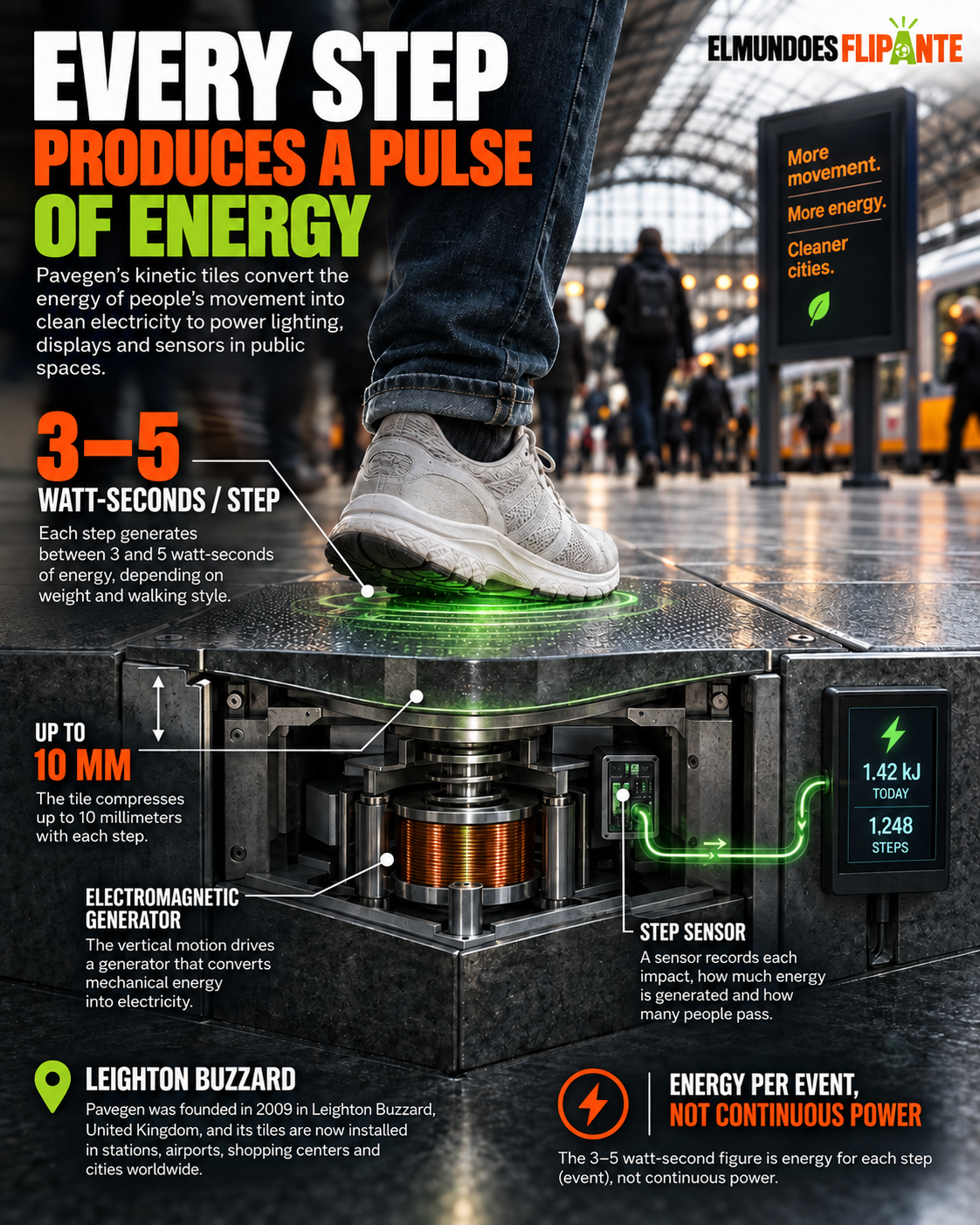
A Pavegen tile drops by about ten millimeters when someone steps on it. That movement drives an electromagnetic generator and a sensor records the step. The floor stops being passive and becomes an interface that measures traffic, returns a small amount of energy and responds to the people using it.
The honest figure
Pavegen puts production at about 3–5 watt-seconds per step, or 3–5 joules per event. One step cannot power a building; thousands concentrated in one place can support sensors, small lights or an interactive screen.
From foot to screen
The Leighton Buzzard station showed the complete route: deformation moves the generator, creates a pulse and the installation communicates it visually. Sensors record counts, dwell time and movement patterns.
This video shows the tile in operation and explains the combination of energy and interaction:
Where it works
The technology makes sense in stations, stadiums and spaces with intense, predictable traffic. On an empty street it would produce little. It does not replace the electrical grid: it adds microgeneration, interaction and movement analytics.
Six ideas to remember
- The tile descends about ten millimeters.
- It produces 3–5 joules per step.
- The generator is electromagnetic.
- Sensors analyze traffic.
- Leighton Buzzard showed the complete system.
- Its best setting is a high-traffic space.
Sources consulted
These are the sources and links consulted for this article: