
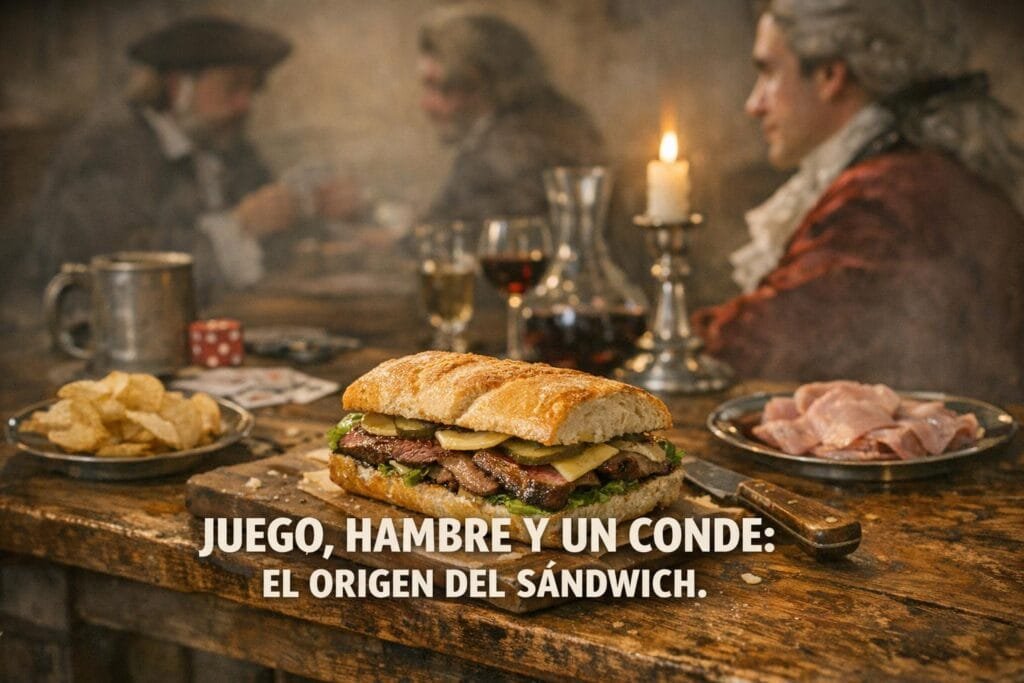
A card game that beat hunger and gave the world the sandwich
Candlelight flickers over a mahogany table already marked by countless nights of excess. The air is thick with tobacco smoke, brandy and the quiet tension of the men around the green baize. Cards slide, coins clink and the hours… well, time stopped meaning much a long time ago. Cinderella left days ago; the sun has risen and set several times, and you have been in that chair at the card table for more than 24 hours.
This was the world—or at least a significant part of it—for a singular figure in eighteenth-century England: John Montagu, the 4th Earl of Sandwich. He was not an inspired chef or a food visionary. He was a compulsive gambler, with wealth and a title, and an overwhelming passion for play that often eclipsed his considerable political and military duties.
This short video places the character and his era in the scene that supposedly changed everything.
In the middle of that merciless card marathon, a need arose. A basic human one, but with a very particular twist: hunger. His stomach was growling, but how could he leave the game? Risk the streak, the control, the moment? And, above all, how could he eat something that required cutlery and a plate—or risk getting meat grease on precious, already battered cards?
The idea born of convenience—and addiction
At that moment of tension and pure practicality, inspiration struck. John Montagu called a servant and, focused on the game while his body demanded food, made a request that now seems as obvious as it was brilliant: “Bring me some meat, but put it between two slices of bread.”
That was it. No more cutlery, no more plates. His hands stayed clean so he could deal cards, count chips or rub his chin while thinking through a move. He could eat without leaving the game, dirtying the cards or even standing up—a perfect solution to a very specific problem: a man so absorbed in his vice that he could not spare the time for a “proper” meal.
The Earl, the Admiral and the irony of posterity
Let us pause for a moment over John Montagu. Born in 1718, he was no nobody. He was an influential politician, an admiral in the Royal Navy, a member of the Privy Council and eventually First Lord of the Admiralty. His life involved naval expeditions, British colonial politics and decisions that affected the course of an empire.
Yet for most of humanity, his name calls up neither the Royal Navy nor the Admiralty nor his political achievements—which were not always well received and often stirred controversy. No. His most universal and lasting legacy is, paradoxically, the humble but immensely versatile bite of meat between two pieces of bread.
It is one of history’s great ironies: a powerful, high-status man remembered not for grand ambitions but for an invention born from an everyday need—not to get his fingers dirty while gambling for his money and fortune.
From the gaming table to the global menu
As practical ideas often do, the sandwich spread like wildfire. Montagu’s friends, other aristocrats with their own obsessions and marathon games, soon began asking for the same thing: “Bring me something like Sandwich’s.” Without a marketing plan, the earl’s name became inseparable from his accidental creation.
What began as a fix for a gambler who refused to leave his game became a phenomenon: first among aristocrats, then in gentlemen’s clubs and eventually at household tables everywhere. The idea’s versatility was undeniable: meat, cheese, vegetables—anything between two slices of bread. Portable, neat and easy to eat.
Today the sandwich is a global food institution, from a simple ham-and-cheese to elaborate creations. We eat it for breakfast, lunch, dinner or any time between meals. It is the king of picnics, a quick office lunch and the perfect travel companion.
All thanks to an earl who cared, quite literally, more about his card game than almost anything else.
Final reflection
Next time you hold a sandwich, think about it: you are holding more than bread and whatever is inside. You are holding a small history lesson—a reminder that great inventions do not always come from altruistic genius or advanced science. Often they arise from practical needs and sometimes from the most questionable human habits.
Maybe laziness, addiction or simply not wanting to stop what we are doing are hidden engines of creativity. Who knows how many other brilliant inventions are being born right now in some dark corner, sparked by an obsession or an “I don’t feel like putting this down”? Keep exploring the curiosities that make us see the world in a completely mind-blowing way.