
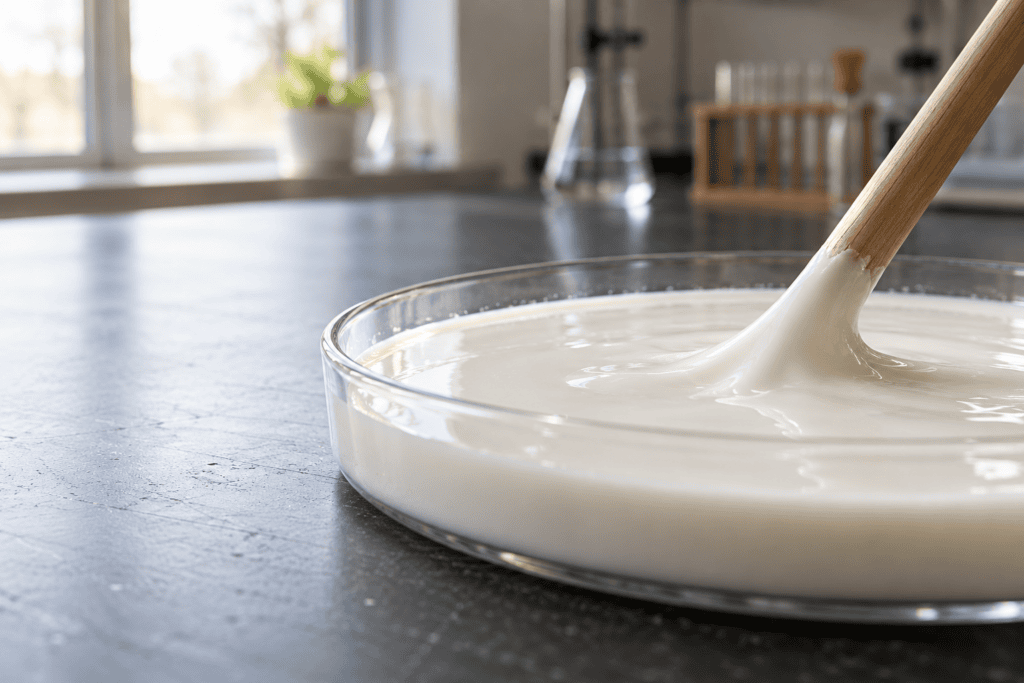
Push a finger slowly into a mixture of water and cornstarch, and the surface gives way. Hit it quickly and it can feel as if there is a rigid plate beneath it. Oobleck has not decided to become stone or performed laboratory magic: it responds differently depending on how quickly you deform it.
The demonstration works because it challenges a comfortable assumption. We expect a liquid to always behave like a liquid and a solid like a solid. Oobleck sits in the in-between zone, right where everyday categories start to fall short.
The slow-hand test
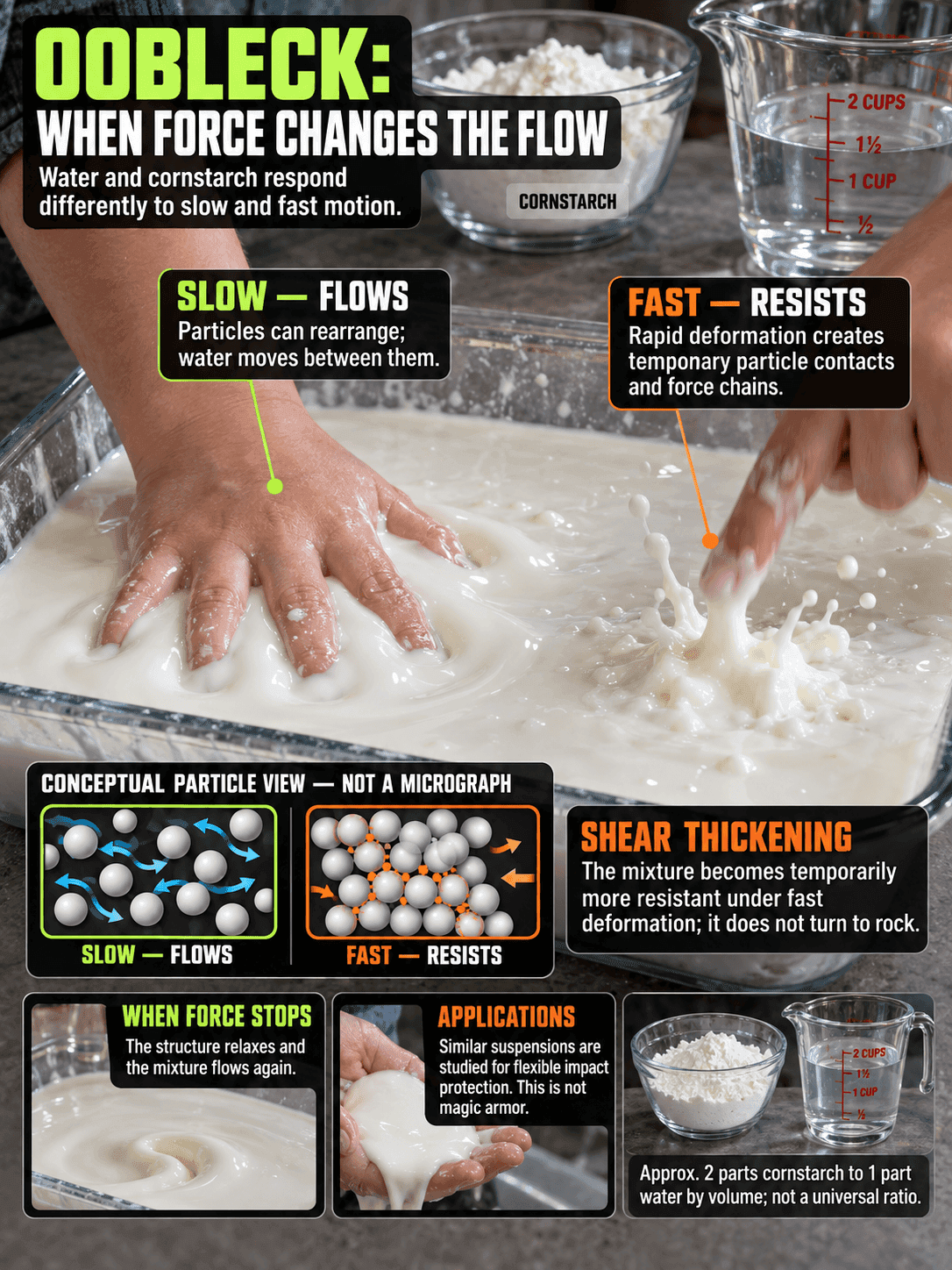
The basic mixture combines water and cornstarch. When pressure is applied slowly, particles can rearrange and water can move between them. A finger sinks, the surface parts, and the mixture behaves like a flowing suspension.
There is no universal ratio that makes every bowl behave identically. Add too much water and it becomes more liquid; add a lot of cornstarch and it can be difficult to move even slowly. To observe the change, add water a little at a time, stir, then test first with slow pressure and next with a quick tap. That lets you compare one variable at a time instead of attributing every result to some mysterious power in the material.
When movement is fast, the system changes. Particles crowd together, water cannot redistribute as easily, and temporary resistance appears. The mixture responds to the motion much like a solid surface.
In Cornell University’s demonstration of shear thickening, researchers compare a mixture moving gently with one subjected to a sudden force. The difference is clearest when treated as an experiment: the same suspension, but a different rate of deformation. That explains why the effect does not mean the liquid permanently turns into a solid.
It does not change its identity
The important term is non-Newtonian. In a Newtonian fluid such as water, viscosity stays approximately constant under ordinary conditions. In a non-Newtonian fluid, resistance can change when force or the rate of deformation changes.
Oobleck is a shear-thickening fluid. Shear occurs when layers of material move relative to one another. With gentle movement, particles have room to shift. Under a sudden force, they crowd into temporary structures that transmit force and increase resistance. It is a mechanical response: no chemical reaction creates a new substance, and no phase change like water freezing takes place.
“Temporary” is essential. Once you stop pushing, the system can flow again; it does not remain a solid object. Nor do all mixtures respond alike: particle properties, concentration, and container shape affect what you feel. That is why two oobleck videos can look contradictory even when both show cornstarch-and-water suspensions.
The Science Museum Group explains the oobleck experiment as a way to observe a physical property with simple ingredients. Simple does not mean trivial: a kitchen can become a laboratory if the question is well framed.
A crowd stuck at a doorway
A useful analogy is a crowd entering a stadium. If people walk calmly, everyone finds a gap and the flow moves forward. If everyone pushes at once toward a narrow doorway, a jam forms. Oobleck particles are not people, but the image helps explain the transition from flowing movement to a temporary jam.
The analogy has limits. Shear thickening is not simply “lots of particles colliding.” Concentration, particle size and shape, available water, and deformation rate all matter. Changing the ratio can completely alter the behavior.
Why viral videos exaggerate
Online, people run across pools of oobleck or strike it in ways that make a household mixture look like concrete. The phenomenon is real, but a staged demonstration can conceal important conditions: depth, concentration, speed, support underneath, and how long the force lasts.
A person may move across a surface by applying fast forces and spreading their weight, but that does not make the material a stable floor. When movement changes, resistance disappears. The same foot that finds support may sink a moment later.
The difference between a demonstration and a safe application matters. Oobleck is an educational experiment—not a recipe for walking across a pool or a material to handle without supervision.
At home, a small version is enough: a container, a tray underneath, and a mixture that can be cleaned before it dries. Do not pour it down a drain; cornstarch can accumulate in pipes. Let it dry and dispose of it in the trash instead. Viral videos often hide how much material was used and how the bottom was prepared. Without those details, the image is impressive but not a safe recipe.
From a bowl to protective materials
Shear-thickening physics is interesting because it offers an adaptive response. A material might stay flexible during ordinary movement and stiffen during an impact. That idea appears in research on body armor, sports protection, shock absorption, and structures that need to respond differently as the load changes.
That does not mean a cornstarch mixture can become wearable armor. Real applications use engineered suspensions, polymers, fabrics, and controlled matrices. Oobleck is a visual demonstration of a principle, not a finished product.
The literature on suspensions and shear thickening shows that researchers are trying to control the transition: how quickly it happens, what pressure triggers it, and how the material returns to its previous state.
What happens at the microscopic scale
Cornstarch particles are large compared with water molecules. At rest, liquid occupies the gaps. Under rapid deformation, particles form contacts and structures that increase resistance. The water does not disappear; the system changes how it transmits force.
An experiment that also teaches skepticism
Oobleck is compelling because it seems to offer an instant answer to a simple question. But the physics appears when we stop treating it as a spectacle. What concentration was used? What does “hit it fast” mean? How long does the stiffness last? What happens when the force stops?
Those questions turn a backyard curiosity into a story about smart materials. The liquid has no will, but its response depends on context. In other words, it is not pushing back because it enjoys drama; it resists because the particles have shifted into a different regime.
Texture depends on how you prepare it
There is no universal ratio that works the same way in every kitchen. The type of starch, amount of water, temperature, and even the container can change how the mixture feels. If it is too runny, it may not resist a quick hit; if it contains too much starch, it can become hard to move and less useful for observing the effect. Add water gradually and test a small amount first.
It also helps to separate observation from explanation. A surface that feels firm for an instant has not necessarily become a new solid. Stop applying force and the suspension can flow again. There is no hardened layer that stays behind and no reaction that turns starch into stone: the mechanical response changes as the deformation rate changes.
What the bowl shows—and what it does not
Oobleck lets us feel an idea usually studied with instruments: apparent viscosity can vary with the stress applied. The demonstration is powerful because anyone can compare a slowly sinking finger with a quick tap. But it cannot measure by itself how much force a structure could withstand, and it does not turn a household mixture into protective gear.
Materials designed to absorb impact usually combine layers, fibers, shapes, and controlled testing. The comparison with oobleck helps us imagine a response that stiffens under a rapid load, but it is incomplete as a full explanation of vests, helmets, or armor. In science, a good analogy opens a door; it does not replace tests on the real object.
That is why the experiment works best when it ends with a question, not a viral promise: what changes when we hit it, what happens when we wait, and what data would we need to compare two mixtures? The answer is not that the liquid “disobeys” physics. It makes one of its rules surprisingly tangible.
Follow the science
- Science Museum Group: Oobleck — an educational experiment and introduction.
- Cornell University: shear thickening — video demonstration of the phenomenon.
- Science Advances — research on dense suspensions.
- ArXiv: shear thickening — physical framework for shear thickening.
- Physical Research Laboratory — related educational materials and demonstrations.