
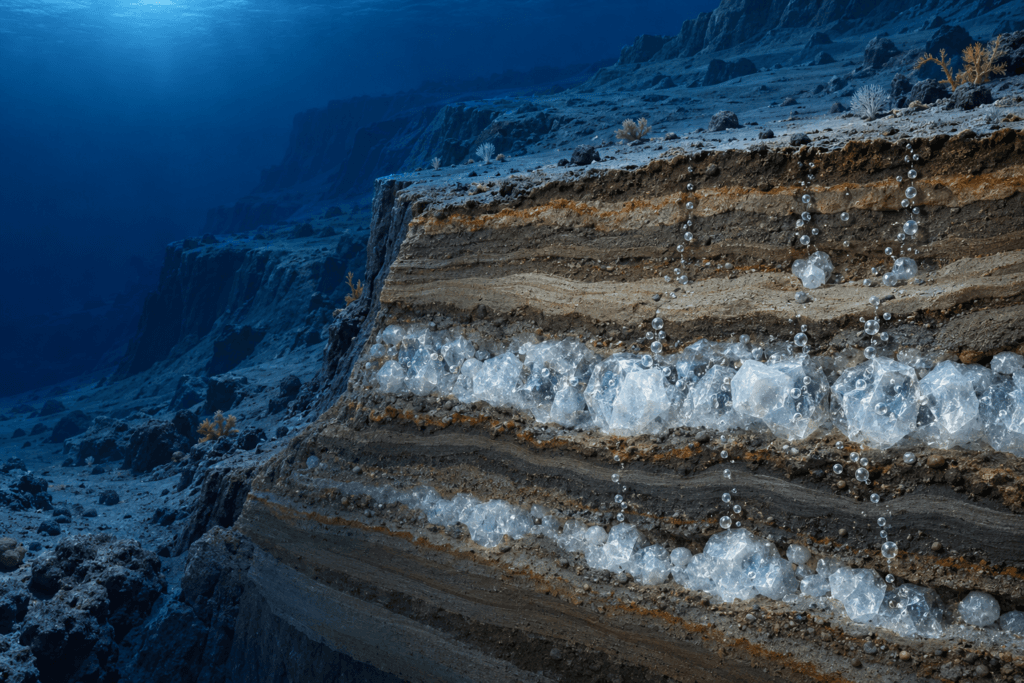
A white fragment can look like ordinary ice until someone brings a flame close and it starts to burn. “Flammable ice” sounds like a carnival trick, but it describes a real property of gas hydrates: crystalline water structures that trap methane molecules in tiny cavities.
The ice is not the fuel. The flame appears when methane is released and burns. That distinction opens the door to a story involving chemistry, geology, energy, and climate.
The flame
Under ordinary conditions, a hydrate becomes unstable when pressure changes or temperature rises. Water stops maintaining the structure and methane escapes. If there is an ignition source, the gas can burn while the solid appears to remain intact.
The image of a block of “ice” with a flame above it is spectacular, but it does not tell us where hydrates form or how difficult they are to extract. The USGS explains why they are called “flammable ice”: gas released from a hydrate can sustain a visible flame.
A cage made of water
Water molecules can arrange themselves into cage-like structures. Gas molecules—usually methane—become trapped inside. This is not an ice cube with a bubble in it, but a crystalline network whose stability depends on pressure and temperature.
In chemistry, this kind of compound is called a clathrate hydrate. The term describes a host structure that encloses another molecule, not a reaction that turns water into fuel. Methane occupies cavities in a network of water molecules, so a cage is a useful metaphor as long as it is labeled a diagram rather than a microscopic photograph. Other gases can form hydrates, although methane is the most common in natural deposits studied by the USGS.
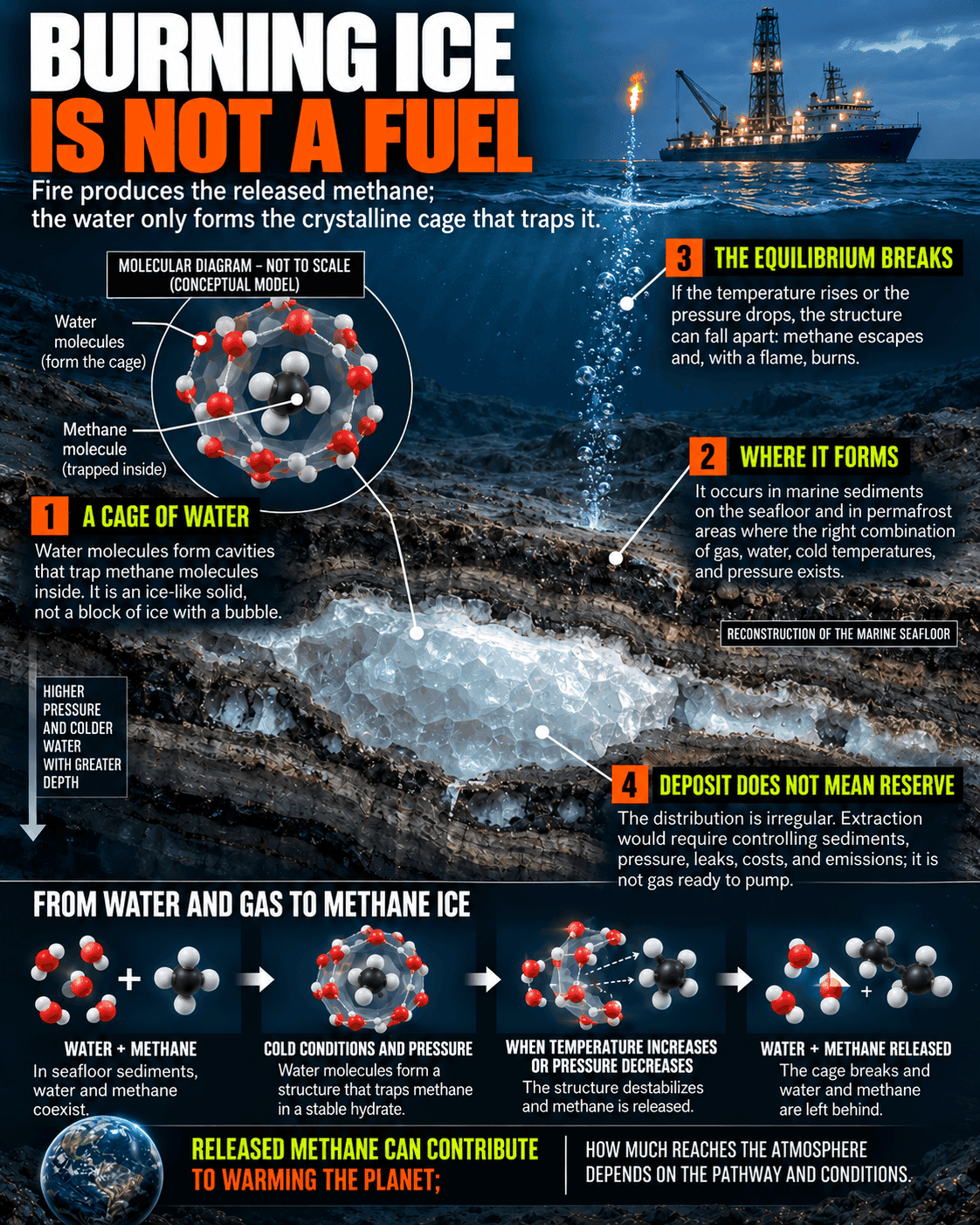
The USGS technical fact sheet distinguishes hydrates found in sediments from an energy reserve that can be safely extracted. That difference prevents a common mistake: turning a geological occurrence into an immediate commercial promise.
Where they occur
Hydrates are found mainly in sediments beneath the ocean floor and in permafrost regions. The deep ocean provides enough pressure; low temperatures help keep the structure stable. On land, permafrost combines prolonged cold with suitable sediments.
The USGS places favorable conditions in marine sediments along continental margins and beneath permafrost, but that does not mean there is a uniform layer of flammable ice. A deposit requires water, gas, suitable temperature and pressure, and a methane supply to coincide. A global map of possible conditions shows a stability zone—not one continuous reserve that can be drilled like a conventional oil field.
The USGS gas-hydrate primer explains that deposits are widespread but uneven. Knowing they exist is not enough: their depth, concentration, permeability, and stability also matter.
The seafloor works like a compressed archive. Organic matter decomposes and produces methane; under certain conditions, the gas becomes stored in the water network. Geology determines whether that cage lasts for centuries or breaks when conditions change.
Pressure is the key player
At the surface, a hydrate can break down quickly. Beneath the ocean, pressure helps keep the structure intact. That is why extraction is difficult: operators must bring the material up without triggering an uncontrolled release or losing more energy than the process yields.
Experimental techniques try to lower pressure, warm the sediment, or inject other gases to release methane. Each method raises questions about cost, ground stability, and environmental controls. A hydrate does not come out like a bag of gas ready to connect to a pipeline.
In a laboratory test, researchers can reproduce controlled pressure and temperature and watch how a sample responds. Fieldwork is more complicated: sediments are heterogeneous, drilling changes the environment, and a recovered sample can change as it leaves subsurface conditions. A test result does not automatically translate into a safe commercial technique. Research must measure how much gas is released, how much can be captured, and what happens to the sediment left behind.
The USGS gas-hydrate research project includes laboratory work, drilling, modeling, and subsurface monitoring.
An energy promise with fine print
Hydrates contain enormous amounts of methane spread across large areas. That estimate fuels headlines about a new energy era. But total volume is not the same as a recoverable reserve. Methane has to be extracted and transported, leaks must be prevented, and the process must prove economically viable.
The American Chemical Society video “Burning Ice from the Ocean Floor” shows hydrates and explains their chemistry. It helps visualize the phenomenon; it does not prove that industrial extraction is already solved.
The climate risk
Methane is a potent greenhouse gas. If a deposit destabilizes and gas reaches the atmosphere, an energy story becomes a climate story. The amount released, the rate of release, and oxidation in the ocean matter as much as the deposit itself.
There is also a geological risk. Hydrates can contribute to the stability of undersea sediments. Changing their structure may alter soil properties and, under certain conditions, increase the possibility of submarine landslides.
That does not mean every deposit is a climate bomb waiting for a spark. It means any decision must account for the whole system: drilling, pressure, temperature, sediments, leakage, and the gas’s eventual use.
It is also worth separating two questions that headlines often merge: whether methane can escape a deposit, and whether it will reach the atmosphere in significant amounts. The USGS notes continuing uncertainty about how hydrates respond to warming and what happens to released gas. A flame illustration explains combustion; it does not predict a global leak or prove extraction will be simple.
Ice does not automatically replace oil
Popular imagination turns any abundant resource into a definitive solution. Hydrates do not fit that mold. They offer scientific insight and a potential source of methane, but they do not remove extraction challenges or emissions.
The interesting question is not “Can we burn this ice?” but “Can we release its gas without making other problems worse?” That framing forces us to look past the flame and toward subsurface engineering.
Hydrates are a story of balance. Water builds the cage, pressure keeps it stable, methane occupies it, and temperature helps determine when it begins to come apart. The flame photograph is the final scene of a process that began much deeper, in the dark sediments.
A deposit is not a bag of gas
A hydrate does not behave like a conventional gas reservoir that can be opened with a valve. Methane sits inside a crystalline water structure, and its stability depends on specific pressure and temperature conditions. Changing those conditions can break the structure down and release gas, but controlling that process beneath the seafloor is an engineering challenge unlike drilling an ordinary reservoir.
The presence of hydrates also does not prove that a commercially useful resource exists. Researchers need to know the amount, continuity of the deposit, sediment permeability, ground response, and cost of maintaining stable production. A sample that burns in a laboratory proves that the material contains methane; it is not a production plan or an estimate of recoverable reserves.
The key question is what happens during extraction
Scientific interest comes with risks that need to be measured. If sediment loses stability, the seafloor may be affected; if methane escapes uncaptured, its climate impact matters. That does not mean every exploration effort will cause a disaster, but any test should monitor leakage, pressure, temperature, and ground movement—and publish its results.
“Fuel” often gets the headline. The difficult part is in the fine print: extracting safely, measuring how much gas actually reaches the surface, and comparing that energy with environmental and economic costs. Until those conditions are demonstrated, hydrates remain a research frontier, not an easy source ready to replace other fuels.
Sources from beneath the surface
- USGS FAQ: gas hydrates — definition and formation.
- USGS fact sheet — distribution and geological characteristics.
- USGS: When Ice Yields Fire — how hydrates can burn.
- USGS Gas Hydrates Primer — stability conditions.
- USGS Gas Hydrates Project — research and extraction.