
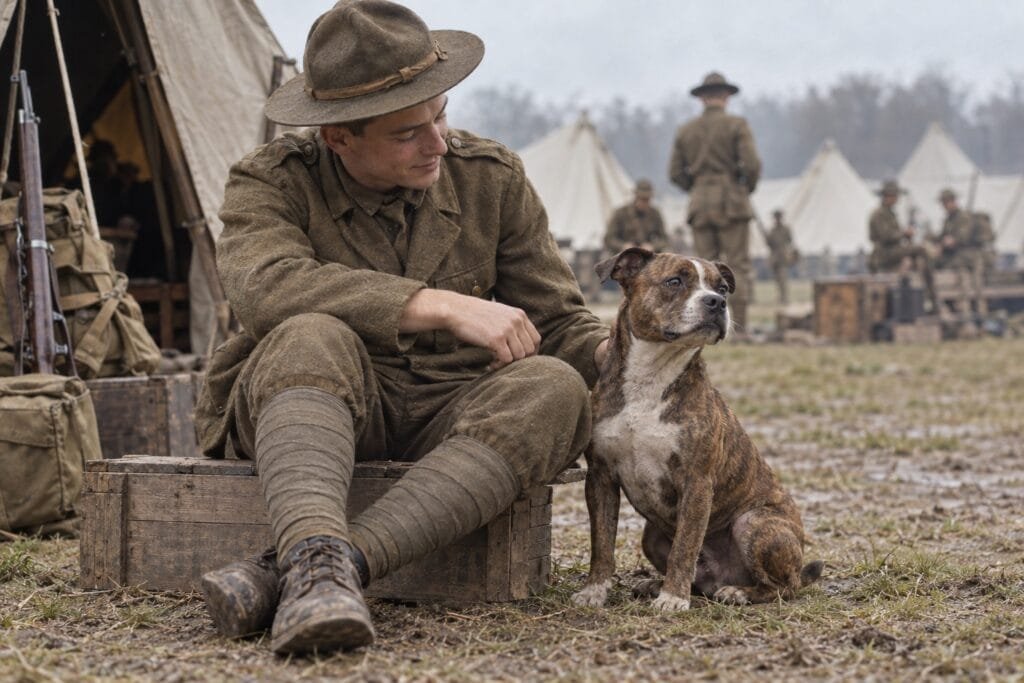
In a military display case, a tiny medal can look like a joke. Add a short-haired dog with the expression of someone who never asked permission, and the scene gets stranger still. Stubby did not begin his career as a hero: in 1917, he was a stray hanging around Yale’s training camp. He ended up as the mascot of an American unit, traveled to France, and came home a celebrity with more decorations than many soldiers.
The story is wonderful, but it is also full of details added later. The challenge is not to decide whether Stubby was “real” or “legendary.” It is to separate what is documented—his presence with the 102nd Regiment, his trip to Europe, and his role as a mascot—from the exploits the press enlarged until they became a movie with paws.
A surprisingly unlikely case file
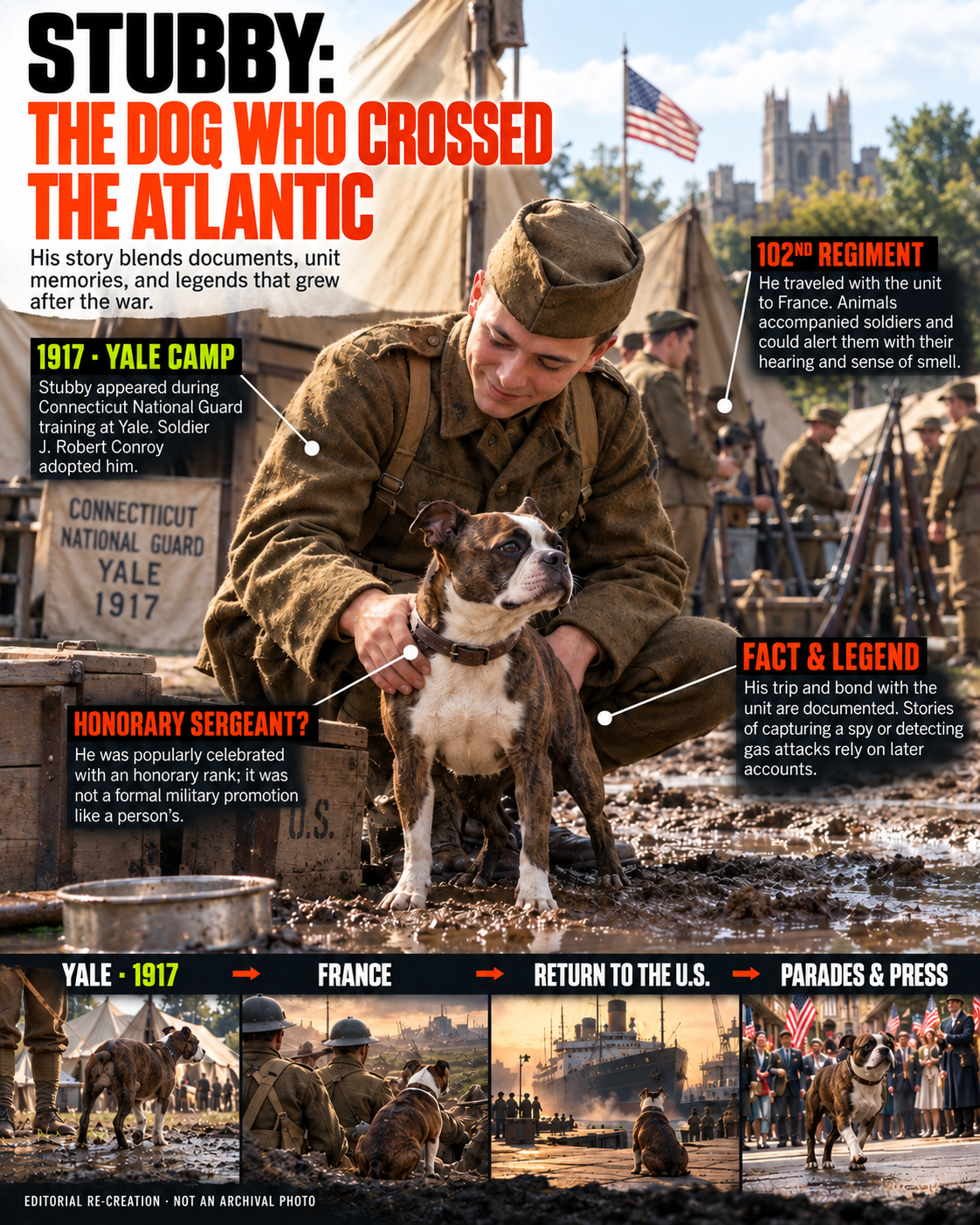
Stubby turned up at the Connecticut National Guard camp associated with Yale. Private J. Robert Conroy grew fond of him and managed to bring him aboard when the unit left for France. According to the unit’s tradition, the dog learned to respond to signals and behave during drills.
The U.S. Department of Defense’s history of the military working-dog program puts the case in context: during World War I, armies already used animals for messaging, transport, sentry duty, and companionship. Stubby was not a secret agent with laboratory training. He was an animal folded into a unit that found practical ways to make use of his presence.
What could a dog really do at the front?
A dog’s nose and ears could pick up changes that took humans longer to notice. An animal might react first to an unfamiliar smell, movement among ruins, or the arrival of a stranger. It could also lift the spirits of soldiers who had spent weeks amid mud, noise, and contradictory orders.
The U.S. Army’s account of the birth of the K-9 Corps shows that the military’s relationship with dogs did not begin with Stubby. What made his case unusual was the combination of documentation, affection from his unit, and media attention.
Later accounts say he warned soldiers about gas attacks and found wounded men. Those jobs are plausible given what a dog could do, though every specific episode deserves caution. There is no recording of the moment and no complete report for every anecdote. There are photographs, testimony, and memories—not surveillance footage from the trenches.
The captured-spy legend
The most cinematic episode says Stubby spotted and held up a German soldier moving behind American lines. According to the story, the dog bit the man and helped the troops capture him.
It is a terrific scene because it fits in a single panel: the dog, the enemy, the bite, and the reward. But that is exactly why we should treat it as a story passed down through unit memory, not as stand-alone proof that Stubby functioned like a programmed military detector.
The National Archives’ records on soldiers and animals help explain why stories like this survive: animals appear in letters, albums, and personal recollections, where affection and historical precision do not always travel together. Memory is not an operations report; it is one way people make sense of what happened.
Was he really a sergeant?
The “sergeant” title is the most repeated detail—and the hardest to fit into an administrative box. Tradition says a commander promoted Stubby after the spy episode. From then on, he appeared in a small jacket, insignia, and medals.
The safest description is that he was popularly recognized as a sergeant and treated as an honorary figure within his unit. It is better not to present this as if he had gone through the same promotion process as a human soldier, complete with a personnel file, payroll, and comparable chain of command.
The Army Museum Enterprise preserves the kinds of objects that helped the story grow: collars, photographs, uniforms, and keepsakes that turn a mascot into a symbol. Each object shows that Stubby was celebrated. It does not necessarily confirm every detail of the story attached to it.
Medals, parades, and a second public life
When Stubby returned to the United States, he was no longer simply a company dog. He took part in parades, met reporters, and was presented as a veteran. His image fit postwar culture perfectly: a small animal stood for soldiers’ loyalty and made it possible to tell the story of war with an emotion that was easier to bear.
The photograph of Stubby with officers and decorations is more than a curiosity. It is an exercise in public communication. The dog makes the bond between the unit and its mascot visible; the medals turn a collective experience into an object; the carefully arranged pose turns the chaos of the front into a scene that can be printed and shared.
That is the most interesting part: Stubby was a hero because he was there, but also because people needed an image of war they could look at without turning away.
He wasn’t the only animal in uniform
Comparing Stubby with other animals keeps us from treating him as an absolute exception. Simon, the cat aboard HMS Amethyst, received the Dickin Medal for his role during the Yangtze Incident in 1949. Reckless, a mare serving with the South Korean Marine Corps, carried ammunition during the Korean War and was officially recognized for her service.
The difference lies in the kind of documentation. Stubby belongs to a time when press photography and oral history could quickly blend together. Simon and Reckless appear in more clearly defined institutional records. All three cases show that animals can perform real roles in military settings—but not every story comes with the same level of evidence.
What remains when we scrape off the varnish
Remove the details that are impossible to verify, and the story is still extraordinary. A stray dog joined a unit, crossed the Atlantic, survived a wartime environment, and became an emblem for the soldiers who had adopted him.
The legend does not erase the facts. It covers them with layers of heroism until it becomes hard to see the original animal. Stubby did not have to act like an elite commando to matter. His company, alertness, and small moment of humanity were enough in a place designed to wipe those things away.
Stubby died in 1926, but his image keeps traveling because it serves a perfect narrative purpose: it lets us talk about an immense war through a protagonist who fits in a photograph. The medal is small. The story built around it is not.
Follow Stubby’s paper trail
- U.S. Department of Defense: War dogs — context on the military use of dogs.
- U.S. Army: The birth of the K-9 Corps — how military working dogs became an institution.
- Smithsonian WWI100 — historical context for World War I.
- National Archives: Soldiers and animals — records about the bonds between troops and their animal companions.
- Army Museum Enterprise — artifacts and material memories connected to animal service.