
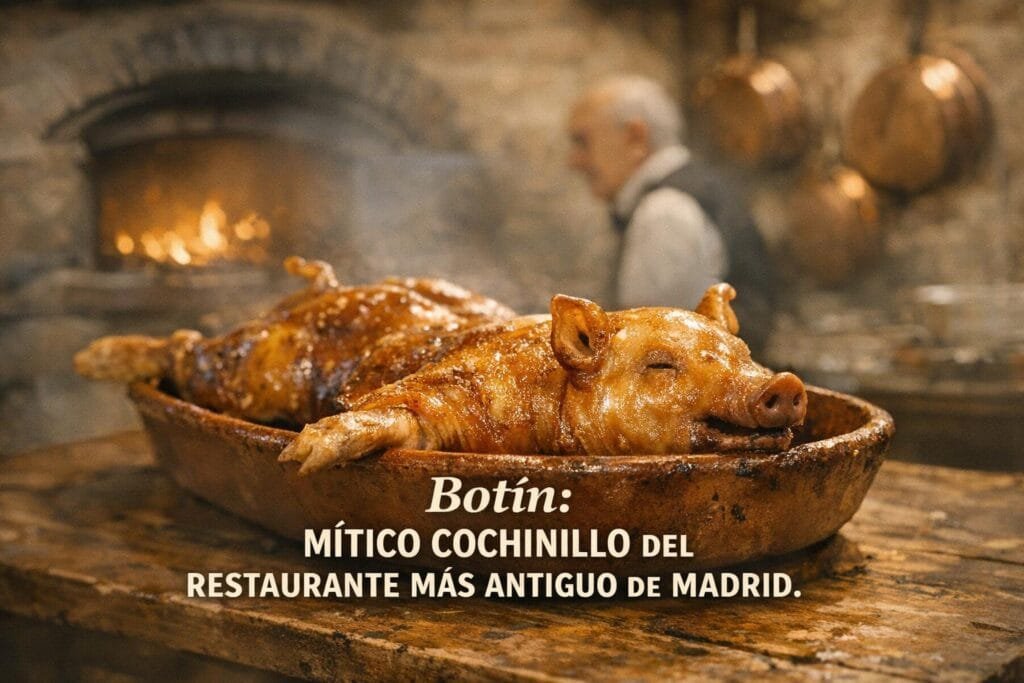
A enveloping warmth, the unmistakable smell of suckling pig roasting slowly, and the echo of conversations mingling with the clink of glasses. Then comes the revelation: that very smell and warmth have been rising from the same wood-fired oven, without interruption, since 1725. In a world where everything changes at breakneck speed and restaurants open and close as easily as someone taps “like,” there is a place in Madrid that laughs at the calendar. It is more than a restaurant: it is a time capsule, a challenge to our fleeting modernity.
Yes, I mean Sobrino de Botín Restaurant, which holds the title of the world’s oldest restaurant, according to Guinness World Records. The fascinating part is not just the title; it is everything wrapped up in it. Perhaps one of the masterpieces we now admire in a museum began taking shape while its creator washed dishes in a shadowy kitchen. Can you imagine?
To soak up a little of the atmosphere—and see its oven in action—here is a short video tour:
An oven with more than three centuries of stories
The beating heart of Botín is its original wood-fired oven. Three centuries of fire. Think about it. Before the French Revolution, before the United States was a nation, that oven was already lit, roasting suckling pigs and lamb with almost mystical devotion. It is not a reconstruction or a replica; it is the very artifact that has seen it all. How many lives have passed through there? How many laughs, confidences, and celebrations have been warmed by its fire?
The oven does more than flavor the food; it fills the room with tangible history. When you enter Botín, you are not just choosing where to have dinner; you are taking part in an unbroken tradition. You sit in a place whose walls have heard more than we can imagine. It is a journey of the senses and through time, starting on Calle Cuchilleros and carrying you to a Madrid that no longer exists—but somehow, through a little magic and a lot of charcoal, is still alive here.
From dishwasher to genius: Goya’s early days
But let’s return to that opening provocation. Yes, this is one of those stories that makes you blink and ask if you heard correctly: it is said that Francisco de Goya, the genius from Fuendetodos, worked as a dishwasher in Botín’s kitchen. A dishwasher! Imagine the future painter of The Third of May 1808 and The Nude Maja with soapy hands, surrounded by pans and pots, earning a living in his youth before his art fully blossomed.
This anecdote has not been documented as rigorously as a birth certificate, but it has passed from mouth to mouth, taking root in Madrid folklore and in the restaurant’s own mystique. Whether it is completely true or carries a hint of urban legend, it adds a layer of romance and wonder to Botín’s story. It lets us imagine a humble, observant Goya—perhaps already seeing the world with the eyes that would later capture its cruelty and beauty on canvas—but at that moment simply washing dishes and dreaming of a better future as the smell of roast suckling pig whetted his appetite.
Hemingway and the taste of history
If Goya was a young shadow at the beginning of his career, another cultural giant sat at Botín’s tables and recorded its greatness: Ernest Hemingway. The American writer was a regular in Madrid, and Botín became one of his favorite haunts. In fact, he gave it a starring role in his novel The Sun Also Rises, in which narrator Jake Barnes ends a memorable day with dinner there:
“We had roast suckling pig and drank Rioja Alta. Collins said it was the best restaurant in the world.”
Do you see the significance? A Nobel Prize-winning writer, known for enjoying the good life and capturing the essence of places, immortalized Botín in one of his defining works. This is not just a mention; it is a declaration of love for authenticity and for the unmistakable taste of a place that was still a temple of traditional cuisine in the twentieth century.
Hemingway’s words do more than validate Botín’s cooking; they raise it to the status of a cultural icon, a landmark for lovers of literature and good food alike. It is remarkable how a place can accumulate so many stories and celebrated guests within its adobe and timber walls.
Beyond the records: the soul of Botín
But let’s not kid ourselves: the charm of Sobrino de Botín goes far beyond being the oldest or hosting famous visitors. Its real secret is consistency, loyalty to a tradition that refuses to die. Roast suckling pig and roast lamb remain the undisputed stars of the menu, prepared with the same recipes as centuries ago in that very oven—a miracle of survival. Many of the waiters have worked there for decades; they are part of its living history and silent witnesses to the city’s evolution.
In a world obsessed with novelty and cutting-edge trends, Botín is an anchor, a reminder that sometimes the truly revolutionary thing is to stand firm, honor the past, and keep doing things well the way they have always been done. It is an experience that transports you, nourishes body and soul, and leaves you with the strange feeling that you have taken part in something much bigger than a simple dinner.
So the next time you come across a list of the “best restaurants in the world” or the “most innovative,” remember Sobrino de Botín. It needs no fireworks or passing fads to keep astonishing people. It invites us to wonder: could true modernity, in the end, mean preserving and appreciating what time has proved to be enduring? The world is undeniably mind-blowing, and it is full of stories like this waiting to be discovered. What other hidden gem would you like to unearth?