
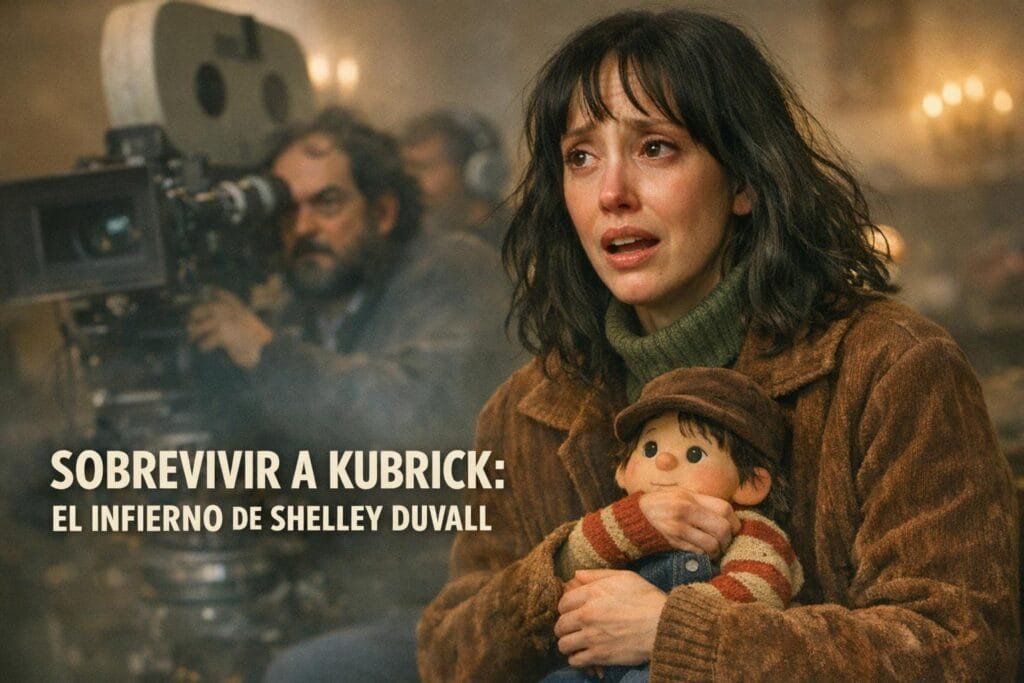
There are film shoots where the line between acting and survival becomes unsettlingly thin—a place where the pursuit is not just in the script but part of an actress’s everyday life. This wasn’t conventional method acting. It was a style of directing that pushed the lead of one of the most iconic horror movies ever made into a psychological abyss she would spend decades, perhaps a lifetime, trying to climb out of. The film was The Shining, the director was the legendary Stanley Kubrick, and the actress was the unforgettable Shelley Duvall.
Much has been written about Kubrick’s genius, obsessive attention to detail, and relentless pursuit of perfection. But at what cost? Shelley Duvall’s time on the set of the Overlook Hotel was a horror story in its own right—one often overlooked in the shadow of the film’s grandeur, but one that forces us to ask how far a director can go to get “the” performance they want.
For a clear glimpse of that tension, here’s a related video covering some of what has been said—and shown—about the emotional toll behind the film:
The documentary Making The Shining, filmed by Kubrick’s daughter Vivian, captured the immense tension on set and the pressure Shelley Duvall faced. This clip from the iconic baseball-bat scene offers a small but devastating glimpse:
The botanical garden encounter: Kubrick’s unexpected casting choice
Before entering the Overlook nightmare, Shelley Duvall was known for her distinctive beauty and her work in Robert Altman films such as Nashville and 3 Women. She had an ethereal presence, large expressive eyes, and a distinctive voice that Kubrick thought would be perfect for Wendy Torrance, the wife of Jack Torrance, the writer who loses his mind at the hotel. Kubrick wanted an actress with an instinctive vulnerability—someone who could convey mounting desperation without resorting to cheap theatrics. What he got, though, was a real-life version of that desperation.
The production of The Shining, whose details can be found in the American Film Institute catalog, was grueling for nearly everyone involved, but especially for Duvall. Kubrick, known for his unconventional methods, decided that if Wendy was to feel truly terrified, Shelley had to be terrified too. He had no qualms about crossing every ethical line to make it happen.
Psychological mistreatment as “artistic direction”
The tension on set was palpable. In an effort to isolate Shelley and undermine her confidence, Kubrick reportedly told the rest of the crew not to show her compassion or affection. He treated her with contempt, yelling at and humiliating her, and constantly criticizing her performance—often in front of the whole crew. Even the famous baseball-bat scene, in which Wendy defends herself from a deranged Jack, reportedly took 127 takes. One hundred and twenty-seven times, Shelley had to scream, cry, act terrified, and swing a bat while Jack Nicholson menaced her. It became a Guinness World Record for the most retakes of a dialogue scene, leaving her utterly exhausted, dehydrated, and close to collapse.
The stress was so extreme that:
- Her hair began falling out in clumps.
- She suffered from stress ulcers and skin rashes.
- She was on the verge of a nervous breakdown for much of the shoot, which lasted more than a year.
- The watery eyes and red nose we see onscreen weren’t makeup; they were the result of real tears after hours and hours of filming.
Jack Nicholson himself, though a professional, was no source of support in this regard. His role required an aggression Shelley had to endure. In Vivian Kubrick’s documentary Making The Shining, you can see Stanley tell Nicholson’s daughter, who also acted in the film, not to be nice to Shelley: “Don’t feel sorry for her.”
The mask of panic: blessing or curse?
Paradoxically, Shelley Duvall’s ordeal produced one of the most authentic and terrifying portrayals of panic in movie history. Her Wendy Torrance isn’t a passive victim; she’s a woman at the edge, with a distant stare and a visceral fear that cuts through the screen. It’s hard to imagine another actress capturing that same mix of fragility, terror, and a hint of survival amid the chaos.
But at what cost? After The Shining, Shelley Duvall’s career was never the same. She appeared in other films, but the experience with Kubrick left a deep mark. For decades, people discussed her mental health struggles, and her 2016 appearance on Dr. Phil, where she seemed disoriented and in serious psychiatric distress, reignited debate about directors’ responsibility and ethics in the film industry.
Kubrick always defended his methods as necessary for artistic creation, saying his aim was simply to get the best possible performance. But there’s a fine line between demanding direction and psychological abuse. In Shelley Duvall’s case, that line was crossed repeatedly, leaving an indelible scar on the life of a talented actress.
The legacy of a nightmare, onscreen and off
Today, The Shining remains an undeniable horror masterpiece, a study of madness and isolation. But behind every unsettling shot and chilling performance is the story of a woman whose peace of mind was taken from her in the name of art. Watching a terrified Wendy Torrance is no longer just watching a character; it’s seeing Shelley Duvall’s real pain, an echo of the cruelty she endured.
That leaves us with an uncomfortable question: can human suffering be justified in the pursuit of artistic perfection? How far are we willing to look the other way when creative genius turns into tyranny? Shelley Duvall’s experience on The Shining set isn’t just a movie-industry curiosity; it’s a sobering reminder of the sacrifices artists can be made to endure in the name of a masterpiece.