
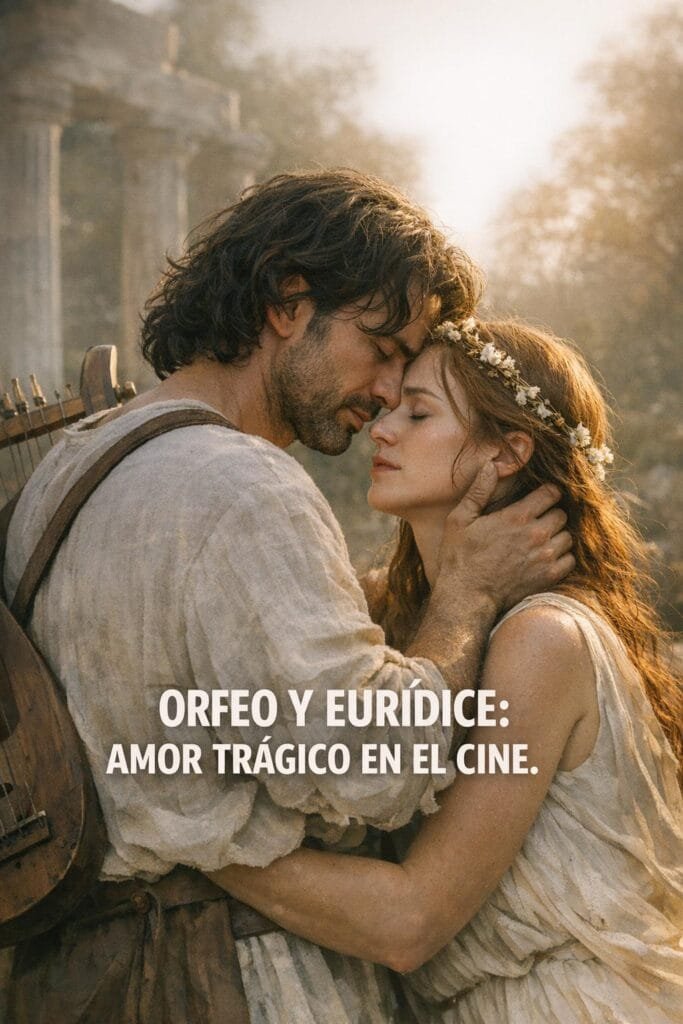
You have defied death, moved the gods of the underworld with the melancholy of your lyre, and been granted the unthinkable: a chance to bring the love of your life back. But there is a condition. Just one. And it is brutally simple: you cannot look at her. Not once—not even a quick glance—until you have both crossed the threshold and returned to the sunlight of the living. Could you resist? Could your love be so blind, so certain, that it would not need a single test or one look to confirm she was there behind you?
This is the torment Orpheus, the greatest of musicians, endured—and the cruel paradox the myth of Orpheus and Eurydice throws in our faces. Their love story is so powerful that it has been retold for millennia in countless works of art. More astonishingly, it helped lay the narrative groundwork for much of the romantic cinema we devour today. It is the original blueprint for an impossible test of love, a journey into the unknown, and—above all—the tragedy that doubt can unleash.
To feel the scale and force of a story that has crossed the centuries, this short animated video captures the heartbreaking essence of the legend of Orpheus and Eurydice.
An artist’s despair and the audacity of eternal love
It begins with happiness. Orpheus, the legendary poet and musician whose music tamed wild beasts and made trees weep, was hopelessly in love with the nymph Eurydice. Their love was a symphony, a perfect idyll. But happiness is often a fleeting interlude in the Greek tragic tradition. One fateful day, as Eurydice walked through a meadow, a snake bit her. Her life went out in an instant, sending her down to the shadowy realm of Hades.
Orpheus’s grief was unbearable—too deep for the world or Olympus to ignore. Without a second thought, he took his lyre and set out on the boldest journey any mortal had ever imagined: a descent into the underworld. Picture the terror: rivers of fire, monstrous guardians, wandering souls… But nothing stopped the musician. With every note, his pain became so heartrending a melody that even the ferryman Charon stopped his boat, the three-headed dog Cerberus howled in sympathy, and Hades and Persephone, rulers of the dead, felt a pang of compassion.
Moved by his art and unwavering love, the gods of the underworld granted him the unthinkable: Eurydice could return to life. But, of course, there was a “but”—and it was cruel. Orpheus had to walk ahead of her for the entire climb, and under no circumstances could he look back. Not for a second. Not even for a breath. Not until they had both left the realm of darkness completely.
The forbidden glance: a climax of human tension
The journey back was an ordeal of suspense. Every step Orpheus took was a battle against doubt, against the fear that Eurydice was not really there, against the anxiety that she might stumble or get lost. He felt her presence—or thought he did—but having no visual proof was torture. Can you imagine the willpower it would take not to turn around, not to seek confirmation of the thing you want most?
At last, sunlight began to filter in. The finish was in sight. Orpheus took one final step, and his whole body emerged from the underworld. At that moment, his heart gave way. Relief, desperation, the need to see her—he turned his head. And there was Eurydice, right behind him, but with one foot still in the shadows. One second, a fraction of an instant, and the condition was broken. Like an exhalation, Eurydice vanished back into the darkness, this time forever. The tragedy was complete, and its echo would ring through the ages.
From Orpheus’s lyre to the big screen: the myth that shaped romance in movies
What makes this story fascinating is not only its emotional power, but the way its archetypes have seeped into Western storytelling—especially romantic movies. Think about it: how many films have you seen where love must overcome impossible obstacles, where there is a journey, a test, or a condition whose violation means losing someone forever?
The myth of Orpheus and Eurydice gave us the master formula:
- The heroic journey for love: The protagonist undertakes an almost suicidal mission to rescue a loved one from a desperate situation—a disease, a kidnapping, or death itself. It is the foundation of countless dramas.
- The cruel condition: An unspoken or explicit rule, a warning, a taboo that must not be broken. Often, this condition generates the story’s greatest tension. Break it, and you lose the person you love.
- Doubt as the antagonist: There is not always an outside villain. Sometimes the real enemy is the protagonist’s own insecurity, lack of faith, or impatience—just as it was for Orpheus.
- The meaningful glance: Remember the moment Orpheus looks back? That glance is the point of no return. In film, a look—or the lack of one, the visual connection—is a powerful storytelling device: it can seal a fate, express emotion without words, or, as it does for Orpheus, trigger catastrophe.
From silent-era romantic tragedies, where gestures and glances said everything, to today’s blockbusters playing with time travel and alternate realities, Orpheus’s story still resonates. Think of films where a character must avoid contacting a loved one until the right moment, where a broken promise brings fatal consequences, or where love demands a leap of blind faith. In one way or another, they all drink from the same spring that saw a musician descend into hell.
The story of Orpheus and Eurydice reminds us that love, in its purest and most desperate form, can push us to the edge of what is possible—but it also exposes our human fragility. Doubt, one impatient moment, one glance: any of them can undo the greatest miracle. It is a story about faith, loss, and the eternal search for what, once loved, seems impossible to let go.
Perhaps Orpheus did not look back simply because he lacked faith, but because he was desperate to know that absolute happiness is fleeting, that destiny is inescapable.