
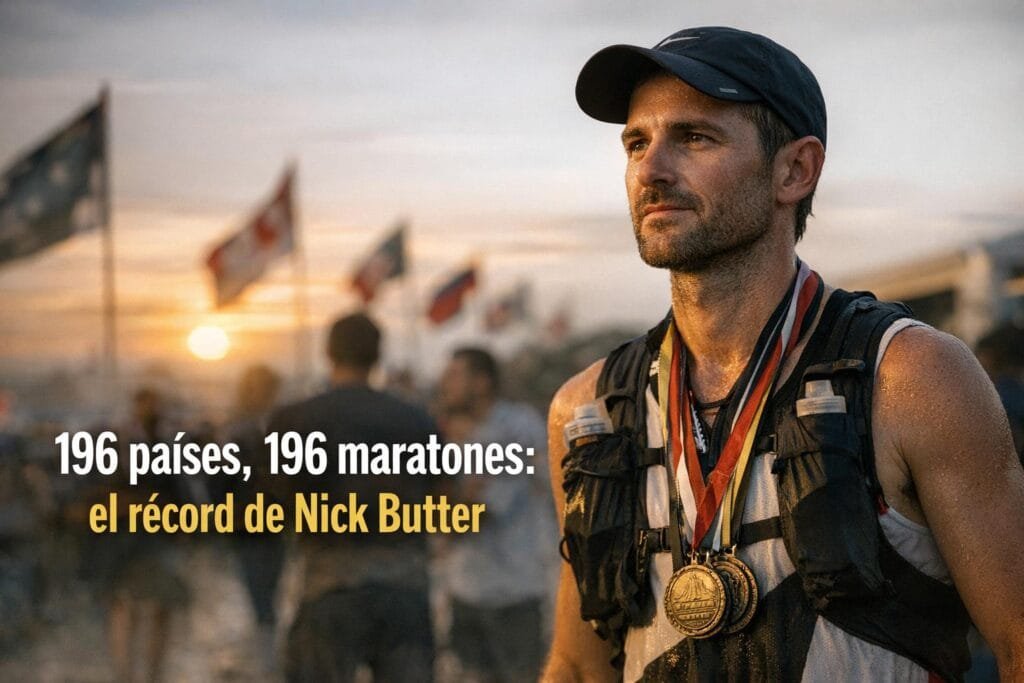
Some feats defy logic, and then there is what Nick Butter did. One marathon was not enough, so he set out to run 196—one in every country on the planet—regardless of wars, deadly diseases or punishing deserts. Sounds crazy, right? That is exactly what he did.
Have you really stopped to think about the scale of it? One hundred ninety-six marathons in 196 different countries. Not loops around his backyard or laps at a sports center. We are talking borders, time zones, brutal climates and wildly different cultures, all while your legs burn and your body screams for you to stop. This was more than an athletic feat; it was a modern odyssey that redefined human endurance, taking it to almost absurd extremes.
To get a sense of the challenge and the man behind it, watch this video summarizing his remarkable journey.
The spark of madness: why 196 marathons?
What makes someone take on an odyssey like this? As with many great challenges, the answer is deeply human and a little heartbreaking. For Nick Butter, the countdown began when his close friend, athlete Kevin Webber, was diagnosed with incurable prostate cancer. Kevin, an ultramarathon runner with an indomitable spirit, told Nick: “Look, if I can’t run, you’ll do it for me.” That planted the idea of raising money and, above all, awareness of the disease. But Nick did not want to do it on a small scale. He wanted the message to resonate around the world. He wanted it to be impossible to ignore.
And it was. From tying his shoes for the first time in Uruguay in January 2018 to crossing the final finish line in Greece nearly two years later, the goal was clear: run a marathon in every sovereign country recognized by the United Nations.
A map of challenges: obstacles at every mile
Make no mistake: this was no walk in the park. A single marathon is hard enough. Multiply it by 196 and add the rule that anything that can go wrong probably will. The challenges Nick Butter faced sound like an adventure movie:
- Nightmarish logistics: Imagine coordinating 196 visas, flights, permits and places to stay in just 675 days. It was a bureaucratic nightmare and a logistics puzzle that would make the best strategist sweat. At times he was stuck in airports waiting for permits that never came, or dealing with canceled flights that threatened to wreck the schedule.
- A body pushed to the limit: His knees, ankles and muscles took a constant beating. He faced dehydration in scorching deserts, hypothermia in Arctic weather and the ever-present threat of overuse injuries. Every step was a battle against his own body.
- Illness and unexpected danger: He dealt with malaria, dengue and dysentery. He was held up at knifepoint in Haiti and narrowly avoided being bitten by wild dogs in Gabon. He was even detained and had to negotiate his release in some countries—all while trying to keep up a pace of 26.2 miles a day.
- The “war” factor: He had to run in or near conflict zones, in countries including Syria and Yemen, where safety was an illusion. Sometimes crossing the finish line simply meant staying alive.
What is remarkable is that he kept going through all of it. He often ran alone; sometimes a local joined him for part of the route. A small support team juggled an impossible number of tasks to keep the mission moving.
Body, mind and unbreakable spirit
In the end, Nick Butter ran more than 6,200 miles. He became the first person to complete marathons in every country in the world. But the number alone does not tell the whole story. The challenge tested his spirit, demanding physical and mental strength in a way that recalls the brutal duality of chessboxing. There were days of extreme loneliness and despair, when he wondered whether he could keep going. Giving up sometimes seemed tempting.
But the image of Kevin Webber, the friend who inspired him, and the knowledge that his effort was raising awareness of a disease affecting millions pushed him forward. The physical pain was enormous, but the purpose was bigger.
Beyond the finish line: a legacy that keeps running
When Nick Butter crossed the last finish line in Greece, he had not only set a world record and raised a substantial amount for prostate cancer research; he had proved something deeper. Human resilience can feel limitless when a cause moves you. Adventure is still alive in our world. Sometimes madness really is the most sensible route to doing something extraordinary.
Nick’s story is a reality check for anyone who thinks they have seen it all. Even in remote corners and the harshest circumstances, the human spirit can flourish and achieve the unthinkable. Who knows what incredible feats—or small everyday acts of heroism—are taking shape somewhere in the world right now? Keep watching, because the world really is mind-blowing.