
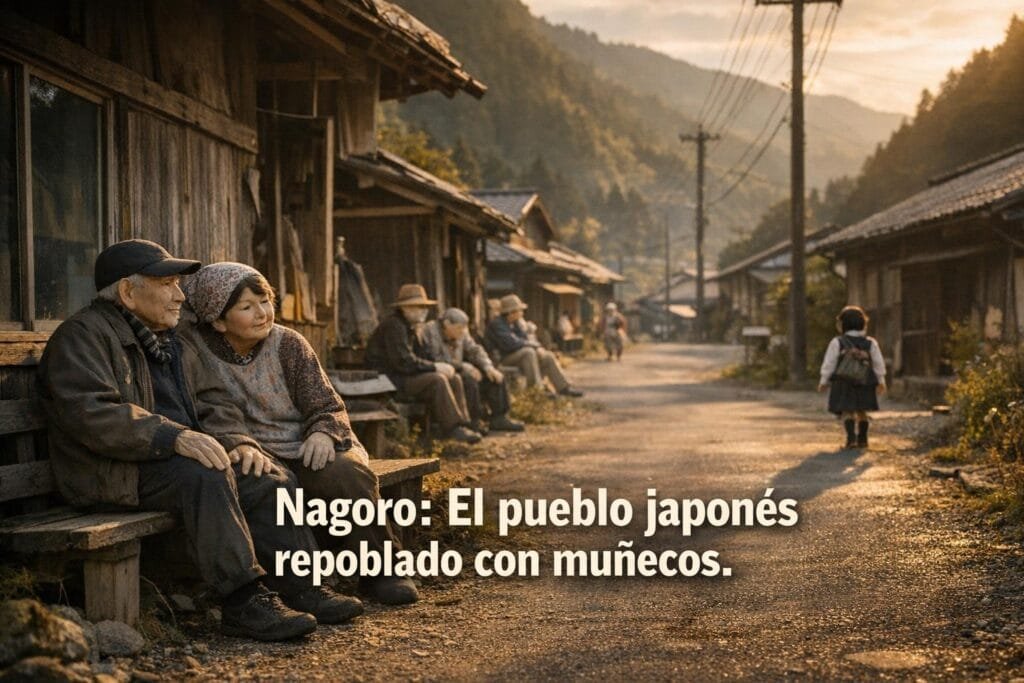
There you have it: the perfect solution to rural depopulation. If people leave—or simply disappear—why not fill the void with something that does not breathe, eat or complain? It is brilliantly absurd, and it could only happen in a place like Japan: a small valley facing extinction with a mix of art, memory and, let’s be honest, a touch of unease. The feeling recalls another famous Japanese place, Aokigahara: the mysteries of Japan’s “suicide forest”. This is not a B-movie plot. It is the curious, melancholy reality of Nagoro, where the silence of the living is almost as loud as the still presence of its new “residents.”
Imagine walking through a mountain village. A group of older people is chatting at a bus stop. Children sit in a schoolyard. A farmer is out in a field. Everything seems normal until you look closer. Nobody blinks. Nobody moves. Their eyes stare ahead, empty. Nagoro’s paradox is that it feels full of life, but its residents are, at best, cloth dummies. Some call it an ingenious solution; others see a chilling way to preserve the past. What do you think?
To get a feel for this place’s unusual atmosphere, take a visual stroll through its streets before reading on.
When the scarecrow became part of the community
It all began with nostalgia, as many of the best stories do. We are in the heart of Shikoku, on a remote, almost forgotten island valley. In 2002, Tsukimi Ayano, a local artist who had returned to her hometown of Nagoro after years away, found a bleak reality. The village she remembered as vibrant and full of neighbors had been emptying out: vacant houses, untended fields and silence. It was a familiar scene in rural Japan, where migration to cities and a low birthrate have reshaped communities—a global demographic trend also reflected in Japanese government statistics.
The idea came from an unexpected frustration: she could not find anyone to scare birds away from her seedlings. Ayano made a scarecrow—but not just any scarecrow. She modeled it after her father. It looked so convincing that, people say, passersby greeted it. That gave her an idea. If a scarecrow could seem so alive, why not take things further?
Tsukimi Ayano began making life-size dolls, each with its own personality, clothes and pose. They were not mere decorations. Every figure was inspired by a real neighbor who had died or moved away. It was her way of bringing them back, remembering their presence and filling the emptiness she felt at the heart of the village.
A village among ghosts made of cloth
Today, Nagoro’s human population is estimated at only about 20. The dolls, however, number well over 300. Yes, there are more dolls than flesh-and-blood people. And these are not static figures behind glass; they are woven into the fabric of daily life—or what remains of it.
- A group of “students” sits at desks in the old school, whose classes closed years ago for lack of children.
- At the bus stop, two “women” wait patiently, shopping bags at their feet.
- A “farmer” seems to work in a field while a “fisherman” sits beside the river.
- An “older man” reads a newspaper on a park bench, and a “couple” sits on a swing.
Each doll is a work of art and memory. Ayano makes them carefully from neighbors’ old clothes or donated fabric, stuffing them with straw and other materials. Their hand-painted faces aim to capture the essence of the people they represent. The effect is both moving and deeply unsettling—like walking through a living museum where the “portraits” have taken the places of the people portrayed.
The melancholy of an absence made present
Nagoro’s story echoes the struggles of rural areas around the world, but Ayano’s response is unique. It is as surprising as the story of Iceland’s huldufólk, said to halt construction and dictate road routes. Is this art? A way of coping with grief? Or a quiet critique of a future that has already arrived in small villages?
Perhaps it is all of those things. For the few residents who remain, the dolls are part of the landscape. They have learned to live alongside them and understand what they mean. Visitors, increasingly drawn to this “ghost village of cloth,” experience a strange mix of fascination, sadness and reflection on how fleeting life and memory can be.
Nagoro’s dolls do not speak, laugh or breathe. Yet their silent presence says more than a thousand voices about the importance of remembering every life that passed through this place. They are a monument to absence, a tangible way to hold on to what was in a world that keeps moving forward. Would you dare walk those streets knowing that most of the “eyes” watching you will never close?
The next time you come across a forgotten place or a story that defies logic, remember that the world is a vast canvas where human creativity—even in its most melancholy or ironic form—always finds a way to leave a mark. At El Mundo es Flipante, we are always looking for those strokes that make you stop and think, like Baarle: one village, two countries and an unusual border. Until the next curiosity!