
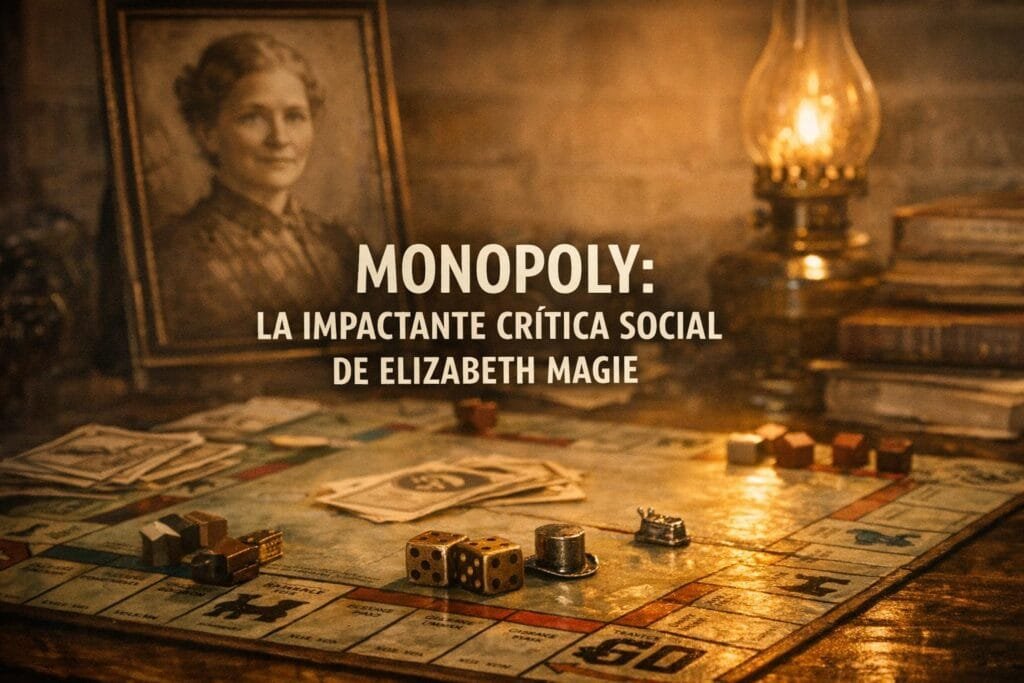
A game designed to expose the dangers of greed, unchecked land accumulation, and the way monopolies suffocate everyone else’s prosperity. It sounds like a manifesto, an educational tool meant to open people’s eyes. Ironically, that was the seed of what we now know as Monopoly—the very pastime that invites us, with a knowing smirk, to hoard, speculate, and bankrupt our opponents without blinking.
The paradox is so blatant it almost hurts. The game that did more than any other to glorify the pursuit of a monopoly began as a fierce criticism of that very practice. It is as if a vegetarian diet ended up being marketed as the world’s best steak. At the center of this historical contradiction is an extraordinary woman whose vision was, to put it gently, “reinterpreted.”
The story of that transformation is one of the most fascinating ironies in board-game history. This video sums up the journey: from a tool for social criticism to a capitalist icon of the family game night.
Elizabeth Magie: the misunderstood prophet of the board
It was 1904. Early-twentieth-century America was a hotbed of industrial progress—and, for some, glaring inequality. In this setting, a woman named Elizabeth Magie, a writer and stenographer, and a committed advocate of economist Henry George’s ideas, set out to do something bold. George argued that because land is a natural resource, it should not be privately owned in the strict sense, but treated as a common good whose rent benefited society as a whole. He believed land speculation and monopolies were the root of poverty.
Magie did not want to write one more essay. She wanted people to experience—and feel firsthand—how rent and property accumulation could enrich a few at everyone else’s expense. So, with admirable determination, she created a board game. She called it The Landlord’s Game. Its purpose was educational, almost subversive.
- It showed how land rent enriched owners and impoverished tenants.
- It illustrated the dangers of monopolies and concentrated economic power.
- It offered an alternative: a set of rules under which everyone could benefit from shared resources.
Yes, you read that right. The Landlord’s Game had two sets of rules: one rewarded accumulation—the path we know today—while the other encouraged cooperation and wealth distribution, showing that a fairer system was possible and beneficial to everyone. Magie received a patent in 1904, hoping her invention would spread as a tool for social change.
From criticism to capitalism: the reversal
For decades, The Landlord’s Game was played in progressive circles, universities, and Quaker communities. In spirit, if not according to the letter of the patent, it was a public-domain game. People copied it, changed it, and added rules. It was a product of free culture before anyone had a name for the concept.
Then the story took an unexpected turn—one Magie had not anticipated. In the 1930s, during the Great Depression, a man named Charles Darrow, who had lost his job, came across a version of the game. Darrow, a visionary with a nose for business, saw the fun, the thrill of winning, and the pleasure of bankrupting someone else—but missed the social message entirely. He modified the board, added street names from Atlantic City, and patented the game as his own in 1935, calling it Monopoly.
The story of how Parker Brothers acquired Darrow’s rights—and later, after realizing he was not the original creator, had to buy Magie’s patents for a mere $500—is a chapter of its own and underscores the irony. Magie received neither recognition for her invention nor credit for its message. Her revolutionary intent faded beneath the glossy veneer of commercial success.
The triumph of fun… and amnesia
Monopoly became a global phenomenon, selling millions of copies and appearing in dozens of languages. It became the very definition of family fun, a symbol of the American dream of getting rich, the boldness of the entrepreneur, and, of course, the harsh reality that in a world of losers there can be only one winner.
What remains of Elizabeth Magie’s vision? Very little in the collective memory. Her name, her fight against land accumulation, and her plan to teach through play were erased from the popular story. The game she designed to criticize monopolies became the game that celebrates them—a practical manual for building one without remorse.
It is a fascinating reminder of how ideas can be co-opted and transformed, how a message of social justice can mutate into a pastime that unconsciously trains us in capitalism’s most ravenous habits. The next time you roll the dice and buy a street, or make your cousin sell a railroad, remember: deep down, you are taking part in one of board-game history’s greatest ironies.
How many other stories are hiding in the everyday objects around us, waiting to be uncovered? If you want another curious story behind an everyday object, surprises may be closer than they seem. The world really is mind-blowing when you look beneath the surface.
Keep exploring
The story of Monopoly shows that even the most familiar pastime can have a surprising origin. If you enjoyed discovering the story behind this board game, you may like this other trip to the origins of entertainment: