
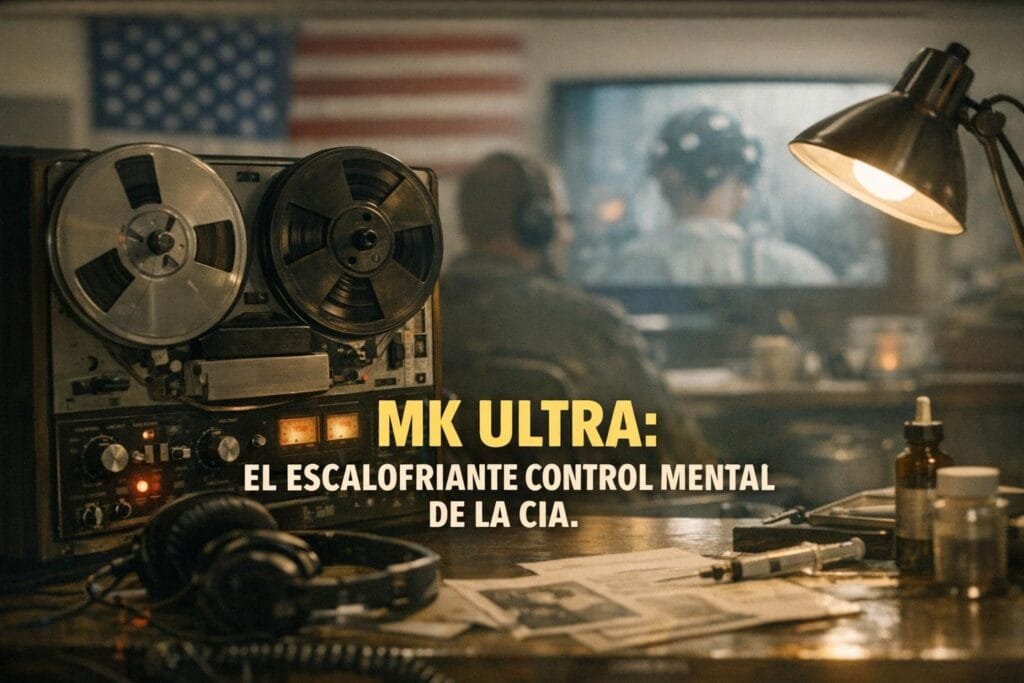
You are sitting in a chair, or perhaps lying in a hospital bed. Someone talks to you, offers a cigarette or a drink. You suspect nothing. Suddenly the world spins, colors intensify, thoughts break apart and reality bends in ways you never thought possible. This is no bad dream or dystopian fantasy. It is the stark, frightening reality of what many people once dismissed as a wild conspiracy theory: the CIA’s mind-control program, the notorious MK Ultra.
I remember first hearing about it. It sounded like cheap science fiction, one of those internet stories that always turn out to be nonsense. But with MK Ultra, the truth is stranger—and infinitely more chilling—than fiction. The U.S. government, or at least one of its most secretive agencies, the CIA, really was obsessed with unlocking the secrets of the human mind and, if possible, controlling it.
Fear of “brainwashing” and the origins of the horror
It began in the middle of the Cold War, an era of paranoia and distrust when world powers eyed one another warily, always looking for a decisive advantage. In the 1950s, the West grew increasingly fearful of “brainwashing,” especially after U.S. soldiers captured during the Korean War appeared to confess to crimes or embrace communist ideas under coercion. Americans believed the Soviets and Chinese had mastered mind-manipulation techniques they did not understand.
In a rush to counter that perceived threat and develop techniques of its own, the CIA launched a covert program that lasted more than two decades, from 1953 into the 1970s. Its codename, MK Ultra, became synonymous with unethical human experimentation, violations of fundamental rights and government secrecy that remains hard to comprehend.
Secret labs, drugs and vulnerable minds
The goal of MK Ultra was ambitious and terrifying: develop ways to manipulate the human mind in every possible way, including:
- Erasing memories.
- Implanting new memories or suggestions.
- Controlling behavior remotely.
- Forcibly extracting information.
- Inducing anxiety or dependence.
- Causing amnesia or confusion.
To pursue these goals, the CIA used extreme methods. Experiments were conducted in secret, often without informed consent and sometimes without subjects even knowing they were part of a study. The techniques included:
- Psychedelic drugs: LSD was the star of this macabre show. It was given to psychiatric patients, prisoners, sex workers, people with heroin dependence and even CIA personnel—often without their knowledge. Researchers wanted to know whether it could disorient, interrogate or control people.
- Hypnosis: Researchers explored whether hypnosis could create “programmed assassins” or implant suggestions that could not be resisted.
- Sensory deprivation and isolation: People were kept in total isolation or deprived of sensory input for long periods in an attempt to break their resistance.
- Electroshock: Electric shocks were used in efforts to induce amnesia or confusion.
- Psychological and physical torture: Extreme interrogation methods included sleep deprivation, isolation, humiliation and exposure to terror.
Dr. Ewen Cameron’s “experiments” in Canada
One of the darkest and best-documented chapters of MK Ultra took place at McGill University’s Allan Memorial Institute in Montreal. Scottish psychiatrist Dr. Ewen Cameron, indirectly funded by the CIA through the Society for the Investigation of Human Ecology, conducted what he called “depatterning” therapies.
Cameron believed he could “reprogram” adult minds. He subjected patients—many admitted for mild anxiety or depression—to massive doses of electroshock, drug-induced comas lasting weeks or months, extreme sensory deprivation and repetitive audio recordings. The result was not healing but damaged brains, ruined lives and people who forgot how to speak, walk or recognize loved ones. This happened with the approval—and money—of U.S. intelligence.
The truth comes out (or what was left of it)
For years, MK Ultra was an open secret, a rumor feeding conspiracy theories. In 1973, fearing damaging revelations, CIA Director Richard Helms ordered the destruction of all records related to the program. By luck—or inexplicable negligence—some documents survived, and many can now be found in the agency’s declassified archives.
The truth began to emerge through the U.S. Senate’s Church Committee investigation into intelligence abuses in 1975. Later Freedom of Information Act (FOIA) requests uncovered more details, revealing the program’s horrifying scope and confirming what many did not want to believe: the government had experimented on its own people.
When you stop and think about it, MK Ultra is not just a macabre anecdote from the past. It is a brutal reminder of how far institutions can go in the name of national security or strategic advantage. It forces us to question the limits of scientific ethics, government accountability and, ultimately, the fragility of our own identities. Can we be sure such horrors will never happen again—perhaps under a different name, at another time? History has a habit of repeating itself, and sometimes its echoes are truly mind-blowing.