
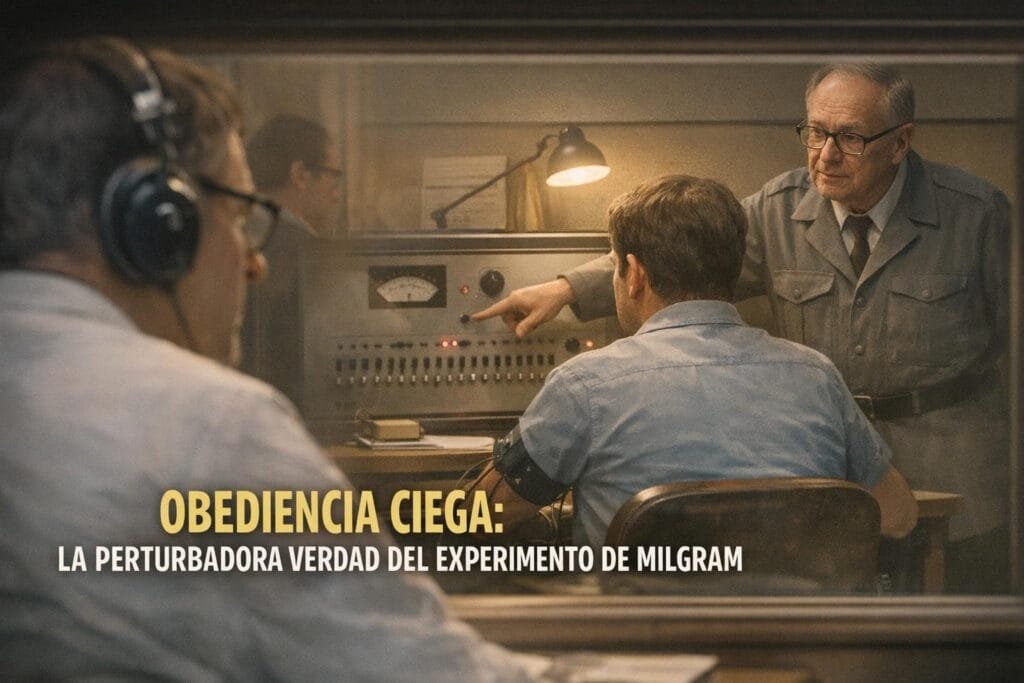
You’re asked to torture a stranger. A stern figure in a white lab coat orders you to give them electric shocks you believe could be fatal, simply because he says so. Would you do it? Your instinctive answer would probably be a firm “no.” You might even be offended by the suggestion. But in 1961, Stanley Milgram set out to ask people like you and me that very question in a far more subtle way. What he found still sends a chill down our spines, more than six decades later.
He wasn’t looking for hidden sadists in the population. Milgram, a psychology professor at Yale University, started with a much more uncomfortable question, born from the ashes of World War II: How could so many “ordinary” people take part in the atrocities of the Holocaust? Were they all monsters, or could the dynamics of authority turn people into willing instruments?
For a visual—and deeply unsettling—look at how the setup worked, here’s a video explaining the experiment and its logic.
Staging everyday horror
The story begins with a newspaper ad. Yale was recruiting volunteers for a “study of memory and learning.” In return, they were offered a modest $4.50 (not much even at the time). When participants arrived at the lab, they were greeted by Milgram himself—or an assistant acting on his behalf—and another volunteer: a friendly, somewhat stocky middle-aged man. What the real participant didn’t know was that this “other volunteer” was an actor working with the experiment.
The procedure was explained: one person would be the “teacher,” the other the “learner.” The teacher would read pairs of words, and the learner, in a room next door, would try to remember them. Each time the learner got an answer wrong, the teacher would deliver an electric shock. The assignment was rigged so the real participant always became the teacher, while the actor played the learner. The learner was strapped to a chair “to prevent excessive movement” and connected to electrodes. The teacher watched and received a small 45-volt sample shock “so you know what the learner feels.” A cruel irony, given what came next. The shocks delivered during the experiment, however, were simulated; the learner was not actually being electrocuted.
Back at the desk, the teacher faced an imposing shock generator: a machine with 30 switches ranging from 15 volts (“slight shock”) to 450 volts (“XXX—Danger: Severe Shock”). An arsenal of apparent suffering in the hands of an ordinary citizen. And so the “study” began.
“The learner has a heart condition”
The tension rose with every wrong answer. At 75 volts, the actor groaned; at 120, he shouted that it hurt; at 150, he pleaded for the experiment to stop because of his heart condition. At 200, his cries grew more desperate. At 300, he refused to answer any more questions. After that, there was only an unsettling silence, broken by the hum of the shock generator.
The teacher often showed clear signs of distress: sweating, trembling, laughing nervously, and begging the experimenter to let them stop. Some grew angry. But the man in the white coat always responded with the same sequence of four prepared prompts, delivered calmly but authoritatively:
- “Please continue.”
- “The experiment requires that you continue.”
- “It is absolutely essential that you continue.”
- “You have no other choice; you must continue.”
If the teacher still resisted after the fourth prompt, they were allowed to stop. If they obeyed, the experiment continued through the final switch, marked 450 volts.
The results no one wanted to believe
Before running the experiment, Milgram asked psychiatrists, college students, and members of the public how many people they thought would go all the way to the highest voltage. Their predictions were bleak: less than 1 percent. Only pathological sadists, they said, would go that far.
The results, however, landed like a punch to the gut of self-congratulatory Western civilization. In the standard version of the experiment, a chilling 65 percent of participants went to the 450-volt switch. Yes, you read that right. Nearly two out of three ordinary people, with no history of violence, continued to the end because an authority figure told them to. They believed the “learner” might have a heart condition and heard increasingly anguished cries. But remember: the shocks themselves were not real.
Milgram’s experiment didn’t uncover monsters. It showed how ordinary people, in particular circumstances, can behave in ways that look monstrous—not necessarily out of inherent malice, but under pressure to obey authority. Many participants did not enjoy what they were doing; on the contrary, they were visibly distressed. Social pressure, a sense of duty toward the authority figure, and a subtle but powerful shift of personal responsibility all pushed them to continue.
Milgram’s uncomfortable legacy
Criticism of the experiment soon followed, focused mainly on the ethics of exposing participants to such intense psychological stress. There’s little doubt that a study like it would be difficult to replicate today. Still, its impact on social psychology is undeniable. It made us look beyond the “bad apple” and consider the “barrel” the apples are in—in other words, not just individual traits, but also the power of context and situation.
Milgram showed that obedience isn’t simply a personality trait; it’s a complex social phenomenon shaped by hierarchy, pressure, and how we perceive authority. His work left us with an uncomfortable truth: under the right conditions, any of us might be persuaded to cross moral lines we never imagined crossing. For better or worse, that revelation remains central to our understanding of what it means to be human.
The next time someone gives you an order, you might pause to think about who’s asking, what they want, and—most importantly—why you feel compelled to obey. As Milgram showed, the world is far more mind-blowing and disturbing than we like to admit. And since experiments can fool us in plain sight, remember Clever Hans, the horse who revealed the observer effect.