
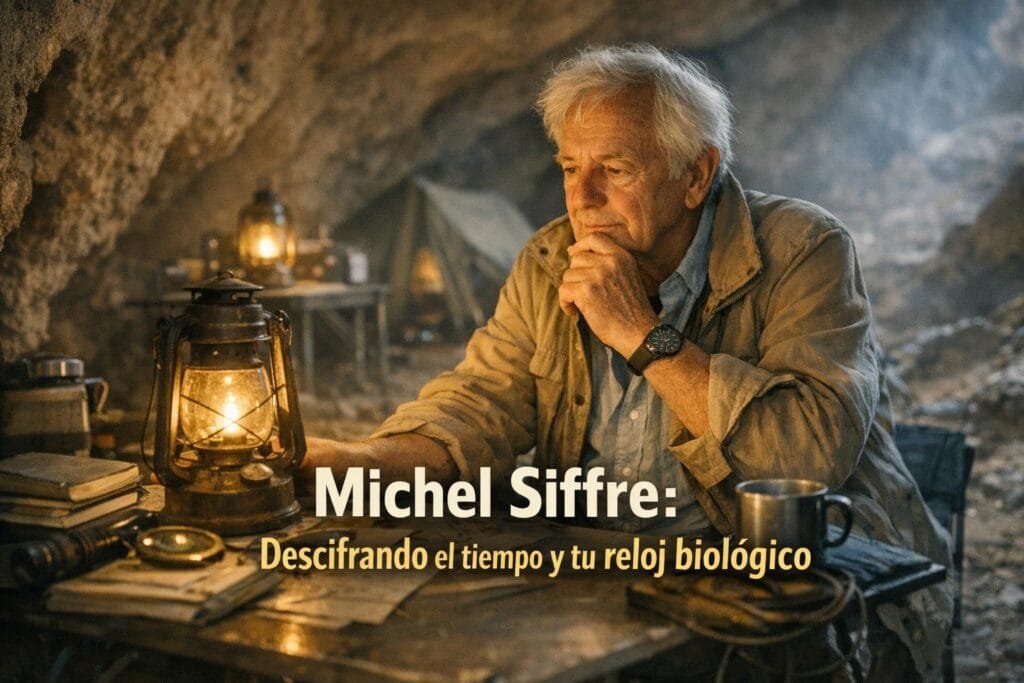
Waking in total darkness, where the sun is only a memory and clocks do not exist, sounds like the opening of a dystopian novel. It was the reality experienced by French scientist Michel Siffre. He was not there as punishment or by accident, but driven by insatiable curiosity and a question: which shapes us more, the sun we see each day or the one we carry inside? His experiment was an endurance feat and a radical plunge into the mysteries of our biological clock. Even now, it fascinates me.
This short documentary sets the scene and explains why Siffre’s experiments marked a turning point.
When the outside world goes dark: voluntary isolation
It was 1962. The Cold War was at its height and the space race filled the headlines. But Michel Siffre’s odyssey looked not to the stars but deep beneath the Earth. With basic survival gear, a rudimentary telephone to reach the surface and iron determination, Siffre entered Scarasson Cave in the Maritime Alps. His goal was simple yet daunting: live completely isolated, without natural light, clocks, calendars or any clue about the time passing aboveground. It was an isolation experiment that recalls other human experiments, such as Biosphere 2, the Arizona experiment and its lessons.
Siffre was not an ordinary man chasing fame. A geologist fascinated by caves, he began wondering how extreme isolation and the absence of light affect people’s sense of time. He knew what it felt like to lose track of day and night underground. He wanted to take the question to its limit.
His team on the surface monitored the experiment in an unusual way. Whenever Siffre felt like eating, sleeping or doing an activity, he called them. His only reference was his own body. The central question was: when does the body decide it is day or night if there is no sunrise or sunset?
Time stretches; the mind bends
One of the first things Siffre noticed was that his idea of a “day” began to stretch. Naturally and without realizing it, his cycles of activity and rest extended beyond the 24 hours we are used to. A “day” in the cave could last 25, 28 or 30 hours; he even experienced a cycle close to 48 hours. Two surface days felt like one to him.
His team confirmed the drift. At one point, after Siffre thought 30 days had passed, 33 had gone by on the surface. What did that mean? His internal biological clock—the system that tells us when we are sleepy or hungry—was still working, but without the daily reset of sunlight, it began to drift and follow its own rhythm.
The mental effects were brutal. The monotony was suffocating; the darkness total. Sometimes communication failed, leaving Siffre in complete silence and even deeper solitude. His sense of time became so flexible that he thought it was Friday when it was actually Wednesday. Without outside stimuli, his brain manufactured its own: auditory hallucinations, the sense of being somewhere else and constant doubt about his sanity.
In one of the best-known and most dramatic episodes, his team asked him to count from one to 120 at a rate of one number per second. Focused, Siffre thought he had done it in two minutes. In reality, it took five. His perception of time had slowed dramatically. What felt like seconds to him lasted much longer in the outside world.
Awakening the “inner clock”
When Michel Siffre emerged after 60 days—he thought it had been 35—the world felt unreal. His eyes had to adjust to the light and his mind to a flood of stimuli. But his findings were important. Siffre’s work helped investigate the existence of an endogenous biological clock, or circadian rhythm: an internal system that regulates sleep and wake cycles, body temperature, hormone production and many other vital functions.
This clock does not need light to keep running, but it uses light as a “synchronizer.” When light disappears, the clock continues but can drift. It is like a metronome keeping time without anyone bringing it into sync with the orchestra. Siffre’s experiments contributed to questions about jet lag, sleep disorders, shift work and even astronauts in space.
Siffre did not stop there. In 1972 he returned underground, this time for 205 days in a Texas cave, to confirm and extend his findings. His cycle stabilized at around 26 hours. His work changed how researchers think about our relationship with time and how the body itself is an astonishingly complex timekeeper.
A reflection in the sunlight
Michel Siffre’s experiment makes us look differently at the ordinary day-night cycle. It reminds us how deeply rooted we are in the planet’s natural rhythms, even when artificial lights and flexible schedules make modern life feel detached from them. How often do we think about how the absence of sunlight could disrupt not only sleep but our sense of reality and identity? It is a question that still resonates.
Siffre’s cave story is more than a scientific anecdote. It is an epic of mental resilience, the beauty of curiosity and the surprising truth that even in absolute darkness, the body keeps searching for its own sun. Have you ever wondered what kind of clock you carry inside?
If you are curious about life adapting underground—under much gentler conditions—do not miss the remarkable underground opal town of Coober Pedy.
The human mind under pressure is a fascinating field of study. Discover the story of Clever Hans, the horse and the psychological effect.