
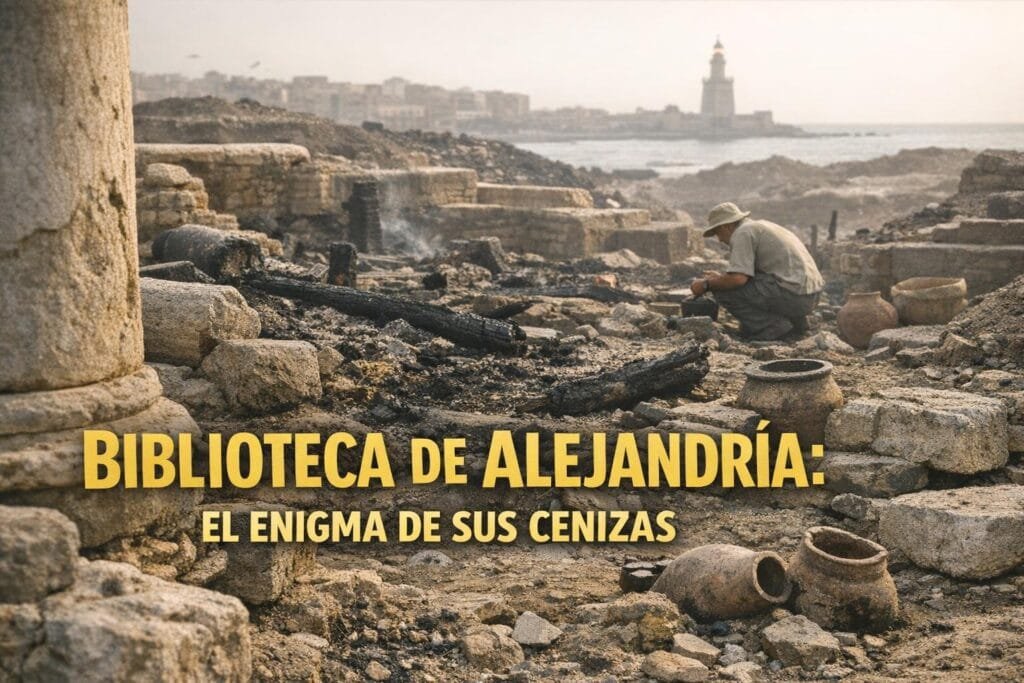
There was a time when one building was both the brain and the heart of the ancient world. Thousands—perhaps hundreds of thousands—of carefully rolled papyrus scrolls held nearly everything humanity had learned up to that point. Science, philosophy, history, literature: it was all there. Then, one day—or perhaps not in a single day, but over years of slow decline—that priceless treasure vanished. And the strangest part? Centuries later, we still don’t know who was truly to blame. It’s history’s great swindle: humanity lost the knowledge, and the culprit got away scot-free.
It’s one of those paradoxes that makes you think about how fragile our intellectual heritage really is. The Great Library of Alexandria was more than a collection of texts; it was a beacon, a force that drove thought forward for centuries and drew the ancient world’s brightest minds. The Ptolemies, the Greek rulers of Egypt who founded it in the third century B.C., had a monumental vision: to gather all the world’s knowledge. They succeeded, at least in large part.
It’s said that the library once held between 400,000 and 700,000 papyrus scrolls. Each represented hours, days, even entire lifetimes of study, transcription, and thought. It was Google, Wikipedia, and NASA rolled into one building. Imagine how many advanced scientific theories, groundbreaking philosophical works, lost plays, and irreplaceable historical records disappeared into oblivion. The number haunts us like a silent ghost.
The lineup of suspects: who lit the fuse?
When something so monumental is lost, our instinct is to find someone to blame—a scapegoat. The Library of Alexandria has a lineup of suspects as varied as the works it may have held. Every era and culture has tried to pin the loss on someone, often a historical enemy. Let’s review the usual suspects.
Julius Caesar: accidental arsonist?
One of the first names to come up is Julius Caesar himself. The story goes that during his siege of Alexandria in 48 B.C., he was in a tight spot and ordered his own ships in the harbor burned to keep them from falling into enemy hands. The fire apparently spread to waterfront warehouses containing—oh, the irony—papyrus scrolls. Was the Great Library itself destroyed? Almost certainly not. Modern summaries of the evidence suggest these were outlying storage facilities, perhaps holding papyrus for export or secondary texts. Still, popular legend blames Caesar for the library’s total destruction. How ironic: a man who admired knowledge and culture accused of wiping them out in one stroke.
It’s the sort of legend that works: a major historical figure makes a colossal mistake. But if the central library had burned down completely, wouldn’t contemporary chroniclers have described an event of that scale in detail, instead of mentioning it in passing in an account of a war?
Christians: purifying the faith?
As the Roman Empire became Christian, tolerance for pagan institutions—and the science often associated with them—began to fade. Enter another recurring “suspect”: Alexandria’s Christians. In A.D. 391, Theophilus, Bishop of Alexandria, with the backing of Emperor Theodosius I, ordered the destruction of the Serapeum, a temple dedicated to Serapis. As the Bibliotheca Alexandrina explains in its history of the ancient library, the Serapeum was considered a “daughter library” or annex to the main collection, and it still held a considerable number of scrolls.
The attack on the Serapeum was brutal, and many texts were certainly lost. But was this the destruction of the Great Library? Many historians believe the main library at the Museum—the associated research center—had already declined or disappeared long before, through neglect or smaller disasters. The destruction of the Serapeum was undoubtedly a tragedy for learning, but perhaps it was the final blow to an institution already on its last legs, not the killing of a giant at the height of its power. Then there’s the dramatic story of Hypatia, the brilliant Neoplatonist philosopher and mathematician, murdered by a Christian mob in A.D. 415. Her death was not directly connected to the burning of scrolls, but it symbolizes a period of hostility toward “pagan” knowledge that may have contributed to the final decline of Alexandria’s intellectual institutions.
Muslims: the final nail in the coffin?
Centuries later, blame was laid at the feet of the Arab conquerors. When Amr ibn al-As, a general under Caliph Umar, conquered Alexandria in A.D. 642, an apocryphal story says he asked what should be done with the books. Caliph Umar supposedly replied that if they agreed with the Quran, they were unnecessary; if they contradicted it, they were harmful. Either way, they should be burned. The scrolls were then said to have fueled the city’s public baths for six months. It’s a powerfully tragic image, and it has resonated for centuries.
But this story is almost universally considered a much later invention, perhaps dating to the 13th century. It doesn’t appear in contemporary accounts of the Arab conquest of Egypt. It seems more like propaganda meant to denigrate Islam during the Crusades. It’s a clear example of how confirmation bias can shape what we think we know and bend history to fit our prejudices. The Alexandria conquered by the Arabs was no longer the center of learning it had once been; its great intellectual institutions had been reduced to ashes—literally or figuratively—centuries earlier.
The silent enemy: decline and neglect
That brings us to the least exciting theory, but perhaps the most plausible—and, in a way, the most ironic: the Great Library of Alexandria did not die in one dramatic fire set by a hero or villain. It died slowly, by a thousand small cuts. Often, the real tragedy isn’t catastrophe but indifference.
- Budget cuts: Over time, the Ptolemies lost interest or resources, and maintaining such a vast collection was a monumental undertaking.
- Censorship and purges: At various points, works considered “dangerous” or “subversive” may have been removed or destroyed.
- Natural wear: Papyrus scrolls were fragile and needed careful storage, recopying, and ongoing maintenance; without sustained care, a collection could gradually deteriorate.
Editorially reconstructed ending: No single blaze can explain every loss, and no single villain can bear all the blame. The library’s story is more unsettling than that: knowledge can disappear not only in a spectacular catastrophe, but also when institutions weaken, collections are neglected, and generations stop protecting what they inherited.