
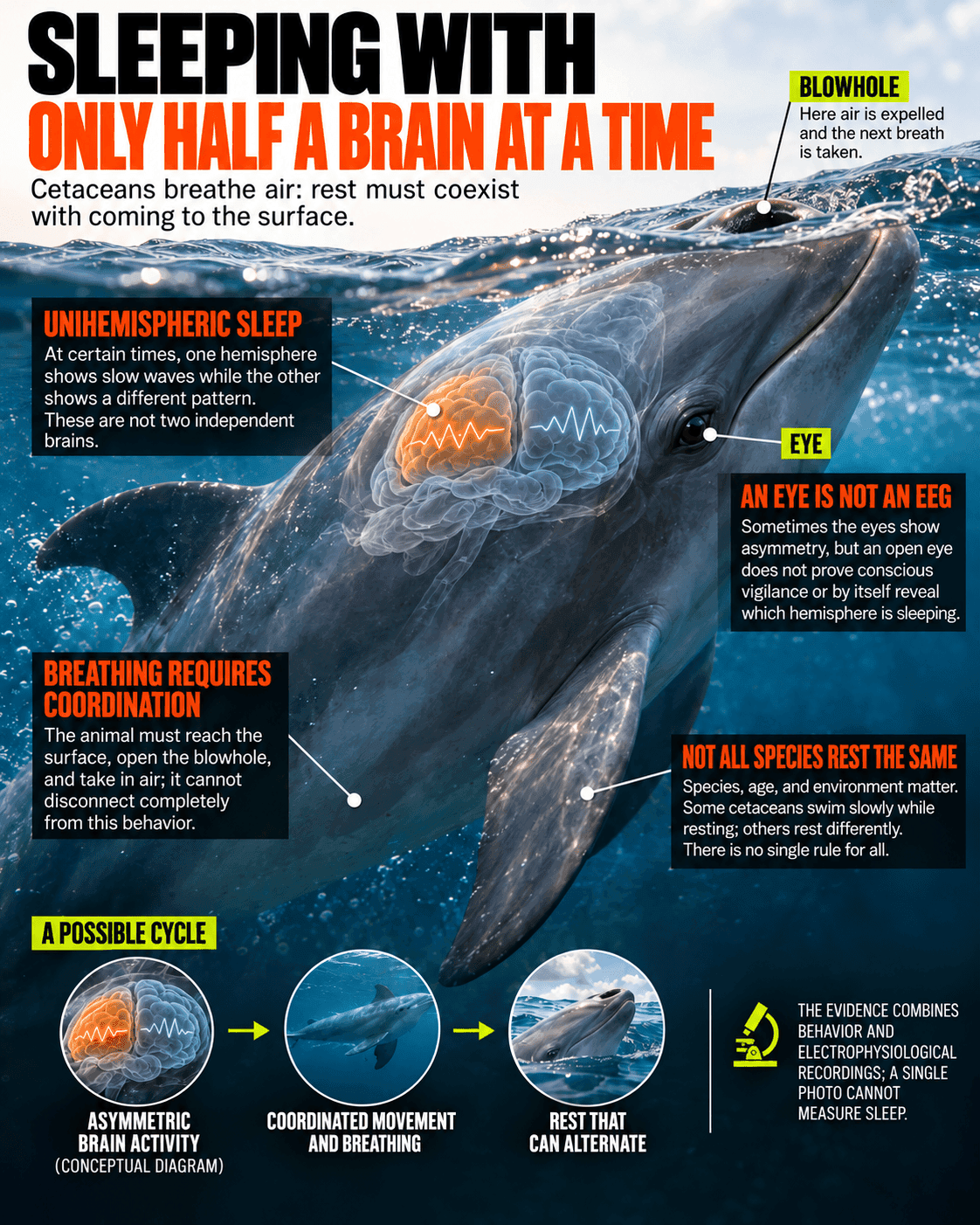
What happens when a mammal has to surface for air while it sleeps? A dolphin cannot simply shut down and wait for someone to tell it when to breathe again. Its solution is unusual and elegant: for periods of time, one brain hemisphere rests while the other maintains essential functions.

Unihemispheric sleep does not turn a dolphin into an animal with two independent brains. It also does not mean the animal is fully awake or consciously standing guard. It is a sleep pattern in which slow-wave activity appears in one hemisphere while the other shows a different state. Exactly how that pattern relates to behavior depends on the species and the situation being observed.
Breathing is not just any automatic reflex
In humans, breathing continues during sleep without our having to decide to take each breath. Cetaceans have more voluntary control over breathing. Surfacing, opening the blowhole, and inhaling require coordination that cannot be switched off completely.
NOAA describes this as sleeping with one hemisphere at a time. Cetaceans breathe air and must coordinate a trip to the surface. This need is commonly linked to partial sleep, though a likely adaptation should not be oversimplified into “one side sleeps while the other controls everything.”
One open eye does not mean a fully awake mind
The image of a dolphin with one eye open is irresistible—and easy to misread. In some observations, the eyes are in an asymmetrical state, but the relationship between an open or closed eye and activity in each hemisphere is neither perfect nor universal. That does not mean the animal is monitoring everything around it like a person on watch.
An eye may offer a clue about a resting state, but it cannot reveal an animal’s intention. The division is functional, not a perfectly straight line. Scientific reviews caution that eye asymmetry and one-hemisphere sleep do not always correlate directly. An illustration should therefore show different levels of brain activity, not portray one eye as an infallible indicator of what the dolphin is “thinking.”
This educational video on unihemispheric sleep is a visual aid, not a primary scientific source. It is in English.
What the electrical evidence shows
Electroencephalography has made it possible to observe changes in activity between hemispheres. Research on dolphins has recorded periods when one side shows sleep-like characteristics while the other remains at a different level of activity.
The behavioral and electrophysiological study matters because it does not reduce the phenomenon to a curious photograph. It examines how an animal maintains behavior over extended periods, alternating rest and activity. The findings apply to the individuals and conditions studied; they are not a universal measurement of how much every wild dolphin sleeps.
Sleeping while swimming
Some cetaceans maintain gentle movement while resting. Swimming can help them stay positioned, regulate breathing, and avoid sinking. In social species, staying close also offers protection from predators and helps adults care for calves.
Smithsonian Ocean explains the relationship between physiology and marine life. Sleep is not an isolated act: it depends on temperature, movement, oxygen, and social relationships.
For a young calf, staying alert can be especially important. A mother must not only breathe; she must also maintain contact and respond to changes around her. Rest becomes a negotiation between recovery and caregiving.
Not every cetacean sleeps in exactly the same way
“Dolphins” are not a single organism. Patterns differ by species, age, habitat, and circumstances. An animal in open water faces different risks from one in a coastal area. A calf also has different needs from an adult.
The scientific review of unihemispheric sleep places the phenomenon within a broader set of adaptations. Comparable patterns also occur in seals and some birds, although their anatomy and needs are not identical. Observations of cetaceans resting while swimming or stationary vary; it would be misleading to illustrate every case with an animal moving nonstop.
A solution with trade-offs
Sleeping with half the brain active may sound like a perfect advantage, but it comes at a cost. Rest may be shallower or more fragmented. Maintaining coordination takes energy and limits the ability to disconnect completely.
The adaptation does not eliminate the need for sleep; it makes sleep compatible with breathing in an aquatic environment. Dolphins have not found a trick to avoid rest. They have found a way to rest without losing functions their environment demands. The evidence also comes from particular species and conditions: applying every result from one studied dolphin to all cetaceans would mistake a documented strategy for a universal rule. It is important to distinguish measurements in captivity from observations in the wild. Instruments can provide more detail, but a controlled environment does not reproduce every variable of the ocean.
Comparing dolphins with humans
The useful question is not whether a dolphin sleeps “better” or “worse” than we do. It is that every body sleeps according to the problems it must solve. A human can close their eyes and rely on breathing to continue automatically; a cetacean must maintain an active relationship with the surface.
Unihemispheric sleep is an evolutionary response to a particular condition. It does not prove that dolphins think with two personalities or remain conscious throughout rest. It shows that evolution can distribute tasks when fully switching off would be dangerous. A rigorous explanation combines an easy-to-picture idea—one hemisphere rests while the other retains activity—with a caveat: the exact pattern varies among species, and questions remain about how it unfolds in the wild.
The ocean does not let you flip the switch
The next time a dolphin surfaces for air, picture the whole operation: a moving body, a blowhole that must open at the right moment, and a brain whose sleep pattern is not the same as ours. Research describes brain activity and behavior; it does not authorize us to translate every gesture into a human intention such as “keeping watch.” Nor can a photograph tell us which hemisphere is resting. That requires physiological measurements, not a striking pose. The image opens the question; it is not an answer by itself. The science lies in connecting behavior, brain activity, and context.
This is not a perfect machine. It is an animal that has found a balance between sleeping and remaining a marine mammal. The solution seems fantastic because it is: it does not erase the contradiction; it manages it.
What it means to measure cetacean sleep
A dolphin surfacing for air does not, by itself, tell us whether it was asleep. Researchers study rest by combining behavioral observations with brain-activity recordings and, where possible, measurements of breathing and movement. Electroencephalography makes it possible to compare patterns between hemispheres, but interpreting those records requires knowing the species, context, and protocol. A line on a graph is not automatically equivalent to a human subjective experience.
Long observations also help distinguish an anecdote from a pattern. Watching for hours or days can show whether an animal alternates phases, maintains breathing, and sustains particular responses. Even so, controlled experiments do not represent every condition in the open ocean. Noise, calves, feeding, and health can all change behavior.
One name, several strategies
“Cetacean” includes very different animals. Observations of one species do not justify describing every dolphin and whale in exactly the same way. Rest duration, alternation between hemispheres, and activity during sleep may vary. Scientific reviews compare studies to identify which results are shared and which belong to a particular species.
It is also important not to confuse adaptation with an absence of rest. Unihemispheric sleep does not mean an animal is always alert or can function indefinitely without recovery. It means some functions must continue while a form of sleep takes place. The body distributes tasks differently; it does not remove the cost of sleeping.
Breathing as both a limit and a clue
Breathing connects each resting phase to the surface. That need explains why “the dolphin that sleeps with one eye open” is such an intuitive story, but the eye is only a visible clue. To know what is happening in the brain, researchers need measurements; to understand the behavior, they must also consider movement and social context. The image is memorable. The evidence is more nuanced.
Sources for understanding partial sleep
- NOAA Fisheries — accessible explanation of unihemispheric sleep.
- Smithsonian Ocean — cetacean physiology and marine life.
- Study of 15-day vigilance — behavioral and electrophysiological evidence.
- Review of unihemispheric sleep — scientific comparison across species.
- Pacific dolphin study — observations of behavior and rest.