
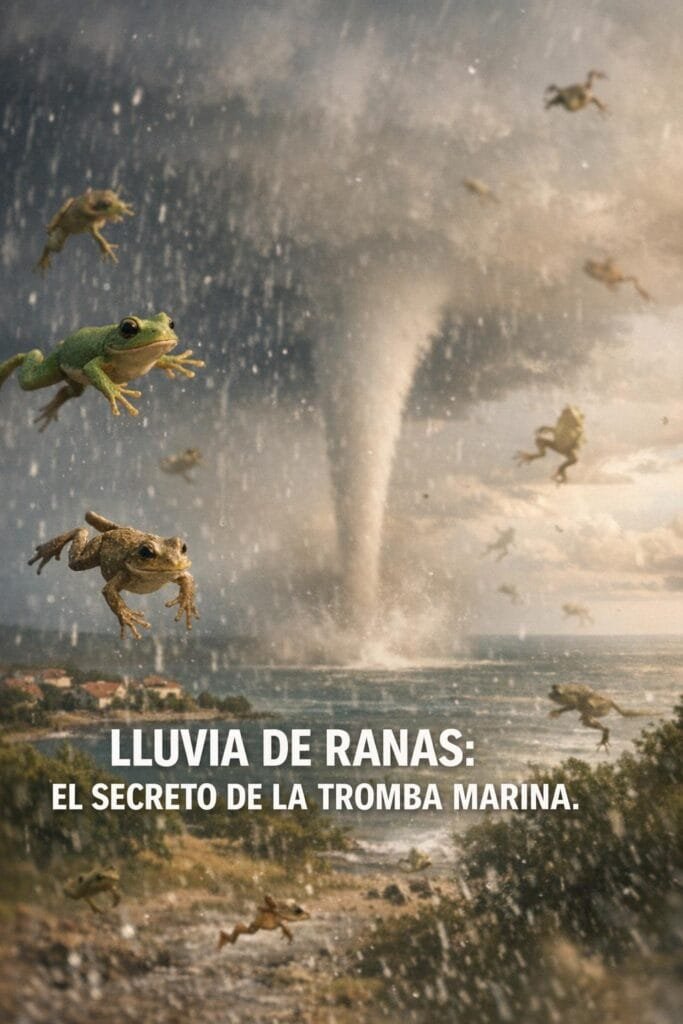
You are enjoying a quiet moment at home—perhaps making morning coffee or finishing dinner—when a strange sound suddenly hits the window. It is not rain or hail. It is heavier, and it seems to move. You look outside, and your blood runs cold: the ground, the roof across the street, even your own balcony are covered in… frogs! Little green frogs, alive and hopping, that seconds earlier were falling from the sky as if someone had emptied a giant fish tank.
Sounds like an amphibian-phobe’s worst nightmare, right? Or the plot of a B-movie with questionable special effects. Hold on, because believe it or not, this is not science fiction. Frog rain—and rain made of other aquatic animals—is a real phenomenon documented throughout history in different parts of the world. It is wild.
As unbelievable as it sounds, this phenomenon has been caught on video several times. The report below shows one of the famous “fish rains” in Yoro, Honduras, an event that is equal parts baffling and fascinating:
When the sky seems to spit out life: accounts of an unbelievable phenomenon
Since ancient times, people have looked up at the sky with awe, sometimes fear and occasionally total bewilderment. Even Pliny the Elder, in his monumental Natural History, wrote about rains of meat, wool and even bricks. Some of those accounts may have been exaggerated or legendary, but animal rain is another story. Reports include:
- Oaxaca, Mexico, where residents found small live fish everywhere after a storm in 1997.
- Rainsville, Alabama, where a 1947 fish rain was intense enough to fill the streets.
- And, of course, famous frog rains, including one in Serbia in 2005, when thousands of green amphibians reportedly fell on a sunny day, and a more recent event in Wales in 2011.
Picture the scene: people staring at the sky, blinking and trying to work out what is happening. Divine punishment? A cosmic magic trick? For centuries, the lack of a clear explanation fed myths and superstition. Fair enough—how do you make sense of something so completely out of the ordinary?
Science steps in: solving the waterspout mystery
Here comes the leading explanation for these jaw-dropping events: meteorology. The main culprit behind these unusual showers is the waterspout.
Think of a waterspout as a tornado that forms over water instead of land. It is a rotating funnel of air that stretches from a storm cloud to the surface of a lake, river or, most often, the sea. And like a giant vacuum cleaner, when it reaches the water it does not just suck up H2O. Not even close. It can scoop up whatever gets in its path:
- Small fish swimming peacefully.
- Countless frogs hunting insects near the surface.
- All kinds of insects.
- And, rarely, small snakes or birds.
These animals can be lifted to considerable heights—sometimes thousands of feet into the atmosphere—and carried for many miles by air currents. It is a kind of natural teleportation, but with much messier logistics.
The unexpected journey: from the depths to the sky—and back
Once a waterspout has picked up its unusual cargo, the animals remain suspended in the cloud. They travel until the storm loses energy or weather conditions change dramatically. Then the animals, along with water and any debris the spout picked up, simply… fall. It is as if a knot in the sky has come undone. Gravity does the rest.
Here is the interesting part: not all “animal rains” are alike. Whether the creatures survive depends on several factors:
- How high they are carried: the higher they go, the more likely they are to die from cold or lack of oxygen.
- How long the trip lasts: a long journey can be fatal.
- The animals’ size: smaller creatures may withstand the impact better.
- How they fall: a fall mixed with plenty of water may be cushioned.
That is why some animals are found dead, frozen or dismembered. In other cases, incredibly, they land alive and hopping as if they had just left their usual pond. Mother Nature can be as violent as she is delicate.
It is not magic—it is physics at work
That is one mind-blowing story, right? It is a powerful reminder that the natural world is a stage for extraordinary phenomena, often stranger than anything we can invent. Waterspouts show that science can explain what first appears impossible. What people once saw as an omen, a divine sign or a supernatural event, we now understand as a fascinating interaction of energy, pressure and the elements.
Next time you look up during a storm, think about the invisible currents moving through the atmosphere. Who knows what tiny aquatic creatures may be taking an unexpected trip to a new home—or at least making a spectacular entrance in an unsuspecting town? The world is mind-blowing.