
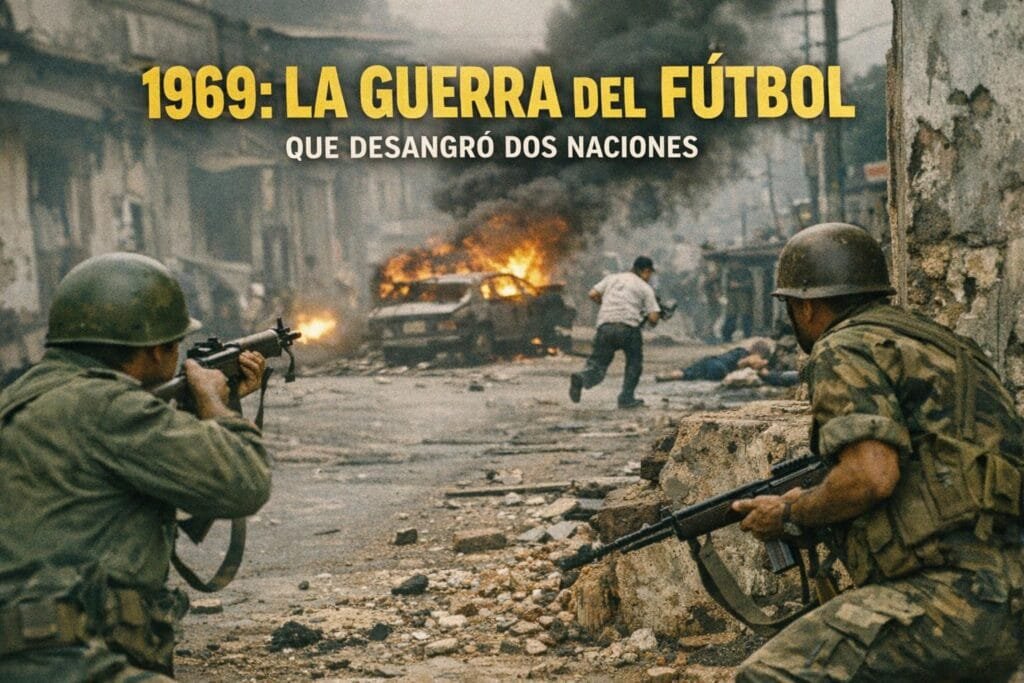
Ninety minutes of pure adrenaline. A roaring stadium, thousands holding their breath with every pass and shot. A goal can mean glory; a miss, tragedy. But what if a soccer result once meant more than qualifying for a World Cup—what if it could help seal the fate of two nations and lead to an armed conflict? It sounds like a macabre joke or sports hyperbole, right? But in 1969, the ball did more than roll: it became part of the story of the notorious Football War between Honduras and El Salvador.
With hindsight, it is one of those stories that makes you raise an eyebrow and ask, “Seriously?” How could a sport capable of bringing people of different faiths and backgrounds together also become part of a bloodbath? The irony hurts. This was not merely a rivalry on the field. It was the culmination of deep political, social and economic tensions; the referee’s final whistle became, in effect, a signal for tanks to roll.
This short documentary sums up the atmosphere and escalation of events:
Tensions beneath the surface: much more than a ball
To understand the story, we need to take our eyes off the ball for a moment and look at the context. By the late 1960s, relations between Honduras and El Salvador were a powder keg. El Salvador was small and densely populated, with an agricultural economy dependent on exports, especially coffee. Its population was growing rapidly, and land was scarce. Many Salvadorans migrated to neighboring Honduras, a much larger country with extensive fertile land.
Tens of thousands of Salvadorans settled in Honduras, often farming land without title. For years, this was tolerated and served as an outlet for population pressure in El Salvador. Then things changed sharply. In 1962, Honduras passed a new agrarian reform law that, on paper, aimed to redistribute land to Honduran farmers. In practice, it began to be used to expel Salvadoran farmers, many of whom had lived in Honduras for decades.
Under pressure from its own farmers and a conservative elite, the Honduran government found a convenient scapegoat for domestic problems in “illegal immigrants.” Media in both countries fanned nationalism and xenophobia. The situation was ready to explode. As history keeps teaching us, people can always find a “reason” to justify a conflict, however absurd it may sound.
The matches: the spark that caught fire
Then came soccer. The qualifying series for the 1970 World Cup in Mexico provided a perfect excuse—or perhaps the final push. The draw matched Honduras and El Salvador in a tense two-leg series in June 1969. Anticipation was intense; the atmosphere suffocating.
- First match: June 8, 1969, Tegucigalpa, Honduras. The atmosphere in the Honduran capital was electric, and not in a good way. There were riots, attacks on Salvadoran fans and tension before and after the game. Honduras won 1–0, but it was a bittersweet victory. Salvadoran media reported that a young woman died by suicide after the humiliating loss; her televised funeral was used as nationalist propaganda.
- Second match: June 15, 1969, San Salvador, El Salvador. Revenge was in the air. Salvadoran authorities did not do enough to protect Honduran fans, to put it mildly. More serious riots followed, along with attacks on the Honduran flag and the burning of vehicles and property associated with Salvadorans carrying Honduran license plates—though many were Hondurans of Salvadoran descent. El Salvador won decisively, 3–0.
With each side having one win, a tiebreaker was needed at a neutral venue. The irony of playing in a third country to decide who would go to the World Cup, as diplomatic relations between the two opponents crumbled, is almost poetic.
The tiebreaker: a point of no return
On June 27, 1969, the decisive game took place in Mexico City. El Salvador won 3–2 in overtime. Joy on one side and despair on the other were intense, but soccer was no longer the only issue. Two days later, El Salvador severed diplomatic relations with Honduras, citing attacks and abuses against its citizens on Honduran soil. The machinery of war was already moving.
Four days of hell: when the goal became a battlefront
What followed was a military frenzy. On July 14, 1969, Salvadoran forces launched a land and air offensive against Honduras. War had begun less than a month after the soccer series. The speed of the shift from stadium chants to artillery fire was astonishing, almost as if both governments had been waiting for a moment to justify what was already becoming inevitable.
The Salvadoran Air Force bombed the airport in Tegucigalpa and several border towns while ground troops advanced across the frontier. The stated aim was to force Honduras to stop expelling Salvadorans and pay compensation. Honduras responded, and despite having a less well-equipped army, it resisted.
Outdated aircraft such as P-51 Mustangs and F4U Corsairs fought aerial duels reminiscent of World War II. Blood was shed, homes burned, and soccer fields gave way to battlefields. In just four days, the war killed thousands—mostly civilians—and displaced tens of thousands more. Estimates put the death toll at around 4,000, a shocking number for such a brief conflict and a measure of the brutality and lack of preparation on both sides.
The final whistle and a bitter legacy
The Organization of American States (OAS) played a crucial role in stopping the violence. Under intense international pressure, a cease-fire was reached on July 18. Peace did not arrive overnight: Salvadoran troops withdrew from Honduras in August, and negotiations dragged on for years.
The Football War—a name that minimizes the real tragedy, do you not think?—did not solve any underlying problems. It made them worse. Border disputes continued, and the countries did not sign a final peace treaty in Lima, Peru, until 1980, eleven years later. Some territorial disputes were not resolved until a 1992 ruling by the International Court of Justice.
It is a disturbing reminder that simple, noble passions such as love of sport can be manipulated and turned into tools of hate when political and social foundations are already cracked. The paradox of an event that should have brought people together—or at least offered a distraction—becoming part of a war is one of history’s darkest ironies. Was soccer really to blame, or was it a scapegoat for problems that were already rotting beneath the surface? As usual, the answer is more complicated than it first appears.
Stories like this, which sound as if they came from a novel, remind us that history is full of unexpected and often absurd turns. If this one blew your mind, do not stop here—the world is full of many more.