
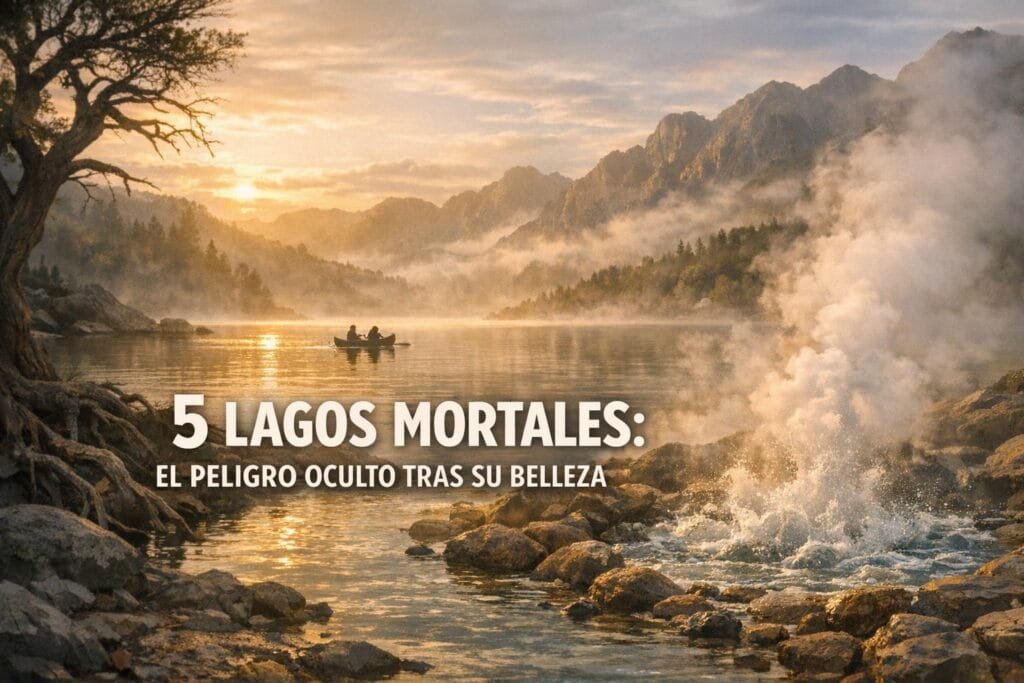
Sometimes beauty is a trap. Have you ever wondered whether, in our search for remote paradises and idyllic landscapes, we might be walking straight into one of the deadliest traps nature has designed? We are drawn to the forbidden and the extreme, as if brushing up against danger reminds us we are alive. But I promise you: with these five lakes, that feeling of living intensely could end in a very, very permanent way. Mother Nature has a twisted sense of humor, and these bodies of water are her masterpiece of irony.
Forget refreshing swims and romantic boat rides. Here is a list of places whose apparent calm hides a death sentence for anyone who dares to test their limits. Get your thinking cap and your adventurous spirit ready (but stay safely behind your screen), because the world really is mind-blowing.
Before we go on, here is a video to show you the kind of “dangerous beauty” we mean. Hit play—and keep your distance, at least mentally.
Boiling Lake, Dominica: the devil’s stew
Imagine a lake that is not just hot, but boiling. Literally. In the heart of Dominica’s Morne Trois Pitons National Park, a UNESCO World Heritage Site, lies Boiling Lake, a flooded crater and the world’s second-largest hot spring. Its name is no exaggeration: temperatures around the edges hover between 180°F and 198°F, while the center—where steam bubbles furiously—reaches the boiling point. It is as if the Earth were cooking its own soup of rock and sulfur.
Get too close and the toxic steam is a blunt warning; slip and fall into the water, and you will be cooked alive. It is not just the heat. The high concentration of minerals and volcanic gases also makes this an unforgettable experience… for those who live to tell the tale from a safe distance. It is terrifyingly beautiful: a giant, water-covered fumarole reminding you who is in charge on this planet.
Lake Karachay, Russia: invisible radiation
From a boiling hell we move to an invisible one, just as deadly. Hidden in Russia’s remote Ural Mountains is Lake Karachay, once regarded as the most contaminated and radioactive place on Earth. For decades during the Cold War, the Soviet Union used it as a dumping ground for nuclear waste from the Mayak reprocessing plant, as documented in a report on radiological conditions at Mayak. It did so with all the care of an elephant in a china shop.
It is estimated that an hour on its banks in the 1990s could have been fatal. Today, efforts to cover it with concrete and rocks have reduced the danger, but it remains an extremely hazardous place. The irony of a lake that looks calm and peaceful while hiding the fury of a thousand extinguished suns is chilling. It is the embodiment of a weapon of mass destruction that does not need to explode to kill; it works silently, cell by cell. A swim here would bring you much too close to the idea of “disintegration.”
Lake Nyos, Cameroon: the silent killer
This lake is a reminder that not every threat is obvious. In 1986, Lake Nyos, an idyllic crater lake in Cameroon, suddenly became a weapon of mass destruction. Without warning, an immense bubble of carbon dioxide (CO₂) burst from its depths, creating an invisible, deadly cloud that slid down the volcanic slopes. The result was unimaginable: more than 1,700 people and thousands of animals suffocated in their sleep, without understanding what was killing them.
The cause? The lake is one of the world’s few “exploding lakes,” or “killer lakes”, where volcanic CO₂ seeps up from underground and accumulates under enormous pressure at the lake bottom. A landslide, minor eruption, or even heavy rain can release the deadly gas. Degassing pipes have since been installed to prevent another catastrophe, but the memory of that day—when the air itself became poison—is a chilling reminder that the most beautiful things can be the most treacherous.
Laguna Caliente, Costa Rica: natural acid
If you thought water meant life, Laguna Caliente in Costa Rica’s Poás Volcano will prove otherwise, with acidity worthy of a chemistry lab. This crater lake is among the most acidic on the planet, with a pH that sometimes drops to zero, making its water as corrosive as car-battery acid.
Its deceptively beautiful turquoise color comes from volcanic minerals dissolved in the extreme water. Sulfurous fumaroles around it help maintain the acidity, which means the lake is not only toxic to any life trying to inhabit it; its gases are also dangerous to inhale. A dip here would not be a bath—it would be dissolution. It is a perfect example of how a spectacular landscape can be the gateway to a painful, irreversible goodbye to your skin and organs.
Lake Kivu, Rwanda/DR Congo: the time bomb beneath the water
Finally, we reach a lake that is a global time bomb. Lake Kivu, on the border between Rwanda and the Democratic Republic of the Congo, is an African giant holding something far more dangerous than water: billions of cubic meters of carbon dioxide and methane dissolved in its depths. Picture it: beneath a lake that is home to millions of people—and from which gas is extracted for energy—a massive concentration of lethal gases is building up.
Like Nyos, Kivu is an exploding lake, but on a much larger scale. If something disturbed its layers—a volcanic eruption, an earthquake, or even minor seismic activity—it could trigger a massive release of gas, known as a limnic eruption. That would create a suffocating cloud that could sweep through surrounding communities; the methane could also ignite, causing a huge explosion. It is nature’s sword of Damocles: serene beauty hiding the potential for an unprecedented catastrophe, a place where life coexists with the possibility of mass death.
So the next time you stand in front of a body of water of inexplicable beauty, take a moment. Ask yourself: is it an oasis or a mirage? Sometimes nature teaches us that the greatest danger is not the one that roars, but the one that whispers through a deceptively peaceful calm.