
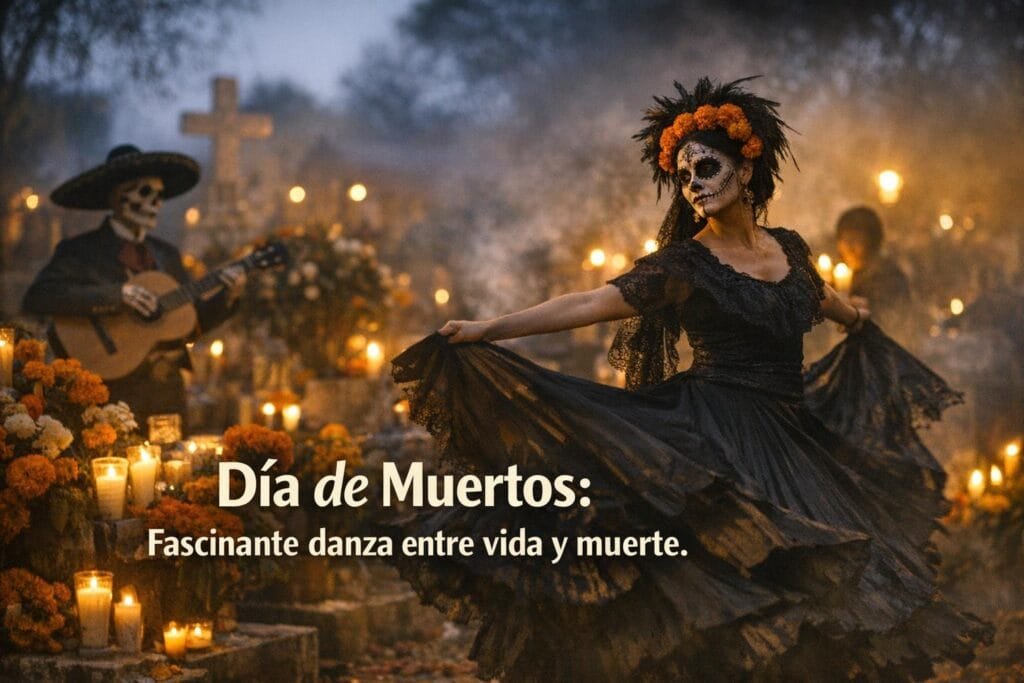
Death does not have to mean a sad ending or a final goodbye. For one culture, it is the perfect reason to throw a party—a lively celebration full of color, music and delicious aromas. That, in essence, is Mexico’s Day of the Dead, a tradition so deep and vibrant it may make you rethink everything you thought you knew about honoring those who are gone.
The scent of marigolds fills the house, mixing with sweet pan de muerto and the rich spice of mole. An altar rises in the dining room, where the family usually eats. But it is not a place for silent, solemn prayers. Not at all. It is there to welcome loved ones back, laying out a floral, fragrant path for those who will return from beyond for a few magical hours. Their photographs smile among candles whose light does more than illuminate: it guides. Can you picture it?
Forget spooky costumes and Halloween pumpkins. Here, death dresses up, laughs out loud and sits at the table to tell stories. UNESCO has recognized this tradition as Intangible Cultural Heritage of Humanity for good reason: it teaches us to celebrate life through death, not fear it.
To get a sense of the explosion of life and color, take a look at this video. The images are the perfect introduction to the magic of the celebration.
A feast for those who are gone: the heart of the offering
The heart of the festival is the ofrenda, an explosion of color, scent and meaning. It is not just an altar; it is an invitation. Every element has a purpose and is placed with love and devotion. What makes an ofrenda so powerful?
- Marigolds: Their vivid orange petals and unmistakable scent do more than decorate. They form a path that guides spirits from the underworld back to their homes—like a floral GPS for souls.
- Candles: Each flame is a beacon lighting the way home. Candles represent faith and hope; families may light one for each person they expect to welcome, plus an extra for forgotten souls.
- Water and salt: Water quenches the traveler’s thirst and purifies. Salt is also associated with purification and protecting the dead during their journey.
- Pan de muerto: This sweet bread, often decorated with shapes resembling bones and a tear, is one of the best-known symbols. It is a taste of home waiting after a long journey—and it is delicious.
- Sugar or chocolate skulls: Colorful sweets often carry the name of the deceased. They are not there to scare anyone; they help people remember, laugh at death and recognize it as part of life. Some are even made for the living.
- Favorite foods and drinks: Tamales, mole, atole, tequila, beer—whatever the departed loved. The idea is that their spirit can enjoy familiar earthly pleasures again. It is a proper feast.
- Personal belongings: Toys for children, tools for adults, photographs and clothes—objects cherished in life, anchoring the offering to the person people remember.
It is an act of generosity and nostalgia, but above all, of love: a tangible expression of the belief that our bonds with those we love do not break; they change.
Smiling skulls: an irreverent conversation with death
Have you noticed how familiarly—even playfully—skulls are treated during the Day of the Dead? Sugar skulls are a clear example, but one figure captures this relationship especially well: La Catrina.
This elegant female skeleton, wearing a French-style hat with an aristocratic air, was immortalized by printmaker José Guadalupe Posada in the early twentieth century. Originally, she was social criticism: a reminder that death levels everyone, no matter how wealthy or important. Even the rich end up as skeletons. Today La Catrina is a global icon of the Day of the Dead, representing a Mexican view of death not as a terrifying end but as a constant presence—sometimes mocking, sometimes elegant, always part of the cycle.
It is a universal truth expressed in a very particular way: many Mexicans do not hide death or fear it in silence. They sing to it, dance with it, eat with it and celebrate it. That is a philosophy of life—and part of what makes this tradition so special.
Ancient roots: when death was not the end
Where did this unique worldview come from? Its roots reach much further back than you might think, into the pre-Hispanic civilizations of Mesoamerica.
A journey to Mictlán and beyond
For cultures such as the Aztec, Maya and Purépecha, death was not the end of existence but the beginning of a journey to different realms or “paradises.” The Aztecs, for example, believed in Mictlán, the underworld, where souls faced a series of challenges. The living offered food and objects to help the dead make the journey. The seed of the ofrenda was already there.
The goddess Mictecacíhuatl, the “Lady of the Dead,” ruled Mictlán alongside her consort Mictlantecuhtli. Rather than simply representing fear, she embodied the continuing cycle of life and death. When Spanish conquistadors arrived, they tried to eradicate these “pagan” practices and impose Catholicism. But Indigenous worldviews were so deeply rooted that, instead of disappearing, they blended with the new religion in a remarkable act of cultural syncretism.
Ancient celebrations shifted and adapted to the Catholic observances of All Saints’ Day and All Souls’ Day (November 1 and 2), giving rise to what we now know as the Day of the Dead. That cultural resilience is astonishing.
Beyond the veil: a bond that endures
At the end of the day, beyond the flowers, candles and sweet bread, the Day of the Dead is a powerful reminder of continuity. It invites us to reflect not on the sadness of loss, but on the richness of memory and the strength of family bonds.
This tradition shows that mourning does not have to be silent and dark. You can grieve an absence while celebrating the life that was. It lets people feel their ancestors’ presence not as ghosts from the past, but as part of the present, shaping who they are and the culture that defines them.
If death were a door, the Day of the Dead would be the moment it opens a crack, letting through a whisper, a fragrance or a fleeting memory of people we hope to see again. It is a beautiful paradox: by honoring death, people celebrate life with a passion and joy the rest of us can learn to appreciate. How would you celebrate the lives of those who are gone if you knew they could visit for one night?