
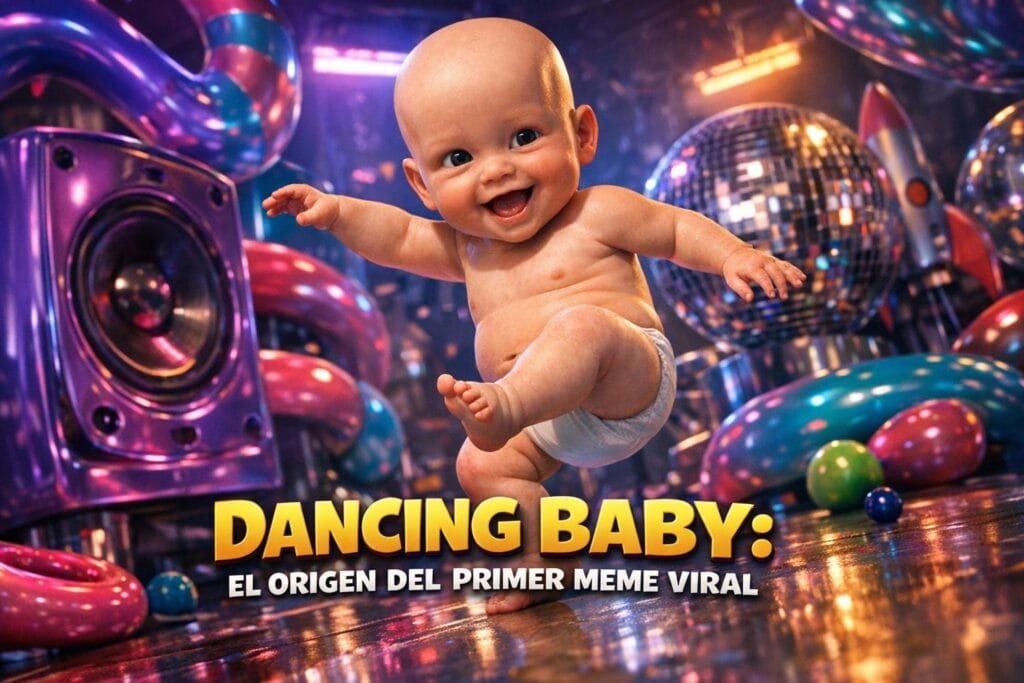
It was 1996. Broadband was a distant dream, and the sound of a modem connecting was the soundtrack to digital life. Back then, the internet—that vast ocean of information—was little more than a babbling puddle, a corner for academics, tech enthusiasts, and the occasional curious pioneer. There was no YouTube, no TikTok, not even Facebook. The idea of a viral video was as exotic as a flying car.
Then, out of nowhere, with no warning, an animated baby began dancing on your computer screen. The moves were clumsy and repetitive, almost unsettling in their primitiveness, but somehow they made you laugh. You forwarded it. Your friends forwarded it. Suddenly, that baby was everywhere. It was the Dancing Baby, and no one had any idea they were witnessing the birth of history’s first viral meme—long before phenomena such as Star Wars Kid: the early viral video and its lesson in privacy showed us the consequences of unwanted fame. The ultimate irony? Something so trivial laid the groundwork for how we communicate today.
To understand the impact of something so simple, the best thing is to see it in action. Here is one of the original clips that started it all:
A test animation: how a star was born by accident
The story of this dancing infant did not begin in a boardroom with a brilliant marketing plan. It began in the most ordinary corner of digital creation: a test file. In the mid-1990s, 3D animation was still in its infancy for the general public. Software such as Kinetix Character Studio (later part of 3D Studio Max) aimed to show off what its technology could do, especially its ability to create and animate 3D human models with relative ease.
In that setting, developer Michael Girard used a small baby model to test skeletal animation and inverse kinematics. The 3D baby came from a program called LifeForms, and the movement—the famous dance—was a motion-data clip called “cha-cha.” It was not a real cha-cha, of course, but a generic animation showing what the character could do. The goal was simply to demonstrate the software’s potential: a routine task, a temporary file, a “Hey, look what this can do.” No one in that office imagined the little technical exercise would become a global phenomenon.
Analog virality in the pre-YouTube era
Today, going viral is a matter of clicks and algorithms. In 1996, it was a hands-on feat. The Dancing Baby, originally known as “Baby Cha-Cha,” first spread through specialist animation forums and Usenet newsgroups. Then it jumped to email, the information superhighway of the day: forwarded messages, chains hopping from PC to PC, and floppy disks changing hands.
Think about it: for that baby to reach your inbox, someone had to download it, save it, and attach it to an email that might take several minutes to send over a 28.8 kbps connection. The effort people put into sharing it says a lot about its power to fascinate. It was so absurdly simple and captivating that people were willing to spend time and resources (yes, connection time cost money) just to show their friends. There was no easy “upload” or “share” button. Sending it was a statement: “You have to see this.”
From PC screen to TV fame: an unexpected celebrity
The Dancing Baby did not stay in the internet-enthusiast niche. In a turn that cemented its status as a cultural icon, it made the leap to television. Its most notable appearance was on Fox’s popular series Ally McBeal. Remember the sequence in which Ally starts seeing a dancing baby everywhere, as a manifestation of her biological clock or inner anxiety? That was him. The same baby, with the same clumsy moves, now woven into a hit TV story.
This crossover mattered. The phenomenon was already big online, but television took it to a new stratosphere, introducing it to a mass audience that might never have touched a computer. Suddenly, the “internet dancing baby” became a shared cultural reference, a bridge between the emerging digital world and traditional entertainment. It was perhaps the first major example of something born online influencing and being adopted by mainstream culture—a pattern we now take for granted.
The legacy of a digital dance: when something trivial changes history
The Dancing Baby is much more than a nostalgic ’90s curiosity. It is a foundation stone of meme culture, a tradition with deeper roots than we might imagine, as stories such as the oldest meme in the world, carved into stone, show. The baby taught millions, for the first time, the power of visual repetition, absurd humor, and a network’s ability to take something and amplify it beyond anyone’s expectations.
It was the ancestor of GIFs, viral TikTok videos, and later phenomena that would even challenge the idea of money, as Doge: the Shiba Inu meme that became a cryptocurrency did. It showed us that you do not need a big production, a profound message, or even an intention. Sometimes all it takes is a dancing baby, accidentally created in animation software, to connect millions of people through a shared laugh. The irony that its creators never sought fame—and that their “work” spread without control or monetization—echoes the anarchic, spontaneous nature of the early internet.
Looking back, it is almost comical how that little test file foreshadowed a future in which fleeting images and videos dominate our communication. It was the spark of a revolution, a reminder that the biggest innovations often begin in the most unexpected corners—and that sometimes the most mind-blowing thing in the world is simply a dancing baby.
What other unexpected stories and curiosities are hidden in the annals of digital culture? Keep exploring the most surprising corners of our world here at El Mundo es Flipante.