
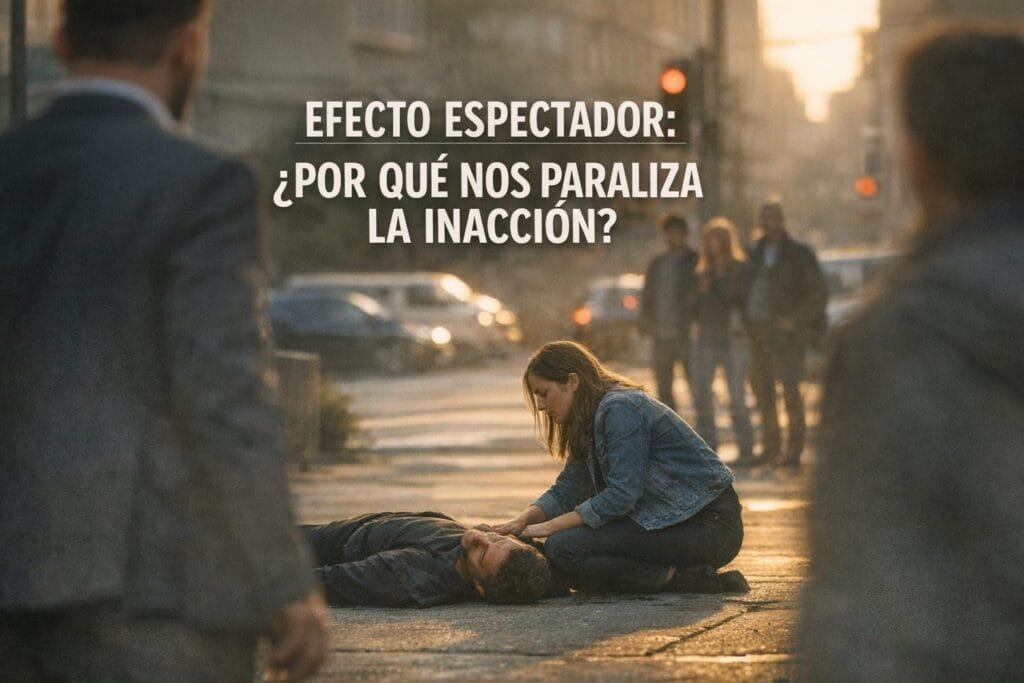
You think you would be a hero, right? The kind of person who rushes in without hesitation when someone needs help. But if twenty other people are standing around, there is a good chance none of you will do a thing. It does not mean we are all bad people. It means we are human—and sometimes human nature is gloriously absurd.
Picture this: New York City, the night of March 13, 1964. Kitty Genovese is walking home from work when an attacker brutally assaults and stabs her. Her screams cut through the quiet. Lights come on in nearby apartments; windows open. At least 38 people reportedly witnessed some part of what happened, directly or indirectly. Some heard the attack; others saw it. The police did not receive the first call until about half an hour after it began. By the time they arrived, Kitty was dead. The most chilling part was not only the crime, but the collective paralysis around it: dozens of people, yet no timely direct intervention or call for help.
The case shook the public and helped inspire one of social psychology’s most intriguing and discouraging ideas: the bystander effect. The supposed safety of numbers can backfire: when other people are present, the chance that any one person will help may go down. When you are alone, you are the only one who can act. In a crowd, responsibility can dissolve like sugar in hot coffee.
Here is a quick, visual explanation of the experiment that popularized the term—and why a crowd is not always the same thing as safety:
The thin line between concern and indifference
What happened to Kitty Genovese confronts us with an uncomfortable truth: our moral instincts are not always unshakable; they can shift with the social situation. The witnesses were not necessarily heartless monsters. Social psychologists Bibb Latané and John Darley tried to understand why people sometimes fail to act. In their influential research, they described several psychological forces that can combine in a crowd and cloud our judgment.
The main culprit is diffusion of responsibility. If you are the only witness to an emergency, the burden of acting falls squarely on you. If fifty other people are there, that burden is spread across the group, and each person may feel only a tiny share. You think, “Someone else will do it. Someone else will call. Someone else knows what to do.” Of course, everyone may be thinking the same thing. It resembles the social loafing described by the Ringelmann effect, where individual effort also fades in a group. It is a kind of failed democracy in which everyone votes to do nothing.
The invisible barriers to helping
Diffusion of responsibility is not the only force at work. Other accomplices can nudge us toward inaction:
- Ambiguity: Is it a fight or a game? Is someone drowning or just splashing around? Emergencies are not always obvious. Afraid of looking foolish or overreacting, people watch everyone else. If everyone is waiting for someone else to interpret the scene—and nobody moves—the group can conclude that it is not an emergency or that someone else has it covered. Inaction feeds on itself.
- Fear of being judged: What if I get involved when I should not? What if I make things worse? What if people laugh at my badly judged “heroics”? For many of us, acting alone and being wrong feels more frightening than doing nothing. That may be the price of socialization.
- Assumed competence: “Someone here must know first aid better than I do,” or “that bigger person is better equipped to step in.” We mentally hand the task to an imaginary expert who may not exist—or may be waiting for someone else to act.
It is fascinating and depressing that other people’s presence—something that should make a place feel safer—can turn us into statues. A city built on millions of connections can become a tangle of disconnections when someone is in trouble. Deep down, most of us want help if something happens to us. The question is whether we are willing to be the first to offer it.
Breaking the spell
Are we doomed to freeze whenever there is a crowd? Fortunately, no. Understanding the bystander effect is the first step toward countering it. If you think someone needs help, a few simple actions can break that social paralysis:
- Be direct and specific: Instead of shouting, “Somebody help!”, point to one person. “You, in the red jacket—call 911 now and tell them someone has collapsed.” Giving someone a clear task makes it harder for responsibility to diffuse across the crowd.
- Make the situation clear: If it is ambiguous, describe what you see out loud: “This person may be having a seizure,” or “That dog is trapped.” Naming the emergency helps others recognize that it is real and urgent.
- Set the example: Sometimes all it takes is one person taking the first step. Courage can be contagious. If you start helping, others are more likely to join in.
This is not about becoming a comic-book hero. It is about understanding how our minds work in groups—and sometimes pushing back. The next time you witness something in a crowd, remember Kitty Genovese. The problem may not be cruelty so much as psychology, and you can help break that peculiar spell. There is something beautifully contradictory about it: sometimes we have to fight what the crowd does to us in order to be more human.
If group psychology fascinates you, explore some of the other strange traps we fall into. You might want to learn about confirmation bias and the secret to challenging your beliefs, or how collective memory can mislead us in the story of the Mandela Effect and false memories.