
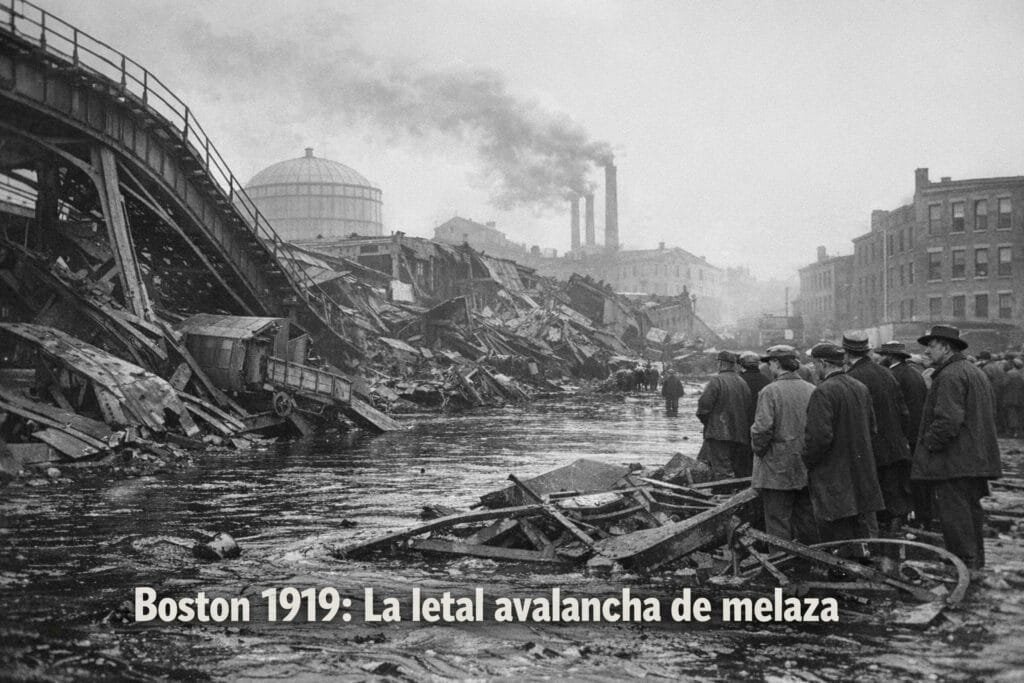
It was January 15, 1919, a cold winter day in Boston. Early that afternoon, January’s sun could not warm the air, but life was bustling in the North End. Then, without warning, a deafening roar shattered the calm. People who heard it described a runaway train, an impossible thunderclap, even a cannon blast. What followed defied logic. Instead of fire or rubble, a gigantic wave of… molasses surged through the streets.
Yes, you read that right. A sweet, sticky tide—and a deadly one. A wave of brown syrup swept away everything in its path at roughly 30 miles per hour. Can you picture it? People drowning, dragged under by a viscous torrent of sweetness? It sounds like history’s macabre joke, so bizarre that without solid documentation we might dismiss it as one of those impossible urban legends.
To put images to what sounds like a fever dream, here is a video that recreates and explains the disaster without interrupting the story.
The giant molasses tank that loomed in silence
To understand this very unusual catastrophe, we need to step back and look at its epicenter: a gigantic steel tank about 50 feet tall and 90 feet across, capable of holding nearly 2.3 million gallons of molasses. It belonged to the Purity Distilling Company and stood in Boston’s North End, near the harbor. It was not just a warehouse. In those years, molasses was a key ingredient in rum and, more importantly during World War I and its aftermath, industrial alcohol used in explosives. Demand was enormous, and the dark tank was usually filled to the brim.
People in the neighborhood had been complaining for some time. It was not only the sugary smell hanging in the air, a constant reminder of the tank. They had noticed leaks: small dark streams snaking down its walls and dripping onto the ground. Children in the neighborhood would sometimes collect the molasses to taste a forbidden treat. The company, however, ignored the warnings. Rumors said the tank had been shoddily built, rushed, and left without the necessary safety guarantees. The pressure to keep production moving—and perhaps the desire to save money—had planted the seed of what was to come.
An eruption of sugar and chaos
That January day, the temperature had risen slightly after a stretch of intense cold. This small change may have been the final catalyst. Stored at a low temperature, the molasses had become thicker and heavier. As it warmed, it may have fermented slightly, producing gas and increasing pressure inside an already overfilled, poorly built tank. The combination proved explosive.
When the structure gave way, it did not fail gradually. It burst with unimaginable force, releasing a wave of molasses that reached as high as 25 feet in some places. Picture it: a dark, churning, dense mass racing down Boston’s narrow, crowded streets like a dessert tsunami. The shock wave was so powerful that the tank’s rivets shot out like bullets, some traveling as far as two blocks.
The scene was surreal and terrifying:
- People were swept away and crushed by the sticky surge.
- Entire wooden buildings were torn from their foundations.
- A truck was lifted and overturned, and a train was derailed.
- Horses, helpless, drowned in the thick liquid, their kicking useless.
The molasses was not just a sugary mass. It was hot, adding burns to the already devastating wave. The liquid was so dense that, once the main current subsided, moving through it was like trying to swim in tar. Victims covered from head to toe fought desperately, but the weight and viscosity trapped and slowly suffocated them.
The tragedy’s long, sweet legacy
The toll was devastating: 21 people died, and around 150 were injured. Emergency crews faced an unprecedented challenge. How do you rescue people from a sea of molasses? Firefighters, police officers, and volunteers had to force their way through the thick, sticky sludge, often using saltwater hoses to dissolve the syrup and free people who were trapped. Cleanup took weeks, and the sweet, cloying smell is said to have lingered in the North End for decades, especially on hot days.
But the Great Boston Molasses Flood was more than a macabre anecdote. It triggered one of the longest and most complex lawsuits in Massachusetts history. The courts took years to determine the Purity Distilling Company’s liability. The investigation uncovered a series of failures in the tank’s construction and maintenance: walls that were too thin, low-quality materials, and poorly installed rivets. It was industrial negligence at its worst.
The bizarre disaster was a painful reminder of the importance of safety in industrial infrastructure. In its aftermath, stricter rules for building and inspecting large tanks and similar structures were adopted across the United States. It also helped establish precedents for corporate responsibility where standards had previously been weak or nonexistent.
So the next time you encounter a sweet memory—maple syrup or a spoonful of molasses—take a moment. Think of that winter in 1919, when sweetness turned into a destructive, deadly force on Boston’s streets. The story teaches us that sometimes the strangest dangers and hardest lessons arrive disguised as something unexpected.
Ready to uncover more chapters where history is stranger than fiction? There is always another surprise waiting at El Mundo es Flipante.
If you want to keep pulling at the thread, here is another historical mystery that is hard to explain.