
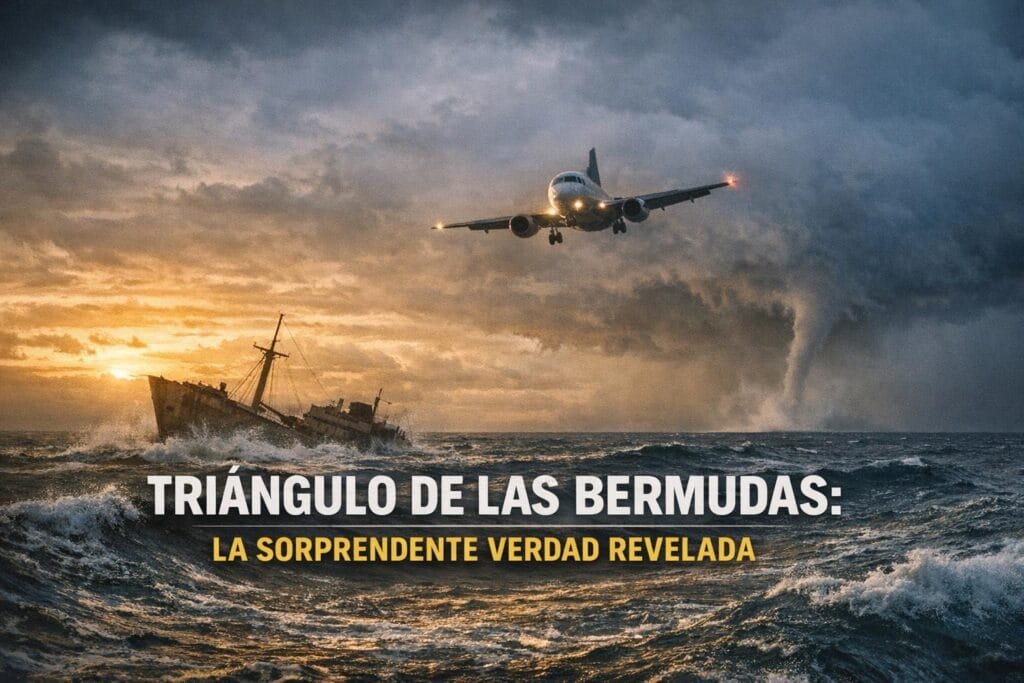
If there is one thing we love as a species, it is a good mystery. Add planes that vanish without a trace and ships swallowed by waves, and we love it even more. The Bermuda Triangle is our favorite ocean ghost story—the one whispered in your ear to make you think twice before sailing those waters. But what if the only black magic there is our human talent for seeing patterns where there is only statistics and, sometimes, a healthy dose of bad luck?
For decades, this imaginary region in the western Atlantic—roughly connecting Bermuda, Puerto Rico and Miami—has inspired endless speculation. Dimensional portals, alien technology, sea monsters, the fury of a sunken Atlantis: anything goes when the simplest explanation sounds too boring. So let us switch off “X-Files” mode for a moment and look at the blunt, occasionally ironic reality.
To get a feel for the scale of this ocean mystery, here is a short documentary that sums up both the Bermuda Triangle’s stories and the evidence. Hit play:
The infamous legend of famous disappearances
You cannot talk about the Bermuda Triangle without mentioning the disappearances that built its notorious reputation. And, to be honest, these are the kinds of stories that grab you. The best known is Flight 19. In December 1945, five U.S. Navy bombers disappeared during a training exercise, along with a seaplane sent to search for them. No trace. Nothing. Lost in a fight with the ocean. The Navy’s official report listed “causes or reasons unknown”—a gift to the popular imagination.
Then there is the mighty USS Cyclops, a huge U.S. Navy ship carrying manganese ore that vanished in 1918 with 306 people aboard. At 542 feet long, enormous for its time, it disappeared without sending a distress call. And the list goes on: passenger planes, cargo ships and pleasure yachts. Each case became another piece in the puzzle of the impossible.
Is it really a disappearance hot spot?
This is where the myth runs into a much more ordinary reality. Look at the numbers calmly and you will find that the Bermuda Triangle is one of the busiest shipping and flight corridors on the planet. Hundreds of thousands of ships and planes cross its waters and skies every year. Compared with that traffic, the number of serious incidents is not significantly higher than in other busy ocean regions.
In fact, the U.S. Coast Guard and other maritime authorities have never recognized a uniquely dangerous “triangle.” Their records do not show an unusual increase in disappearances or accidents there compared with other high-traffic coastal areas. What they do find in many incidents is a familiar factor: people encountering natural forces, often with predictable results when those forces are ignored.
When science meets land—and water
So what lies behind the events that feed the legend? Science offers several explanations that are less exciting than alien abductions but much more plausible:
Treacherous pockets of methane
Picture large deposits of methane hydrates beneath the Bermuda Triangle’s seafloor: methane frozen under high pressure and low temperatures. If those hydrates destabilized—because of an underwater earthquake or a temperature change, for example—the methane could escape rapidly in enormous bubbles. If a ship were directly above, the water could become much less dense, sharply reducing its buoyancy. The vessel might sink without a trace or enough time to send a distress call. A massive gas release could also create severe turbulence for aircraft, or even cause engine problems by displacing oxygen if the gas reached the atmosphere.
The oldest enemy: bad weather
Never underestimate the ocean’s fury. The Bermuda Triangle is known for sudden, violent weather changes. Tropical storms, hurricanes and giant waves can appear with little warning, swallow vessels or bring down aircraft in minutes. The pilots of Flight 19, for example, were disoriented in a storm, and their radios were failing. That is a perfect recipe for disaster, mystique or no mystique.
Human error and technical trouble
The truth is often simpler and less glamorous: mechanical failures, navigation mistakes, running out of fuel, inexperienced pilots or captains. Many incidents can be explained by a combination of these causes. At sea, a small error can quickly grow into a catastrophe with no chance of rescue—especially if no distress call is sent, or if it never gets through.
Magnetic quirks and powerful currents
Earth’s magnetic field really does have variations, although they are often exaggerated in Bermuda Triangle stories. One peculiarity is that the region lies along one of the few areas where true north and magnetic north can align on certain agonic lines. A navigator or pilot unfamiliar with the phenomenon may be thrown off if they do not account for it. The area’s ocean currents are also extremely strong and can scatter wreckage quickly, making search-and-rescue operations much harder.
The paradox of a mystery that will not go away
It is fascinating that the Bermuda Triangle myth refuses to disappear, even with rational explanations in hand. Maybe we prefer the intrigue of the unknown to the ordinary explanations of gas pockets or miscalculations. We love the idea of a hidden force beyond our understanding rather than accepting that sometimes nature is simply relentless—and humans are fallible.
The Bermuda Triangle reminds us that even in a world increasingly mapped and understood, there will always be corners where reality blurs into legend, and a simple truth can sound less convincing than an elaborate theory. That is how we are. And that is why, at El Mundo es Flipante, we keep digging up these curious contradictions. Ready to keep exploring?