
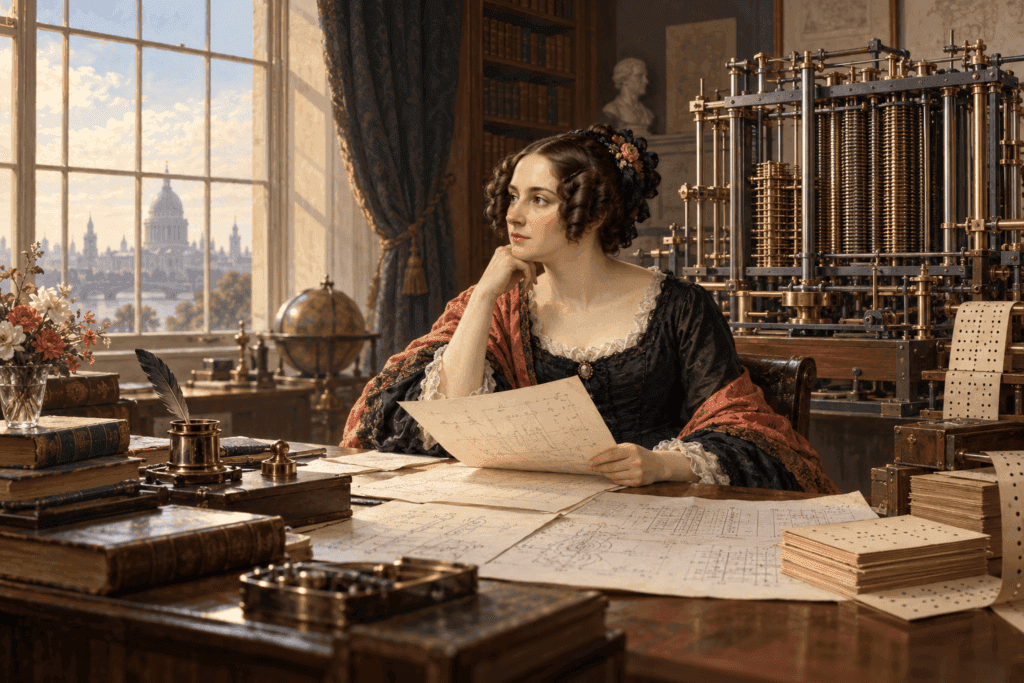
In 1843, Ada Lovelace wrote a sequence of instructions for a machine that had not yet been built. There was no screen, keyboard, or power plug. There were gears, punched cards, and an idea more consequential than any component: a machine could follow ordered steps and work with symbols, not just numbers.
The scene sounds modest—a woman writing notes in the margins of a technical paper—but it hid a change in scale. While most people saw a giant calculator, Lovelace imagined a machine capable of carrying out general operations. She never saw it work. That is exactly why her story asks us to separate the real achievement from the easy headline.
The note that turned a translation into something more
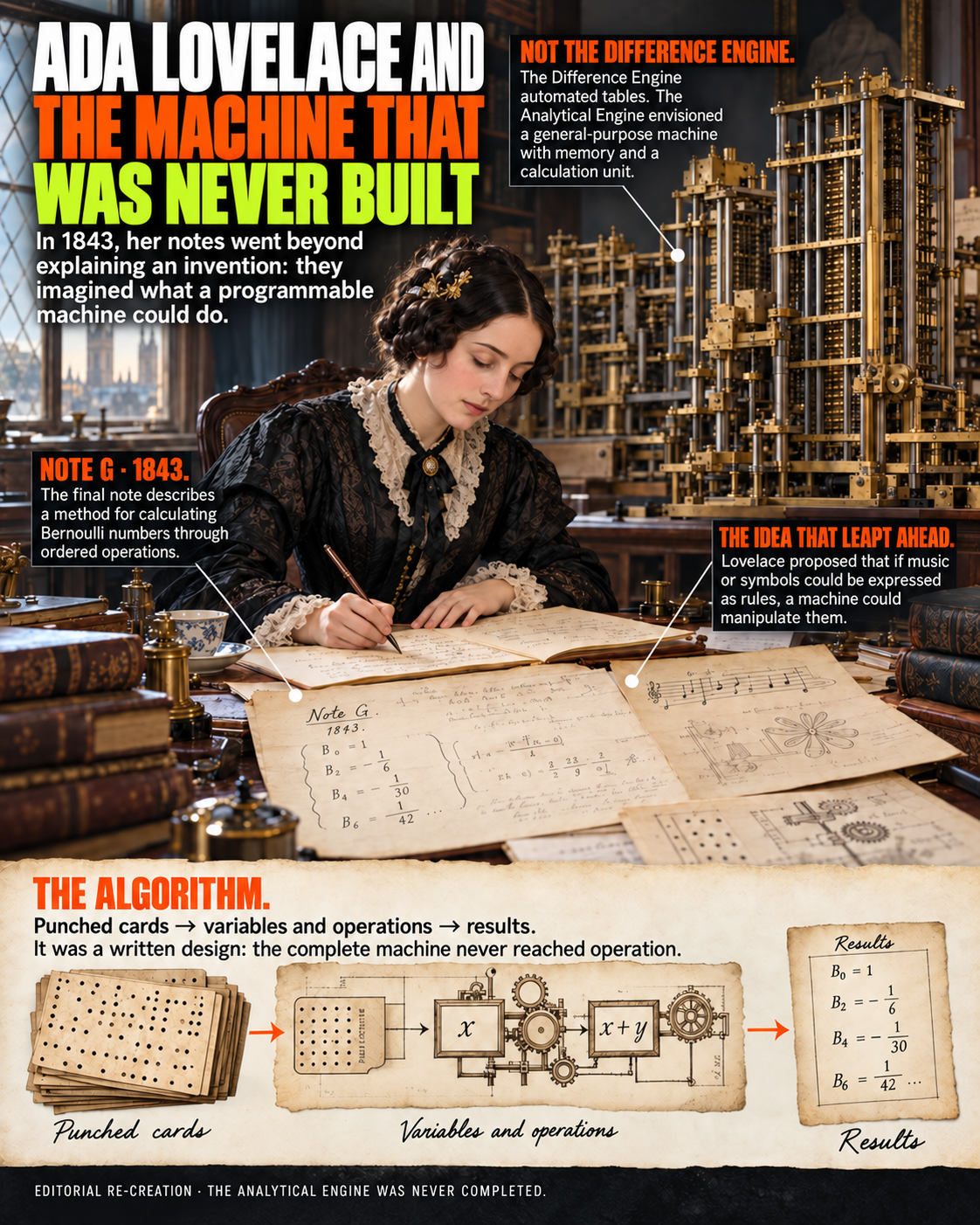
It began with a paper by Italian engineer Luigi Federico Menabrea about Charles Babbage’s Analytical Engine. Lovelace translated it into English and added a set of notes far longer than the original. The last one, known as Note G, described a procedure for calculating Bernoulli numbers with the machine.
It was not a list of commands for a modern computer, but it was a detailed description of linked operations. The machine was meant to store intermediate results, reuse them, and follow a sequence that could be repeated. That logic looks more like a program than a simple multiplication table.
The Science Museum Group’s reproduction of the Analytical Engine notation reveals the less cinematic—and more important—details: columns, variables, and steps that should be read as an architecture of instructions. The achievement is not that Ada “predicted the laptop,” but that she grasped the abstract potential of a mechanical machine.
The Difference Engine was not the Analytical Engine
Here is where the names get confusing. Babbage first worked on the Difference Engine, designed to automate mathematical tables using successive differences. It was a specialized machine. Its goal was to produce specific results with fewer human errors.
The Analytical Engine was a different creature. It included a calculating unit, memory, control, and input through punched cards inspired by Jacquard looms. In modern terms, the comparison would be between a highly sophisticated calculator and a programmable, general-purpose machine.
The Science Museum’s Analytical Engine model helps explain the paradox: we can look at real components from a machine that was never completed as an operational project. The metal exists; the complete machine does not.
The decisive idea: numbers could stand for something else
Lovelace’s most modern insight appears when she suggests that a machine could act on things other than numbers if those things could be expressed through rules. A sequence of symbols, a musical composition, or a logical structure could all be handled according to the same principle.
That is where she moves beyond the image of a brilliant calculator who can do sums faster. Ada was thinking about representation: if an idea can be translated into symbols and those symbols follow rules, a machine can manipulate them.
The concept still feels familiar today. An audio file is not “music” inside a computer; it is an encoded sequence the system interprets. A photograph does not arrive as a landscape, but as organized data. Lovelace could not foresee digital formats, but she understood the bridge between an abstract instruction and a mechanical operation.
Was she the first programmer?
The label works beautifully in a headline and needs more care in an article. Note G is often considered the first published, detailed program for a general-purpose machine. That makes Lovelace a central figure in the history of programming.
But Babbage also wrote instructions and developed algorithms for his machines. So the more precise claim is not that Ada invented programming single-handedly from scratch, but that she produced an extraordinarily developed account of how the Analytical Engine could carry out a complex procedure.
The Computer History Museum preserves that double perspective: Lovelace’s collaboration with Babbage was real, but her contribution was far more than translation. Her notes expanded the machine into an idea of general-purpose computing.
Mathematics, education, and an uneasy collaboration
Ada received an unusually strong mathematics education for a woman of the British aristocracy in her day. Her mother, Annabella Milbanke, wanted to steer her away from Lord Byron’s romantic, unruly image and toward discipline, logic, and science.
Her intellectual relationship with Babbage was intense, though not always easy. He had the machine, the plans, and a monumental ambition; she brought a perspective that could explain what it all might mean. This was not a perfectly coordinated laboratory partnership. There were disagreements, delays, funding problems, and a project caught between engineering and politics.
Babbage’s story itself shows the practical limit: a machine with thousands of parts requires money, precise manufacturing, maintenance, and an administration able to support it for years. The idea could be a century ahead of the technology available to prove it.
A machine that never worked—and an idea that did
In 2015, the Science Museum completed a working version of the Difference Engine using Babbage’s plans. The reconstruction does not prove that the 1843 Analytical Engine would have worked without problems, but it does show that those designs were not decorative fantasy.
To see how this connection between blueprints and programming is explained today, watch The First Computer Program, which walks through Note G and the logic of Bernoulli numbers. It belongs here because it does not replace the explanation: it lets you see how a page of columns becomes an interpretable sequence.
Lovelace’s recognition came late. For decades, her notes circulated as a curiosity attached to Babbage. In the twentieth century, when computers stopped being a mechanical promise and became real technology, the idea of a machine that could manipulate symbols took on new meaning.
Her legacy is not a prophecy, but a method
Lovelace did not predict the internet, smartphones, or artificial intelligence. Her achievement is less spectacular and more solid: she described a way of thinking about machines before the infrastructure existed to prove it.
That is why it is worth remembering her without turning her into the patron saint of every computer. Ada worked within a network of ideas, plans, and discussions shared with Babbage and other mathematicians. Her contribution was to recognize that a machine’s value did not depend only on the number it produced, but on the rules it could carry out.
The final irony is delicious: she wrote a program for a machine that could not obey her. And yet the instruction outlived the metal, the failed budgets, and the author herself. When a computer today processes an image, a melody, or a conversation, we are still living inside that insight: first the world is translated into symbols; then a machine learns to move them around.
Sources used for this article
- Science Museum Group: Ada Lovelace — biographical context and her connection to the Analytical Engine.
- Science Museum Group: Notation of the Analytical Engine — a reproduction of the notation and Note G.
- History of Science Museum, Oxford: Imagining AI — the difference between Babbage’s machines and modern reconstructions.
- Computer History Museum: Ada Lovelace — collaboration, the algorithm, and its historical reception.
- Max Planck Society: Ada Lovelace — her scientific education and the context for her work.
- The text of the 1843 notes — a digitized primary source for the notes Lovelace added.