
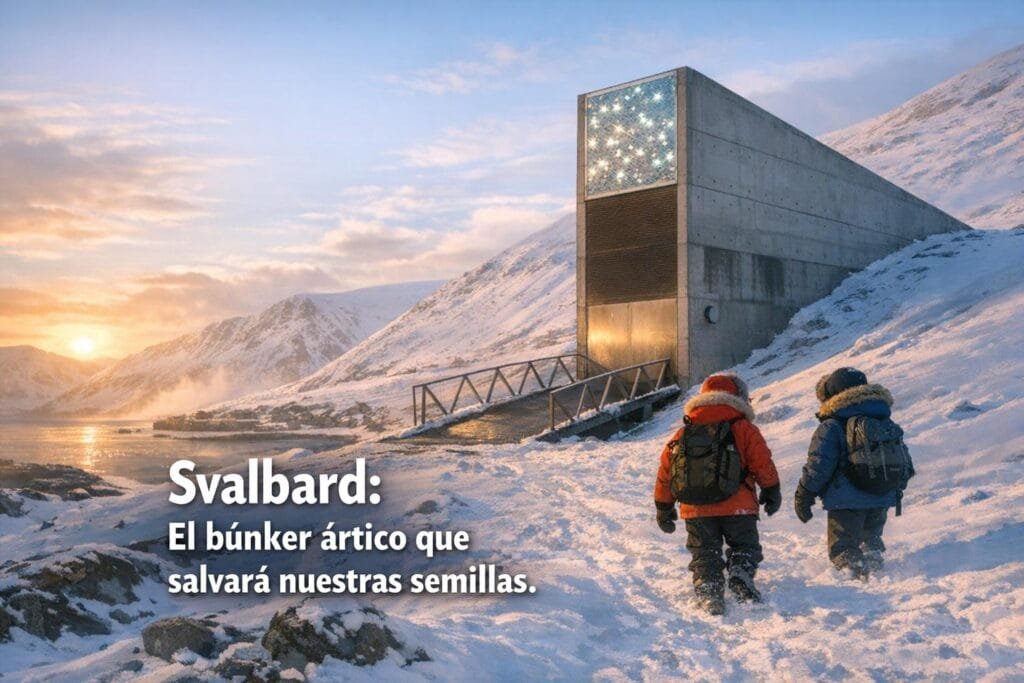
For centuries, humanity has perfected the art of self-destruction: wars, pollution, ecological disasters—a thousand ways to erase the world around us. Then, almost casually, we decided that just in case, we needed a bunker. Not a bunker for ourselves, no. A bunker for seeds. A Noah’s Ark designed, ironically, for a flood we may bring about ourselves.
I am talking about a place so remote and inhospitable that its very existence gives you chills. Hidden beneath the Arctic permafrost, in a corner of the planet where the sun decides whether to show up for months at a time, stands a monument to foresight—and human uncertainty. It is the Svalbard Global Seed Vault, a name that sounds like science fiction but is as real as the polar cold surrounding it.
To grasp the scale and isolation of the place, watch this video, which takes you to the vault’s entrance in the middle of the Arctic nowhere.
The doomsday bunker is in a forgotten corner
To get our bearings, travel in your mind to the Norwegian archipelago of Svalbard, halfway between mainland Norway and the North Pole. On the island of Spitsbergen, near the small settlement of Longyearbyen, sits the facility. It is not an imposing building rising above the landscape. In fact, all you see is a concrete entrance jutting out from a mountainside, as if the planet itself were spitting out a warning.
It is an outpost at the edge of the world, a place whose uniqueness recalls other geographic anomalies. If you love places like this, read about Baarle, the extraordinary border town between Belgium and the Netherlands.
The location was not chosen at random. The reasons reveal almost obsessive preparation for every kind of apocalyptic scenario:
- Geological stability: low seismic activity reduces earthquake risk.
- Permafrost: permanently frozen ground acts as a natural refrigerator, keeping temperatures around -3 to -4°C even if artificial cooling fails.
- Elevation: about 130 meters above sea level, protecting the facility from sea-level rise caused by melting ice or extreme tsunamis. Yes, they thought of that too.
- Political security: Norway is stable, and the 1920 Svalbard Treaty guarantees the archipelago’s demilitarized status, making it neutral ground.
So no, this is not a refuge for eccentric billionaires or a warehouse for secret documents. Its treasure is humbler and much more valuable: seeds. Billions of them, waiting for their moment.
The engineering of survival—and paranoia
Entering the vault is like going into the guts of an iceberg. A tunnel of steel and concrete about 120 meters long leads to three vaulted chambers, each roughly the size of a volleyball court. Seed samples sit on metal shelves, vacuum-packed in three-layer aluminum pouches and sealed inside boxes. Every box is a small biological treasure chest.
The vault currently holds more than 1.2 million seed samples—about five billion individual seeds—representing an extraordinary diversity of food crops from around the world: varieties of corn, wheat and rice, as well as lesser-known species vital to local food supplies. Each sample is an insurance policy against losing a particular variety to extinction.
What about security? Picture an impregnable fortress. Access is extremely restricted; only a handful of people hold the keys. There are multiple reinforced doors, motion sensors and surveillance cameras, while the remote location is itself a barrier. Anyone trying to break in would have to face not only technology but the Arctic outdoors. Let us say it is not an ideal place for a heist.
The basic idea is for Svalbard’s natural conditions and steady permafrost to act as a “passive” backup system. If the electricity fails—or humanity decides yet again that more urgent problems matter and forgets maintenance—the seeds should remain frozen for centuries. Here, cold is the most efficient and quietest guard.
A Noah’s Ark—or a reproach to the future?
The paradox of the Svalbard Vault is not only that it exists, but what its existence implies. It is insurance, yes, but insurance paid for with skepticism about our own ability to manage the planet. Its unspoken message is: “We do not trust ourselves to get this right, so we are keeping a backup copy just in case.”
Most of the seeds deposited here do not come from wealthy countries but from developing nations. They are collections from gene banks around the world that could lose their priceless genetic heritage because of armed conflict, natural disasters or simply a lack of resources.
The vault has already been used. During the Syrian civil war, the International Center for Agricultural Research in the Dry Areas (ICARDA), based in Aleppo, had to rebuild collections after they were destroyed. Where did it get replacement seeds? From Svalbard, of course. A quiet, almost miraculous rescue.
So the vault is not just an end-of-the-world fantasy; it is a practical and vital tool today. It is a tangible reminder that agricultural diversity underpins our food—and therefore our survival.
Insurance against ourselves
When you stop to think about it, the Svalbard Global Seed Vault is one of humanity’s noblest and most depressing projects. Noble because it aims to protect life; depressing because it assumes we may need protection from ourselves. It is a massive investment in hope, born from fear of a future that we largely have the power to build or destroy.
Perhaps the ultimate irony is that while we are busy storing a backup, we continue erasing the original at an alarming rate. Biodiversity loss is a silent, ongoing crisis. The vault stores thousands of varieties while many others go extinct every day. Is this vault a solution or a symptom? A lifeboat or a reminder of our persistent blindness at the edge of the cliff?
Whatever the answer, next time you eat bread, rice or an apple, remember that in a remote, frozen place, billions of their distant cousins are sleeping deeply, waiting for a future they will hopefully never have to inaugurate.
If this corner of the world—where foresight meets paradox—fascinated you, keep exploring the strangest places and most mind-blowing stories on our planet here at El Mundo es Flipante.