
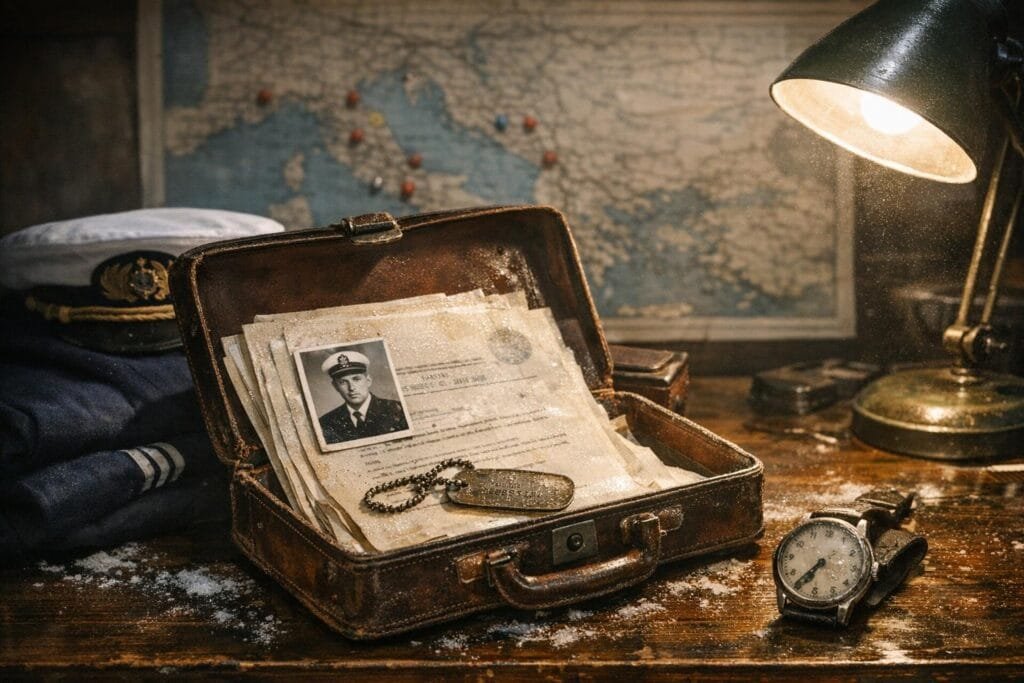
The wet pocket that changed a war
The tide nudges it along with almost bureaucratic patience. A bloated body in a suit, boots and life vest, a briefcase cuffed to the wrist. He does not look like an ordinary castaway; he looks like someone in a hurry to get somewhere—and who never made it. When he is found off the Spanish coast in 1943, the important thing is not only the corpse but what he is carrying. In his pockets is a story designed to be believed by the Germans. For once, a war may turn on wet paper.
What sounds like a thriller plot was a real British intelligence operation: disguise a corpse as a naval officer, give him a convincing identity, load him with fake documents and let the sea act as the mail carrier. The goal was to mislead Hitler about where the Allies planned to attack—specifically, to draw attention away from Sicily, the obvious stepping-stone into Europe through the Mediterranean.
To understand the kind of deception—and the painstaking detail—the operation required, this video summarizes the case and shows why the plan seemed so plausible.
Why Sicily was “too obvious”
In 1943, after the North African campaign, Allied headquarters—and Berlin—were asking the same question: where would the next blow fall? Sicily seemed the natural next step. It sits on the map like a bridge between Africa and Europe, with airfields, ports and a position threatening Italy and the central Mediterranean.
That was exactly the problem. If Sicily looked obvious to the Allies, it looked obvious to the Axis too. In war, an obvious move can become a trap: the enemy waits, watches your breathing and prepares an artillery welcome. So the British did what a good magician does: accept that the audience is looking at the right place, then make it see something else.
The idea: a dead man who “doesn’t know” he is lying
The plan that became Operation Mincemeat had a dark elegance: use a corpse as an unwilling messenger. A living agent can make a mistake, improvise or sweat. A dead man cannot contradict himself in an interrogation, regret his story or change his account. Most importantly, he can “lose” documents without it looking deliberate: a maritime accident, a body carried by the current, an ordinary tragedy of war.
The story had to be so plausible that the enemy would accept it without being pushed. The body had to look like a real officer. The papers needed the exact tone of military bureaucracy—not too theatrical, not too perfect. And the place where he washed ashore had to be one where the documents could plausibly reach German hands.
Officially neutral but full of eyes and ears, Spain was an ideal setting: close enough to the Axis for information to “leak,” and formal enough for everything to pass through authorities, consulates and procedures. In espionage, sometimes the most useful thing is not secrecy but paperwork.
The false identity: a man with an inner life
The corpse could not be just a uniform with a body inside. He had to be a person. The British built him an identity: “Major William Martin” of the Royal Marines. Here is the unsettling part: for the deception to work, they also had to invent his everyday life. The enemy would not inspect only important documents; it would look at the details.
A pocket tells small truths: receipts, letters and personal effects. So the supposed Martin carried a carefully chosen collection of belongings—things that should not be there if this were a setup, and that made him more convincing precisely because of it. They included personal correspondence, among it a letter from a supposed fiancée, and other traces of an ordinary routine.
This was not decoration. It was applied psychology. If an officer dies with a messy personal life in his pocket, the pocket can be more persuasive than the official seal.
The documents meant to be “stolen”
The heart of the plan was a set of fake documents suggesting the Allied invasion would target places such as Greece and Sardinia, not Sicily. Those alternatives did not have to be impossible; they had to be plausible enough to make the enemy spread its forces.
The trick was not to make Hitler believe an absolute lie, but to push him toward a mistaken reading of a partial truth: yes, there would be an offensive in the Mediterranean; yes, there would be landings—but not where you think the main blow will fall.
The documents also had to survive the water—not in the sense of being waterproof, but narratively: damaged enough to look as if they had genuinely been recovered from a body at sea, yet legible enough to matter. The ocean was part of the production crew.
Spain’s role: neutrality with the door left ajar
When the body appeared on the Spanish coast, the authorities had to manage a delicate balance. Spain was not officially at war, but its position was complicated and its territory a chessboard for competing interests. The British needed the documents to pass through Spanish hands and, with enough “coincidence,” reach German intelligence.
The operation depended on the system working as it usually did. No cinematic double agent was required; the information only needed to be juicy enough for someone to copy, photograph or summarize and circulate. In a world of spies, indiscretion is a natural resource.
The British were playing both sides: they wanted Spain to return the documents, preserving the appearance of propriety, but also wanted signs they had been opened. Here comes one of espionage’s wonderfully human obsessions: how do you check whether an envelope was handled without making it obvious? The enemy may take the bait with gloves on, but it leaves marks.
Did it really fool Hitler?
The central claim—that a corpse with a false identity misled Hitler and diverted troops—is broadly true as far as the operation’s record shows. Historical documentation and the general consensus indicate that German intelligence took the deception seriously and that it reinforced the perceived threat elsewhere, especially in the eastern Mediterranean.
Still, intelligence stories need nuance. One wet letter did not move armies like game pieces. An operation like this alters perceptions, deepens uncertainty, supports decisions already under consideration and, above all, forces an enemy to spread resources. In war, dispersal is a slow form of defeat: fewer aircraft here, more divisions there, more fear of an attack that never comes.
When the Allies finally landed in Sicily in Operation Husky, the deception was not the sole reason for success. It helped make the blow less direct than it might have been had the Axis concentrated more forces where the invasion actually took place.
The most disturbing detail: the corpse was a stranger
There is a moral layer we cannot sidestep. The body did not belong to a volunteer hero or an officer killed in combat. It was the corpse of a man who had died in circumstances unrelated to the operation. Many accounts describe him as a homeless man or someone without an obvious family network, which made using his body less likely to raise immediate questions.
His real name is now part of the operation’s history, but the important point is what it reveals: war turns even the dead into tools. It does so with an administrative chill that can be more frightening than drama. This was not a crime of passion; it was a form filled out correctly.
There is also a strange irony: a man who may have passed through life without being noticed was given an entire life in his pocket. They gave him a fiancée, a rank and a mission. They manufactured the sort of story people remember—and that false story had real effects.
Why the plan worked: a lie that behaved like the truth
Great deceptions succeed through the ordinary, not the spectacular. Mincemeat worked because it imitated the messiness of reality: crumpled papers, intimate details, bureaucracy, a plausible death, a plausible discovery and a neutral country with predictable leaks.
The plan also relied on a basic human bias: when information fits our fears or expectations, we tend to accept it. If German leaders already suspected threats in Greece or wanted to believe Sicily was a feint, the documents did not create an idea from scratch. They reinforced it, made it look “official” and put it on letterhead.
And then there is the simplest factor: in war, nobody has complete information. Decisions are made from fragments. One well-designed fragment can outweigh ten accurate but less convincing reports.
A war made of theater—with consequences
It is tempting to tell this as a brilliant prank, an act of stage magic against the Nazi monster. Part of it was. But it is also an uncomfortable reminder of how advantage is won: by manipulating trust, exploiting procedures and using bodies and biographies as props.
The astonishing part is not only that a corpse with a false identity could influence strategic decisions. It is that the modern world—with its stamps, letters and hierarchies—can be so vulnerable to a well-built narrative. A nonexistent man, with an invented life, entered the enemy’s mind because everything around him looked authentic.
Here is the uncomfortable question that remains: if a pocketful of papers could divert an empire at war in 1943, how many decisions today are also based on stories that “seem true” simply because they are told well?