
The sky split open and the forest fell like grass
First came a light that made no sense: brighter than the Sun, but with a strange, almost “metallic” color, some witnesses said. Then came the blow. Not an ordinary thunderclap, but a chain of explosions that seemed to chase one another across the sky. Then the air itself became a fist: windows burst, doors flew open and people were knocked down miles away.
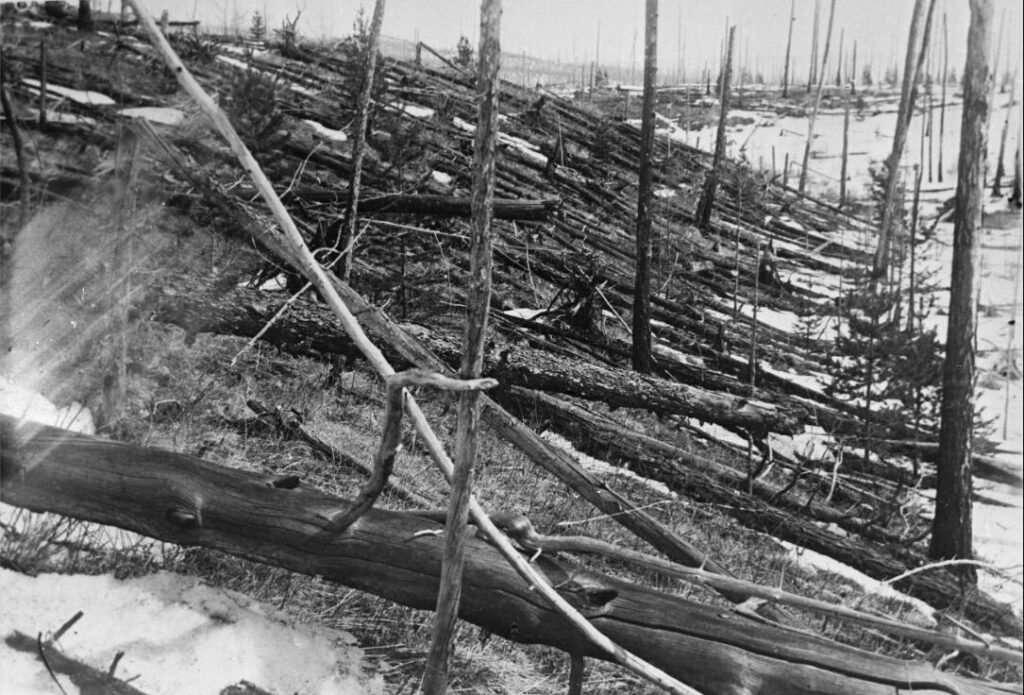
In the central Siberian taiga, near the Stony Tunguska River, the world unleashed a show of force on June 30, 1908, without leaving the most familiar signature of an impact: there was no crater. What it did leave was a landscape that looked like a model crushed in the palm of a hand. More than 2,000 square kilometers of forest were devastated: millions of trees flattened in the same direction, as if a giant broom had swept across the taiga.
Picture it without a map: a major city and its surroundings turned into a carpet of trunks, but without the central hole you expect when something “falls from the sky.” That detail—the missing crater—is why Tunguska still sits at the border between science, mystery and imagination.
This video helps visualize what happened—and why it remains so unsettling.
An impact without a mark: the strange “no crater”
When a large meteorite hits the ground, it normally leaves a crater, like a stone dropped into a pond: a clear mark, excavated material and fragments. At Tunguska, however, the dominant pattern had a different geometry. The trees had fallen radially, like spokes on a wheel pointing outward from a central area.
At the center, instead of a hole, many trunks were still standing—but stripped of branches and burned, like peeled posts. That pattern fits an explosion in the air better than a direct hit on the ground.
The distinction matters. A crater is a “ground signature.” Tunguska looks like an “atmospheric signature”: an explosion that released its energy before reaching the surface. In everyday terms, it is the difference between throwing a firecracker onto the ground, leaving marks and debris, and setting one off several feet up. The blast still shakes you, but the ground remains almost “innocent.” In 1908 that innocence was deceptive: the damage was enormous, simply distributed differently.
The best-fitting explanation: an airburst
NASA supports the leading hypothesis that a meteoroid—a fragment of rock or cometary material—entered the atmosphere at high speed and broke apart under the brutal stresses of descent. As it plunged downward, air compressed and heated in front of it while forces tore at the object itself.
At a certain point, its structure could no longer hold: it broke, potentially releasing energy all at once, as if the sky had become an explosion chamber. The resulting shock wave traveled toward the ground and flattened whatever lay in its path. At Tunguska it knocked down the forest like dominoes, but on the scale of the taiga. With no large, compact body continuing to the surface, the crater—that reassuring “proof”—never appeared.
An airburst is not a trick invented to save a mystery. It is a real, physically plausible phenomenon. The atmosphere is not a gentle vacuum. For an object entering at tens of kilometers per second, air behaves almost like a wall, and fragmentation can turn an “impact” into something closer to a distributed explosion.
So what was it? An asteroid, a comet and other possibilities
Knowing it was an airburst does not fully answer the question people really care about: what exploded? Here are the leading possibilities, with different levels of support.
Option 1: a rocky asteroid
A denser, more durable asteroid could explain a powerful blast and fragmentation at a certain altitude. If it almost completely disintegrated in the air, any pieces reaching the ground could have been small, scattered or difficult to identify in a remote, swampy environment. This fits a concentrated release of energy capable of flattening trees across a vast area.
Option 2: a more fragile comet-like object
A comet or comet fragment is usually more fragile and rich in ice and volatile materials, which could favor complete breakup in the atmosphere and leave few recognizable remains. This possibility has been attractive because it “explains” the lack of large fragments, but it also raises questions: a body that is too fragile might distribute its energy differently. The devastation pattern suggests a highly efficient release of energy, and that is where the debate gets technical.
Option 3: more exotic ideas—and why they are not favorites
Hypotheses about Tunguska have ranged from unusual geophysical events to far more exotic proposals. The reason is simple: there was no crater, and direct data were scarce for a long time. Yet most exotic alternatives offer no mechanism as clear for producing an atmospheric shock wave and the radial pattern of fallen trees, nor do they fit what we know about objects entering the atmosphere as well.
That does not mean every detail has been sealed with a definitive answer. It means that in science, “mysterious” does not always call for magic; sometimes it calls for physics—and a remote place where evidence arrives late.
Why it took so long to investigate: the taiga does not forgive
Another ingredient in the Tunguska legend is the delay in investigating it. This did not happen beside a capital with newspapers and laboratories around the corner. It happened in an immense, hard-to-cross region of swamps, mosquitoes and distances that change your idea of what “nearby” means. Reaching the site, mapping it, collecting accounts and understanding what people were seeing was an expedition, not a quick errand.
When investigators finally studied the ground, they found the fan of fallen trees and the central area with stripped but standing trunks. They also collected accounts from people who had seen the sky light up and felt the shock. Human testimony is imperfect, of course, but when many accounts agree on the essentials—intense light, a roar and a shock wave—they begin to form a coherent picture.
The physics behind the scare: energy, altitude and direction
Tunguska came down to a combination of factors: speed, entry angle, composition and burst altitude. Change one parameter and the disaster changes too. If the object had been more compact or followed a different path, it might have reached the ground and left a famous crater—one people could visit and photograph, making the event less unsettling.
But if it breaks apart at the right height, the shock wave can maximize surface damage without boring into the earth. Think of the difference between a focused hose nozzle and a showerhead. One hits a single point hard; the other spreads its force. An airburst is like a nozzle of energy opening in the sky: it does not punch one hole, but it can sweep across a vast area with enough pressure to flatten an entire forest.
What we know—and what we do not: the mystery that remains
We know that something released an enormous amount of energy over the taiga in a way consistent with an airburst. The pattern of fallen trees points to a shock wave coming from above. We know the absence of a crater is not a contradiction but a clue: this was not a classic “impact,” but a violent breakup in the atmosphere.
We are less certain about the object’s exact identity: whether it was mainly rocky, cometary or a mix. We also have no indisputable “museum piece” we can point to and say, “This is Tunguska.” The lack of a physical trophy adds to the place’s aura: a disaster measured in fallen trees, while the culprit seems to have evaporated into the sky.
An uncomfortable reminder: the planet lives in a shooting gallery
Tunguska is not just a strange Siberian story. It is a lesson in scale. Earth does not need a crater-forming impact to take a serious hit. Sometimes an object only has to enter the atmosphere, break apart at the “perfect” moment and turn the air into a hammer.
That changes how we imagine danger. It does not always arrive with a movie-style crater; sometimes it leaves a silence afterward and a forest flattened as if a giant hand had swept over it. The Tunguska paradox is that the missing crater—that visually unimpressive absence—is exactly what makes the event unforgettable.
If the sky can devastate a vast region without leaving a hole to expose it, how many other traces from space go unnoticed until, suddenly, they do not?
For a deeper dive: Explore books about the 1908 Tunguska event.
If this story caught your interest, the Svalbard Global Seed Vault is another extraordinary reminder of how humans prepare for planetary risks.