
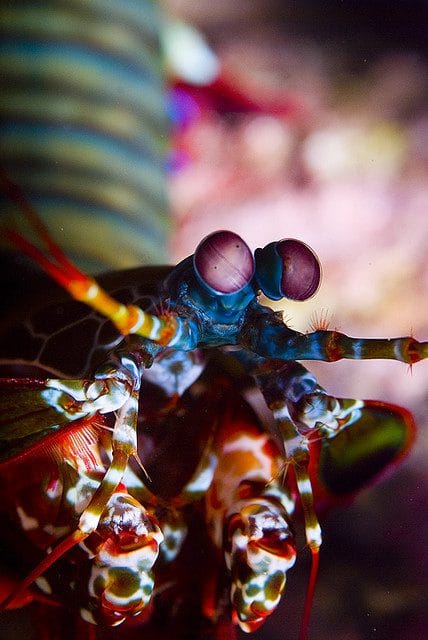
A click sounds underwater—and for an instant, the ocean cheats
The mantis shrimp is famous for a punch that seems too fast for the water around it. The animal’s club-like appendage accelerates so quickly that it does not merely hit its prey: it also creates a low-pressure bubble in the water. When that bubble collapses, the resulting cavitation adds a second shock to the strike.
The result is one of nature’s strangest combinations: a small animal, a spring-loaded limb and a burst of fluid physics that lasts only a fraction of a second.
This video shows how the strike and cavitation work.
The strike that arrives before the strike
The appendage moves so rapidly that pressure in the surrounding water drops. Water vapor forms a bubble, which then collapses almost immediately. The collapse creates a shock wave that can deliver another jolt to the target—even if the shrimp’s club misses by a little.
The bubble that “boils” without boiling: cavitation in an animal
Cavitation is not ordinary boiling. It is the formation and collapse of vapor-filled bubbles when pressure changes in a liquid. In the mantis shrimp’s strike, the collapse can produce a brief flash of light called sonoluminescence and a localized burst of heat.
So does the water around it boil?
No. The phrase “temperatures as hot as the Sun” refers to an extremely brief, tiny region inside the collapsing bubble—not to the surrounding ocean reaching the temperature of the Sun. The event is microscopic and fleeting. It is dramatic physics, not a pocket of solar heat floating in the reef.
A boxer with a spring: how the strike is loaded
The shrimp’s limb stores energy in an elastic structure and releases it quickly, much like a spring-loaded mechanism. This allows the animal to strike with remarkable speed without relying on muscle contraction alone to drive the entire motion.
Why would an animal want a weapon that breaks the rules of water?
The strike helps the shrimp crack hard-shelled prey and defend itself. Different mantis shrimp species have specialized appendages for smashing or spearing. The “weapon” is a product of evolutionary adaptation to feeding and survival, not a deliberate attempt to exploit physics.
The sound of the reef: when wildlife becomes interference
Mantis shrimp strikes contribute to the acoustic bustle of reef environments. Their clicks can be heard alongside snapping shrimp, fish and other sources of underwater sound. What seems like one sharp noise is part of a crowded soundscape.
An important detail: “Sun-level temperatures” do not mean “solar danger”
Headlines love the comparison, but scale and duration matter. The extreme temperature is confined to the collapsing bubble for an instant. It does not heat the water around the animal or pose a threat to the reef as a whole.
What is truly astonishing: nature as an engineer of extremes
The mantis shrimp did not study fluid mechanics. Evolution shaped a body that stores energy, releases it rapidly and takes advantage of what happens when a fast-moving limb meets water. That is the astonishing part: a tiny animal can create an event that belongs in a physics demonstration simply by doing what it needs to survive.