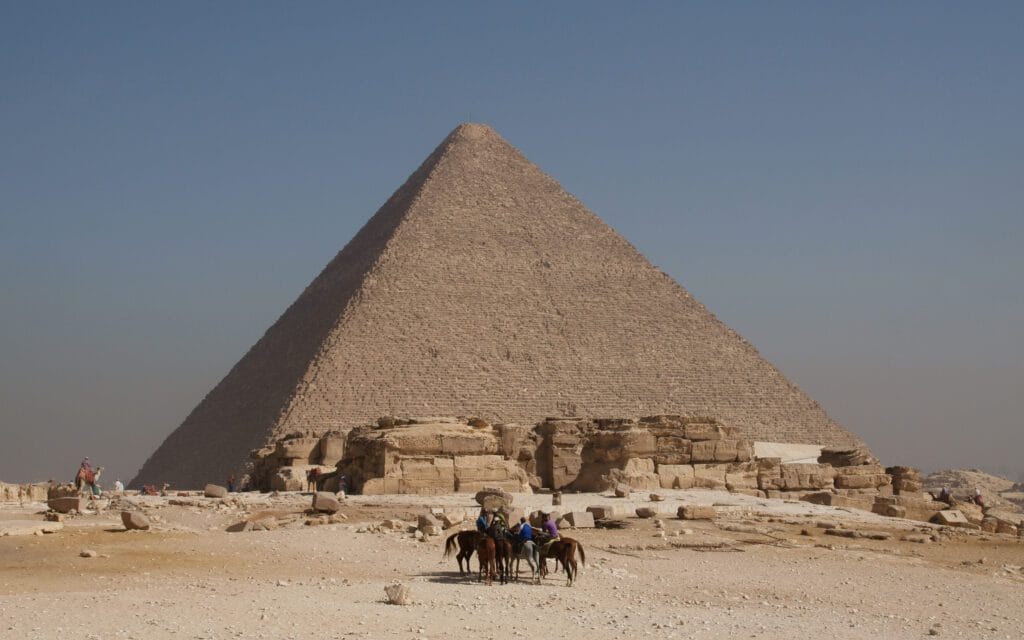
Cleopatra is closer to Neil Armstrong than to the pyramids—and that breaks your mental timeline
Picture Cleopatra walking through the palace corridors in Alexandria, messengers coming and going, grain ships docking at the harbor, and a court tuned to alliances, betrayals and rumors. Now make a leap in your mind: if you travel backward from her time to the construction of the Great Pyramid of Giza, you have much farther to go than if you move forward to the 1969 Moon landing.
It sounds like an internet joke, but it is a real, verifiable fact: Cleopatra lived closer in time to the first Moon landing than to the pyramids. And yes, it is one of those lines that sounds fake because we have been taught to put “ancient Egypt” in one box, as if everything happened during one afternoon of sand and hieroglyphs.
If you want a visual explanation, this video helps put the dates in perspective.
Three dates that change everything
Here is the basic timeline, without the extra decoration:
- Great Pyramid of Giza: generally dated to around 2560 B.C.
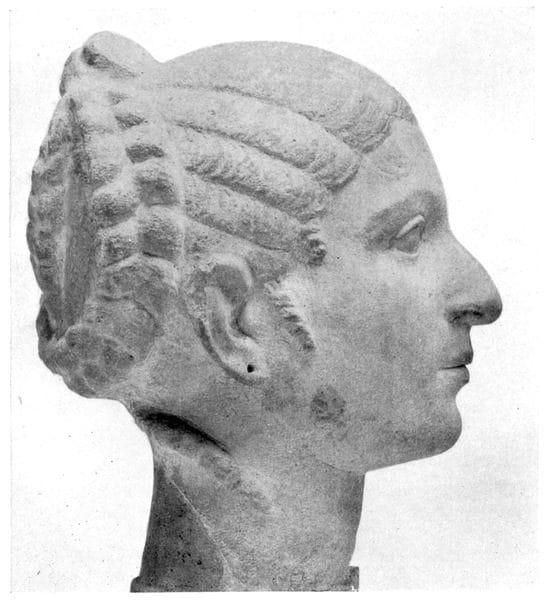
- Cleopatra VII: born in 69 B.C., died in 30 B.C.
- Apollo 11, the first Moon landing: 1969.
Now compare the distances:
- From 2560 B.C. to 69 B.C. is about 2,491 years (the exact count depends on how B.C. dates are handled).
- From 69 B.C. to 1969 is about 2,038 years.
The result: Cleopatra is “closer” in time to the Moon than to the Great Pyramid. If time were a highway, she would be nearer to a modern freeway than to the planet’s most famous pharaonic construction project.
How can that be, if Cleopatra and the pyramids are “the same thing” in my head?
Because your brain—and mine—does something very human: it compresses. When a historical period feels far away, we zip it into one file. Into that file go pyramids, mummies, pharaohs, sphinxes, Cleopatra and, sometimes, Tutankhamun and Ramesses II, even though they belong to very different points on the timeline.
It is like thinking of “childhood” as one thing, even though an enormous gap separates learning to read from your first day of high school. Egypt works the same way, only a thousand times bigger and with more sand.
The mental shortcut also comes from how we teach history: Egypt as one block, Rome as another and Greece as a third. Because Cleopatra was “queen of Egypt,” our minds automatically file her under “pyramids.” But hers was a very different Egypt.
Cleopatra’s Egypt was not Khufu’s Egypt
When the Great Pyramid was built, Egypt was in the Old Kingdom, and the pharaoh associated with it was Khufu (also known as Cheops). This was an early Egypt, with its political and religious structures taking their classic form and monumental ambitions that still seem almost science-fictional.
Cleopatra, by contrast, belongs to a late and distinctive period: the Ptolemaic dynasty, of Macedonian Greek origin. Her family ruled Egypt after the conquests of Alexander the Great. Cleopatra was not the “typical pharaoh” people picture in a white-and-red crown and false beard (though she adopted pharaonic symbols). She was a monarch in a world already globalized in its own way, where the Mediterranean was a network of power, trade and propaganda. For more context, see this overview of Cleopatra, the Ptolemaic queen of Egypt.
Here is an everyday comparison: the distance between the Great Pyramid and Cleopatra is a bit like assuming a Romanesque cathedral and a skyscraper belong to the same era because they are both made of stone. The material can fool you. Context is everything.
Cleopatra lived in a “classical” world, not a “pyramid” world
Cleopatra lived in Rome’s orbit, on a chessboard whose pieces included Julius Caesar and Mark Antony. Her story is about a queen trying to hold on to a wealthy, strategically important kingdom while the Roman Republic was transforming into something else. It was an age of civil wars, aggressive diplomacy and carefully manufactured narratives.
Here is another detail that can throw people off: when Cleopatra was born, the pyramids were already ancient. Not “a few centuries old” ancient, but old in the way we now think of monuments that seem almost outside of time.
Think about this: the Great Pyramid was older to Cleopatra than the Colosseum in Rome is to us. The numbers are not exactly equivalent, but the feeling is: Cleopatra looked at Giza the way you look at distant ruins, with a mix of cultural familiarity and historical distance.
The Moon as an unexpected neighbor
The leap from Cleopatra to 1969 is strange in its own right. It contains empires, religions, languages that rose and vanished, trade routes, scientific and technological revolutions—and yet the total span is shorter than the time separating Cleopatra from the pyramid’s construction.
If time were a bookshelf, the pyramid would be at one end, the Moon landing at the other, and Cleopatra would not be in the middle. She would be tilted toward modern technology more than your intuition can handle. Like reaching into a closet for a mug and finding a wrench: it does not seem to belong, but there it is.
This says less about Cleopatra than it does about our habit of imagining the past as one uniform mass. History is not a still photograph; it is a very long movie, and we usually see only the trailer.
So the pyramids were still there? Yes—and already a “classic”
The pyramids were, of course, still standing (though they had changed: some of their original outer casing was lost over time and through the reuse of stone). They were not a recent project, a passing architectural fashion or the symbol of a living dynasty. They were inherited monuments, part of a landscape heavy with the past.
That also explains why the fact works so well: it clashes with the popular image of Cleopatra posing “among the pyramids,” as if they were her natural backdrop. Her real setting was Alexandria, a cosmopolitan, intellectual port city of libraries, debate, international politics and close ties to the Greek and Roman worlds.
The hidden lesson: “ancient” has layers
These timeline comparisons are little bombs for common sense, which is why they are useful. They force us to accept that “ancient” is not one category: there are layers of antiquity within antiquity. Today we call both a 2016 phone and a 1920 house “old,” even though they have nothing in common in experience or context.
The effect is even stronger with Egypt because it was a civilization of extraordinary duration, with many distinct phases. Cleopatra appears near the end of pharaonic history, almost in the epilogue, when the country was already operating in a different political world. For an overview of her life and context, see this biography of Cleopatra VII.
A mind-blowing fact that does more than surprise
The interesting part is not just dropping the line at dinner and watching everyone ask, “Wait, what?” It is what the fact reveals: our mental map of the past is full of shortcuts. They are convenient, but they make us miss the nuance.
Next time you see a pyramid in a documentary and Cleopatra in the next segment, imagine a year counter running in the background like a scoreboard. History stops being scenery and becomes what it is: real distance, enormous and sometimes hard to look at directly.
And here is the paradox: if a queen of “ancient Egypt” is closer to an astronaut than to a pyramid, how many other things do we assume happened “at the same time” only because we learned them in the same mental box?